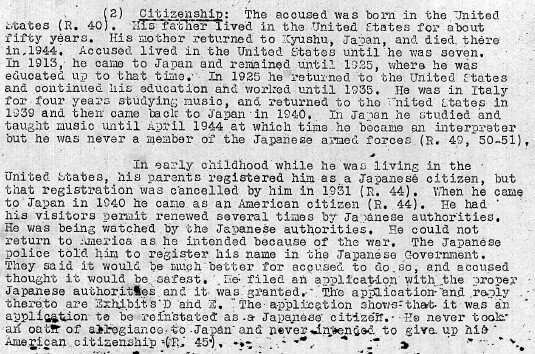
Approximately 20,000 second-generation Japanese (Nisei), born in the United States, spent World War II in Japan. There were at one time some 50,000 Nisei in Japan; see excerpts below. Even though they were American citizens, because of a special law the Japanese Government regarded them as citizens of Japan. Incidentally, many Nisei in the United States had dual citizenship; in the Territory of Hawaii alone, some 60% of the Nisei were also Japanese citizens (i.e. over one-third of Japanese in the territory were dual citizens). Per a US Navy Dept. intelligence report: “Out of a total Japanese population of 320,000 in the United States and its possessions, it is estimated that more than 127,000 have dual citizenship. This estimate is based on the fact that more than 52% of American born Japanese fall into this category.” Per Roehner’s research (2014; see also my assorted notes from his book):
For the 158,000 residents of Japanese ancestry in the Territory of Hawaii, the figures (in 1940) were as follows:
- Dual Japanese-US citizens: 55,000
- Non-dual US citizens: 65,000
For the 162,000 residents of Japanese ancestry in the continental United States, the figures (in 1940) were as follows:
- Dual Japanese-US citizens: 62,000
- Non-dual US citizens: 62,000
A. Carly Buxton in the first footnote in her book, Un-Thinking Collaboration: American Nisei in Transwar Japan (2022):
Historian Paul Spickard estimates that 35,420 Nisei were living in Japan in 1942. “Twice Immigrants: Kibei in America and Japan and America, 1910–1950” (paper presented to Japanese American Experience conference, Williamette University, Salem, Oregon, September 18, 1998). Spickard’s calculations are based on research and statistics appearing in D. S. Thomas, C. Kikuchi, and J. Sakoda, Japanese American Evacuation and Resettlement, vol. 2, The Salvage (Berkeley: University of California Press, 1952), 580–591. Historian W. Puck Brecher’s estimates are a more modest 20,000. See W. Puck Brecher, Honored and Dishonored Guests: Westerners in Wartime Japan (Cambridge, Massachusetts: The Harvard University Asia Center, 2017).
Be sure to read her Epilogue as it has quite an interesting dialogue re the use of “enemy aliens” for the Nisei living in Japan during the war. Buxton noted regarding her sources: “I focused on the interviews of fifty-two Japanese American individuals who had lived in Japan either before, during, or after World War II.” Many of these are mentioned in her Acknowledgments.
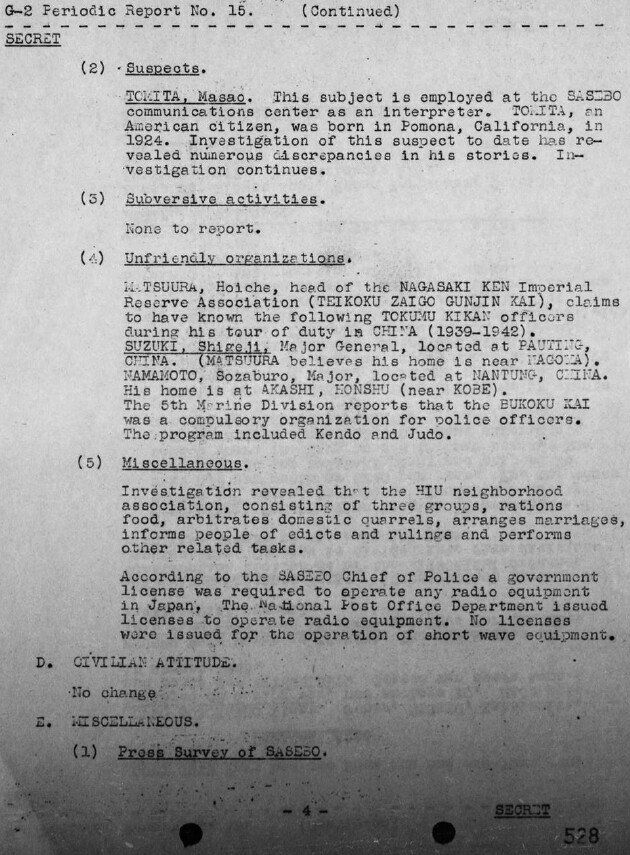
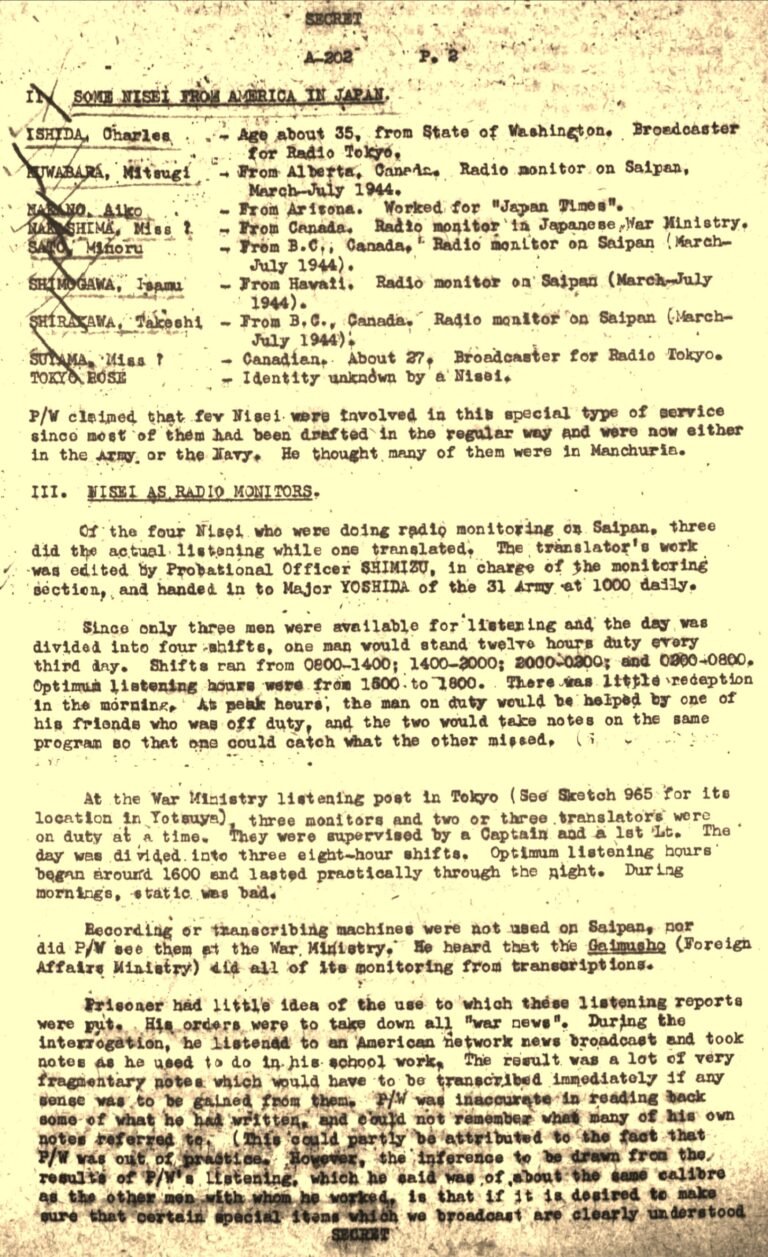
Hundreds of Nisei in Japan worked for the Imperial Government as translators and interpreters, some as guards at POW camps, and some even fought in the Imperial Japan armed forces. Official Japanese figures state that 1,648 Nisei had joined the Imperial forces; other estimates are as high as 7,000, but the true figure would be much higher if one considered the many other areas of sub-contracted work that supported the military. After the war, only 10,000 Nisei were allowed to return to the United States; quite a number remained in Japan and worked for the Occupation Forces. The US Military Intelligence Division produced in Aug. 1945 a 430-page document (names
A-J,
K-O,
S-Y) listing Japanese, including a number of American-born Nisei, who were “reported to be loyal” and “expected to cooperate” with the Occupation Forces (N.B. the Nisei were “reported to be loyal,” yet there is no record of their being interned in Japan).
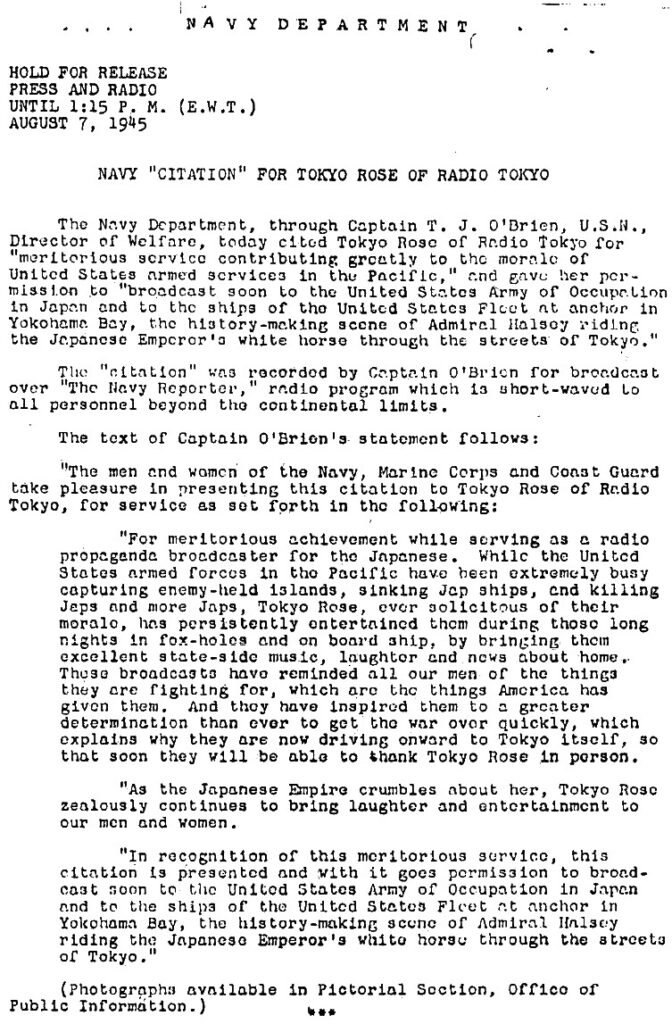
Duplicity was normal then and no one thought it strange — but to most Americans suddenly confronted with an aggressive Japan, it was paramount to being a traitor. The trial of “Tokyo Rose” is well known, and there were several others who were tried for their anti-American actions. The whole subject seems to be somewhat a taboo topic — to many, no doubt, it is embarrassing to talk about their chameleon-like past. You will not find this data on any other website, and even Wikipedia’s page on Japanese-Americans will not sanction such data to be disseminated.
It is, nevertheless, a historical fact. You will find here an assortment of news articles and archival material which reveals the other side of these Nisei who were in Japan during WWII (alphabetical index here). This list is only a fraction of the total. I have also included below some who were probably not directly connected with the Japanese military. Further research is being conducted by author and professor-emeritus Hawaii, John Stephan, who is hoping to publish his massive work on the Nisei, Call of Ancestry: American Nikkei in Imperial Japan, 1895-1945; when he does, it will be noted on this page as the go-to reference book on the Nisei in Japan.
For further info regarding the numbers of Nisei in Japan, here this from my page on Civilian Internment Camps in Japan:
Figures do not include Japanese-Americans (Nisei), who, in accordance with wartime directives issued by Japan’s Ministry of Home Affairs, were to be treated as Japanese nationals. As for the numbers of Nisei in Japan, “Japanese figures show that in 1937 there were 50,000 American citizens of Japanese ancestry residing in Japan” (Gentlemen of Japan by Haven, 1944) — the Japan Foreign Office urged these kibei shimin (American returnee citizens) to return to the US. Approximately 20,000 Nisei were living in Japan in 1940 (Zaibei Nihonjinshi, 1940). According to an estimate by the U.S. Consulate in Yokohama, some 15,000 Nisei were residing in Japan at the end of the war, 10,000 of whom were eligible to return to the United States (Rafu Shimpo, March 22, 1947). See Were We The Enemy? by Rinjiro Sodei for further information. See here for number of resident aliens of Japanese descent as of June 1942. Forthcoming book by John J. Stephan will cover this subject in detail. For further info and extensive data on ethnic Japanese and Japanese Americans in the US prior to and during WWII, see my EO9066 website, The Preservation of a People, dealing with the evacuation and relocation of people of Japanese ancestry (assembly and relocation centers, internment camps, etc.).
From Were we the enemy? American survivors of Hiroshima by Rinjiro Sodei (1998):
The Japanese Ministry of Foreign Affairs estimated that the number of Nisei from both the U.S. mainland and Hawaii who were living in Japan for family reasons or for education reached almost 30,000 as of January 1929. Of these, 4,805, or sixteen percent, were living in Hiroshima Prefecture. Their ages ranged from one to thirty, but 3,803, or some eighty percent, were attending elementary and middle schools. According to the same statistics, 11,312 Nisei in the United States, excluding Hawaii, had parents who came from Hiroshima, while Nisei residing in Hiroshima numbered 3,404. When 2,759 of the latter group were asked in 1929 whether they wanted to go back to the United States, only 755 answered yes, while 2,004 said no. In other words, seventy percent expressed no desire to return.
After the 1924 revision of the Immigration Act prohibited Japanese from immigrating, only Nisei possessed the right to enter the country without restriction. A book published in 1929 about Hiroshima immigrants in the United States emphasized, “From the viewpoint of the development of the Yamato race overseas … some measures must be urgently taken to encourage the Nisei in Japan to come back to the U.S.”
The foreign ministry survey was made that same year, twelve years before Pearl Harbor. In the intervening years, how many Nisei returned to the United States? A history of the Japanese in America, published in December 1940 by the Association of Japanese Americans in San Francisco, states: “As a result of a nationwide movement that was started around 1935 to encourage Nisei educated in Japan to return to the United States as the only real successors to the Issei, it is estimated that about ten thousand Nisei have returned at the present time.” This statement is qualified, however, by the observation that “around twenty thousand Nisei are believed to still be in Japan.”
How many of the latter were living in Hiroshima in 1940? No statistics are available, but if we assume that the sixteen percent of the total that prevailed in 1929 remained consistent, we get an estimate of around 3,200 for the number of Nisei in Hiroshima. Most of these would have been living in and near the city of Hiroshima itself.
The US Consulate estimated there were 15,000 Nisei residing in Japan at the end of the war, and 10,000 of those were eligible to return to the US. In May 1946, the GHQ ordered the J-Govt. to produce a list of all Nisei who lived in Japan during the war, including those who served in the J-military or in J-govt. Sodei says approx. 5,000 Nisei returned to the US after the war.
Some thoughts…
What made the difference between pro-Japan and pro-US Nisei? It could have been the home environment, where the parents were always talking about their motherland, reading news and literature from or about the motherland, with very little Americanism being absorbed in their lives, except perhaps through the American schooling their children were receiving. These Nisei children would then be receiving mostly news and views from a Japanese perspective via their parents as well as from the Japanese language schools (if they were attending) which were teaching not only the language but also the culture and ethics of Imperial Japan, all so that they would not forget their heritage. Compounding this with the fact that many of the Nisei had dual citizenship, it is no wonder, then, that there would be Nisei with a strong attachment to Japan, or at least ambivalence. This could be one of the reasons many in the US military were concerned about the Nisei’s loyalties.
Further data:
Up to 7,000 Nisei in Japanese military — excerpts (PDF) from Michelle Malkin’s book, In Defense of Internment.
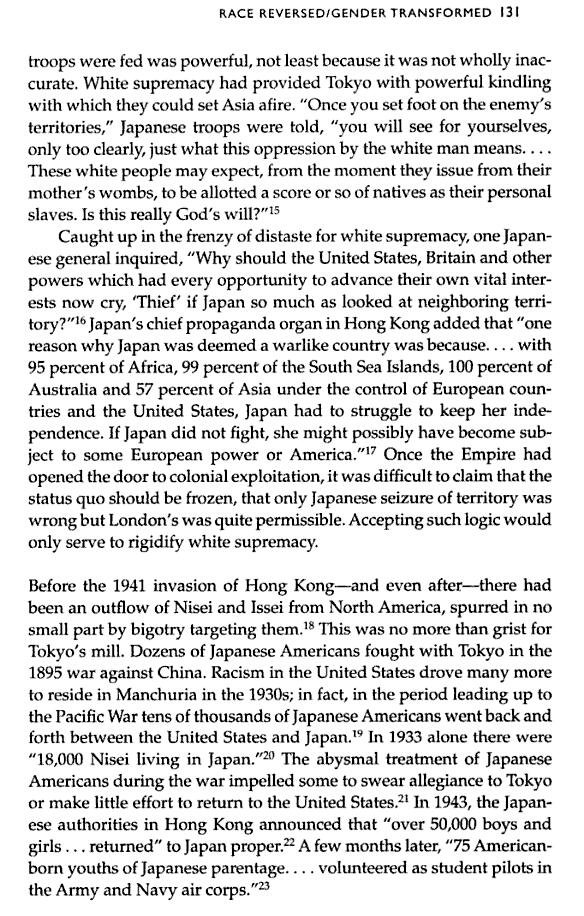
18,000 Nisei in Japan in 1933, per Horne book.
From a very enlightening work, The Pacific Era Has Arrived: Transnational Education among Japanese Americans, 1932-1941 (PDF), by Eiichiro Azuma:
The precise number of Nisei students in Japan during the 1930s is difficult to estimate. According to some contemporary sources, there were 40,000 to 50,000 American-born Japanese in the island country in any given year during the decade. The vast majority of them, however, probably resided in Japan permanently with their parents, who had returned home for good. Only about 18,000 Nisei were considered “Americans” by the Japanese police, who had kept a close eye on any “foreign” elements. Still, most of them had spent a substantial amount of time in Japan, receiving much of their formal education there rather than in the United States. In 1940, a survey of Nisei students over eighteen estimated the presence of 1,500 in the Tokyo area. This is probably the most reliable ballpark figure for the Nisei youngsters who are the subjects of this study. See Nisei Survey Committee, The Nisei: A Survey of Their Educational, Vocational, and Social Problems (Tokyo: Keisen Girls’ School, 1939), 2; and Yuji Ichioka, Beyond National Boundaries: The Complexity of Japanese-American History, Amerasia Joumal 23 (Winter 1998), viii. For the general statistics of Nisei in Japan, consult Yamashita Soen, Nichibei wo Tsunagu mono [Those who link Japan and the United States] (Tokyo: Bunseisha, 1938), 319-334.
See here for more on the 50,000 figure.
See also Chapter 5 re the Nisei in Japan in Japanese Americans and Cultural Continuity: Maintaining Language through Heritage by Toyotomi Morimoto.
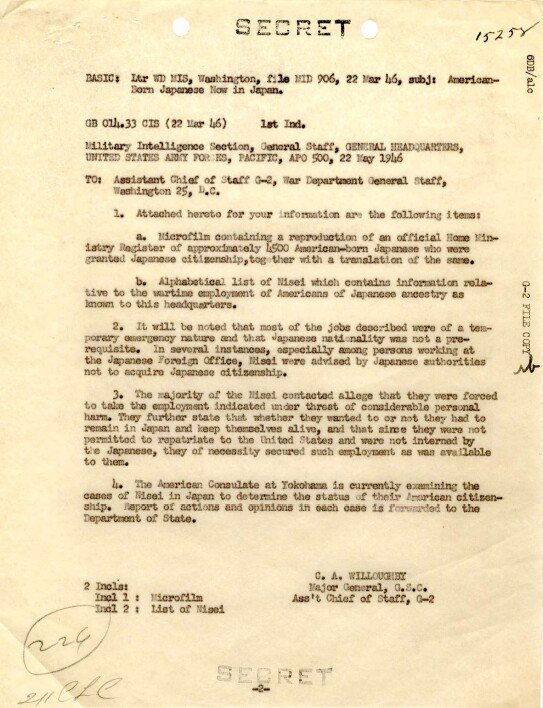
Nisei_in_Japan_211_G-2_FEC_Jan-Dec_1946.pdf – List of Nisei employed by the Japanese Govt. and desirous of repatriation to US. Mention is made of 4,500 Nisei who were granted Japanese citizenship (possible correlation with number of renunciants at the relocation centers, viz. Tule Lake). Note also that Japanese nationality was NOT a pre-requisite; some even were advised not to acquire Japanese citizenship.
For more information on the Kibei, see this WRA article, Japanese Americans educated in Japan: The Kibei.
Transnationalism in education: the backgrounds, motives, and experiences of Nisei students in Japan before World War 2 by Yuko Konno
Beyond Two Homelands Migration and Transnationalism of Japanese Americans in the Pacific, 1930-1955 – Enlightening paper by Michael Jin (2013) on the “50,000 American migrants of Japanese ancestry (Nisei) who traversed across national and colonial borders in the Pacific before, during, and after World War II. Among these Japanese American transnational migrants, 10,000-20,000 returned to the United States before the outbreak of Pearl Harbor in December 1941 and became known as Kibei.” A number of Nisei mentioned by name in this work.
See Densho.org’s article, Stranded: Nisei in Japan Before, During, and After World War II, review of the book Midnight in Broad Daylight by Pamela Rotner Sakamoto. Densho.org Archives (guest login required) has a number of interviews relating to Life in Japan — During WWII.
Books on this topic – much to be gleaned from these, esp. re the issues of loyalty and collaboration:
Citizens, Immigrants, and the Stateless: A Japanese American Diaspora in the Pacific by Michael R. Jin (2021)
Unthinking Collaboration: American Nisei in Transwar Japan by A. Carly Buxton (2022)
American Survivors: Trans-Pacific Memories of Hiroshima and Nagasaki by Naoko Wake – many names listed in the Select Bibliography
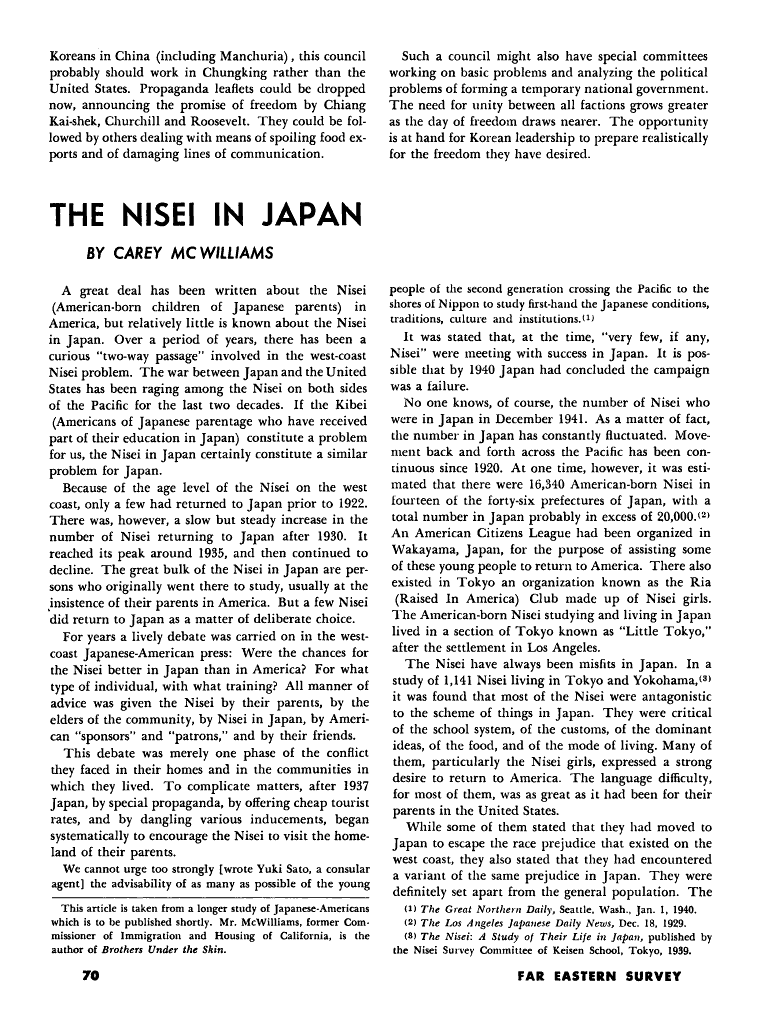
Nisei in Japan — interesting excerpt from the Far Eastern Survey, Apr. 19, 1944
See Kabuki’s Forgotten War: 1931-1945 by Brandon (2009), p. 390 note: “Ministry of Health and Welfare in 1943… called on Nisei to resist assimilation and ‘remain aware of the superiority of the Japanese people and proud of being a member of the leading race.'” See also sections dealing with dual nationality Nisei and their inner conflict (search).
Additional Notes:
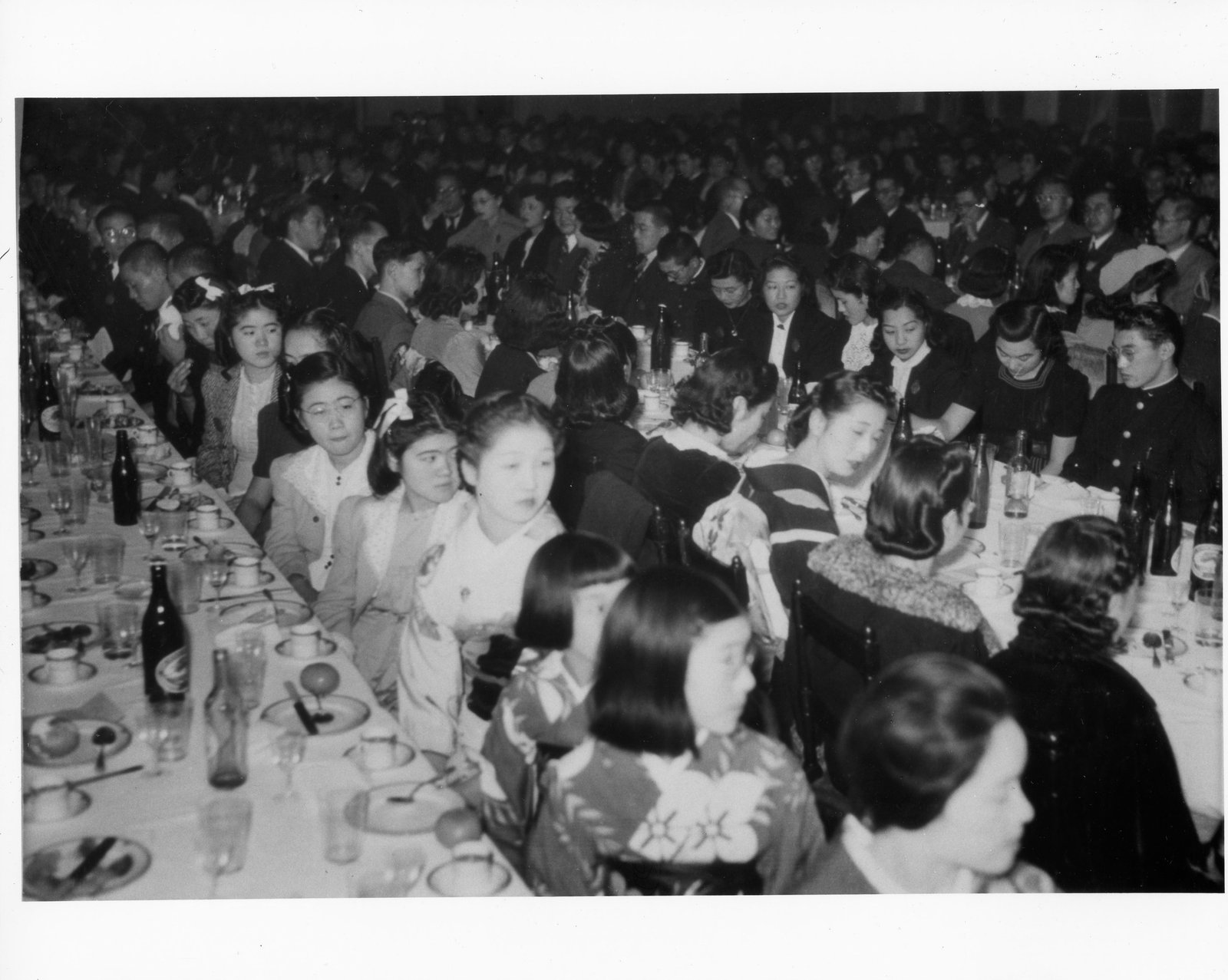
Image: Banquet for Nisei, Kaigai Doho Taikai (Overseas Compatriots’ Convention), Tokyo 1940-11 (image courtesy of John Stephan). Also related organization Nisei Rengokai (Nisei Union).
“Bushido is the very core of the Nisei” — Terry Shima, executive director for the Japanese American Veteran Association
A number of interpreters are mentioned in the Tokyo War Crimes Trials (IMTFE) Reviews. A search within this file for “interpreter” may give possible leads to more Nisei involved at the POW camps:
See further Assorted Notes at end of this page.
The Dilemma Facing the Nisei
From: National Defense Migration Hearings, Parts 29-31, Enemy Aliens 1942-4
EXHIBIT E. — CALIFORNIA JOINT IMMIGRATION COMMITTEE
(Copy of report prepared at the request of the Dies Committee, House of Representatives, on Japanese problems and propaganda)
The 150,000 Japanese in continental United States form one of the country’s most foreign-minded racial groups. The native-born among them are American citizens, but they are dominated by their ineligible alien parents, whose patriotism for Japan and its emperor, whom they worship as a god, is almost fanatical. Because of this domination and their strongly Japanese racial characteristics, these American-born Japanese are not assimilated into the social structure of this country.
Japanese immigrants have never been welcome here because of their aggressiveness, unassimilability, and low living standards. In 1892 the first unsuccessful attempt was made to keep them out of San Francisco, and soon so many coolie laborers were coming that there was much agitation for an exclusion law similar to that barring the Chinese. Congress was unsympathetic, but Japan, fearing the stigma of an exclusion law because 12,000 Japanese came in one year, agreed in 1900 to keep her laborers out of continental United States. This was the first gentlemen’s agreement.
In violation of this agreement, from 1901 to 1908, inclusive, 51,689 Japanese, most of whom were or became laborers, entered. California continued to protest, and in 1907 President Theodore Roosevelt, to save Japan’s pride, negotiated another gentlemen’s agreement, the details of which were secret, although it was announced that Japan had again agreed not to send laborers to continental United States.
This agreement was also violated, and the American courts were powerless to enforce its terms, since it was neither law nor treaty. Between 1909, when it went into effect, and 1924, when the agreement was terminated, the Japanese population of continental United States increased from 76,714 to 131,357. Prolific picture brides contributed to this increase, each family averaging five children. The Japanese quickly acquired land, not being content to work as day laborers, and frequently depleted it. Women and children worked with the men, and this sort of competition helped to drive out the Caucasian population, notably in certain communities in the Sacramento Valley. The Japanese were assertive, antagonistic, and not too honest.
Failing to get relief from Congress, California in’ 1913 enacted an alien land law, prohibiting aliens ineligible to citizenship from purchasing land or leasing agricultural land. The Japanese circumvented this law in a measure by operating in the names of their American children. The agricultural communities of California seemed overrun with Japanese. Feeling against them ran high, but there was little violence. The other Pacific Coast States had the same problem, in a lesser degree.
In 1924 California and her neighboring States made such a convincing presentation of their Japanese problem to Congress that the exclusion measure, barring aliens ineligible to citizenship as permanent residents, was included in the Immigration Restriction Act. The fight was a hard one, for Japan had enlisted many friends to her cause — church people, idealists, foreign traders, employers of cheap labor, and uninformed Government officials.
Japan protested against the measure, claiming discrimination and hurt national pride. She has even claimed that because we have thus insulted her she is avenging herself by her present predatory course in Asia and will close the door to us in China unless we open our door. This attitude overlooks the fact that the open door of trade in China is guaranteed by international treaty, while immigration is a purely domestic matter. But Japan brought exclusion on herself by 24 years of evasion of the spirit and letter of two agreements not to send her laborers to the United States.
A number of extensive campaigns to break down the exclusion measure have been inaugurated during the years since 1924, but each has failed. Japan has spent much money on these campaigns, and has even attempted to propagandize in our schools through a textbook giving an erroneous statement of the exclusion problem. This book was written in Hawaii under the joint auspices of the Territorial Board of Education, the Institute of Pacific Relations, and the Japanese Government, and introduced into the schools there. After protest it was rewritten, but because of serious omissions leaves much to be desired as an authentic textbook.
The Japanese have been disliked and distrusted wherever they have migrated. Australia excluded them summarily and even contemptuously in 1900, but because of that firm attitude they have long since ceased to protest. Today there are less than 2,500 Japanese in the Commonwealth. Canada wanted to exclude them but was induced to accept a gentlemen’s agreement, which has been violated since its inception, and British Columbia’s long protests are now culminating in a demand for deportation of all Japanese. Canada does not grant the franchise to orientals, nor does she accept them for military duty. Several South American countries, notably Brazil and Peru, have had trouble with the Japanese, and even South Africa excludes them.
Although no more are coming in, there are still many alien Japanese in California, living a typically Japanese life and controlling in large measure, by tremendous industry, skill and incredibly low living standards, the fruit, berry, and vegetable industry of the State. This control of much of our food supply is disquieting, as they are distrusted. The Tanaka memorial calls for control of the food supply of desirable localities.
But the main problem now is the second generation Japanese, or Nisei, of wdiom there are more than 50,000 in California. They apparently want to be part of the social structure but are not welcome because of their too evident racial characteristics. They complain constantly of racial discrimination, but their plight is the direct result of their parents forcing themselves unwanted on this country. They are splendid people in many ways, good students and workers, but they are “Americans with Japanese faces.” They cannot find work except among their own kind, and while intermarriage is forbidden in California, they really do not desire it, considering it an insult to the pride and glory of the Yamato race. Even in Hawaii there is little intermarriage between the Japanese and other races, particularly the Caucasian. They must live in segregated districts, which they resent, but are accepted on equal terms into the Army, where most of them seem quite happy.
These conditions, while unfortunate, are the result of the determination of the Caucasians to keep their country and their blood white, and involves no claim of superiority. Our laws against which the Japanese protest were enacted to keep out immigrants who cannot be absorbed into the lifeblood of the country, and who form unassimilated racial blocs. The Founding Fathers of the Republic stipulated that citizenship should be granted only to free white persons. But a grave mistake was made when citizenship was granted to all born here, regardless of fitness or desire for such citizenship. Another grave mistake was the granting of citizenship to the Negroes after the Civil War.
One of the greatest handicaps which the Nisei must fight is the possessive attitude of Japan. Koki Hirota, former foreign minister, said in 1938 that the Japanese in America must be educated as Japanese to retain their Japanese virtues, and that the Migration Association of Japan keeps close connection with them for that purpose. More than 60 percent of their number are citizens of both Japan and the United States because they were registered as Japanese at birth and have not expatriated, although free to do so under Japanese law. Much publicity has been given to expatriation campaigns, and there is much public affirming of allegiance to the United States and much flag waving, but no official expatriation figures are forthcoming or available. American official sources say there is little actual expatriation. Japanese births are still being registered at the consulate. Loss of family standing and inheritance in Japan are the chief reasons given for lack of expatriation, but how much property in Japan did coolie immigrants leave behind?
Japanese consuls and visiting dignitaries play a large part in the life of the Nisei, who are constantly being advised by them to be “good Americans.” Even Matsuoka, educated in the United States but hating it, has advised this. The influence of the Japanese language schools may be responsible for many of the troubles of the Nisei. There are 248 of these alien-controlled schools in California, teaching about 18,000 children the culture and emperor worship of Japan daily after public-school hours. In 1939 these schools cost the Japanese $398,000. Textbooks printed in Japan, superseding those approved by the California State Board of Education, and teaching patriotism to Japan and emperor worship, were used in these schools until the Japanese learned the fact was known, when they were stacked away and the approved books again used. This occurred on February 14, 1941. An attempt was made by the California Joint Immigration Committee to have the recent California Legislature enact a law prohibiting the teaching in language schools of allegiance to a foreign government, but the Japanese lobby, much in evidence, was apparently successful in having the bill killed.
This Japanese lobby was able to defeat a measure in the 1939 California Legislature to curb espionage activities of Japanese fishermen in southern California. The F. B. I. questioned the source of the large sum of money spent in that fight. The activities of these fishermen have been too persistently exposed to be mere fiction.
Walter Tsukamoto, former national president of the Japanese American Citizens League, a Sacramento attorney and United States Army Reserve officer, is the guiding spirit of the Japanese lobby in the State legislature. In 1940 he received an award from the Japanese Young People’s Society of Chicago as “the Nisei of the year” for his activities in helping to defeat the afore-mentioned fishing bill.
The Nisei are urged by their leaders to be active in American politics and to use their bloc of 25,600 California votes for the benefit of the Japanese, alien as well as native born. They are even urged to join with the Negroes to make a sizable bloc which may swing an election, or break down the laws which Americans have enacted for their own protection and welfare. They have been very active recently in entertaining publicly newspapermen and politicians, getting the latter to bestow their trophies and laud them for their “Americanism” — 25,600 is a large number of votes.
Study trips to Japan for young Nisei are financed by the Japanese Government. One such party leaves early in July. A 3-months trip costs $190. This goes on each year, and the returning children frequently engage in lecture tours to spread the word about the wonders of Japan among their fellows. Entrance examinations in Japanese universities are eased for Nisei wishing to study there, and money for the purpose is loaned to them by the Japanese Government. Some are trained to propagandize in this country.
Many American-born children are sent to Japan in early childhood for education, and when they return are practically alien Japanese, frequently speaking no English. There were about 50,000 of these Kibei Shimin in Japan until recently, when the passage of the 1940 American nationality law, presuming expatriation of those who have been in the country of their parents for more than 6 months was passed. To avoid losing their American citizenship under this law many of them are scurrying back before the deadline in the middle of July. After that time they will be in grave danger of losing it.
==========================
p11076
JAPAN’S POLICY FORCES CONGRESSIONAL ACTION
In California the Japanese established a state within a State wherein every Japanese, whether alien or American citizen, was forced, through registration in a minor association, subject to control of the Japanese Association of America (which in turn acted under direction of the consulate general of Japan) to obey the orders of Japan in peace and in war.
In 1915 the Federal Council of the Churches of Christ in America, hoping to secure thereby Japan’s aid in evangelizing that country, promised to obtain for her nationals immigration and naturalization privileges in the United States; inaugurated a Nation-wide campaign therefor; had two bills introduced in Congress for the purpose in 1919 and actively championed those bills in committee hearings.
In 1920 the Japanese population of the United States, including Hawaii, had become over three times as great as that of all other countries of the world, outside of Asia, combined.
An aroused Nation demanded abrogation of the “gentlemen’s agreement” and exclusion of Japanese by law. Hearings were held before the congressional committees in 1919 and the following years, and in 1924 Congress included in the immigration restriction act the provision excluding all aliens ineligible to citizenship. In the final hearing before the Senate Immigration Committee in March of that year the cause of Japan was presented by the Federal Council of the Churches of Christ in America under direction of Sidney Gulick, while the case for general exclusion of all ineligibles was presented on behalf of the California Joint Immigration Committee, under authority of its then four sustaining California State bodies — American Legion, Federation of Labor, Grange, and Native Sons of the Golden West — by ex-United States Senator J. D. Phelan, State Attorney General U. S. Webb, and V. S. McClatchy. Enforcement of that law stopped further entrance of Japanese for permanent settlement, and in consequence the Japanese births in California alone dropped from 5,010 in 1923 to 1,448 in 1936.
=====================
p10974
JAPANESE ORGANIZATIONS
An additional factor in the danger and one which would probably not be apparent to persons unfamiliar with the California Japanese lies in the fact that the Japanese in this State are very closely organized. There are a large number of Japanese organizations covering every branch of life. There are Japanese agricultural, commercial, educational, social, religious, and patriotic associations in every Japanese community. Almost every Japanese in the State is included in one or more of these organizations.
The actions of individual Japanese have been in the past very largely controlled by the organizations to which they belong. Although the several organizations in Japanese communities are concerned with different fields of activity, they are all quite closely integrated by means of interlocking directorates and officers, honorary advisers, and interlocking membership among the ordinary members. This organizational machinery, reaching as it does into every phase of Japanese life and exercising very real control over the actions and conduct of most of the Japanese in the State, is a type of organization that is ideally adapted to carrying out a plan for mass sabotage. If the leadership of the main Japanese organizations fell into the wrong hands, it is quite conceivable that some, though certainly not all, of the Japanese organizations could be utilized for carrying on a program of sabotage and fifth-column activity.
State and local law enforcement authorities have no other knowledge of the purposes and objectives of Japanese organizations than what has been acquired from common experience with the Japanese in their several communities, the investigation of all subversive matters having been left to the Federal Bureau of Investigation in accord with the request of the President. However, the interrelationship of the many Japanese associations and their control over the Japanese population of the State has been a matter of general knowledge and has been apparent from items appearing in the Japanese newspapers. These Japanese newspaper items also show that in the past years there has been a close relationship between Japanese associations in California and parent or governmental organizations in Japan and that on many occasions the associations in California have contributed to and assisted in the war effort of the Japanese Government. While we have no complete information as to the number of Japanese organizations existing in California, Japanese sources indicate that the number is large. Thus the public press carried an item from Tokyo April 25, 1941, to the effect that the Japanese “Central Council of Overseas Organizations announced that there are 2,700 Japanese organizations in the United States, representatives of which will meet for a convention in Tokyo in November 1941.”
The organization of Japanese in California follows a quite definite pattern. The associations are almost invariably broken down into very small units, dependent upon geographical location and graduating into larger and larger units of the association until all are embraced in at least a State-wide organization. A typical example is the Japanese Association of the Gardena Valley which at first glance would appear to be a very small organization. It is composed, however, of a large number of other smaller organizations and thus includes within its control a very large number of persons. At the same time it is a component of larger district and State organizations. The true situation appears from a petition filed by the Japanese Association of Gardena Valley under «date of September 4, 1932, directed to the Administrator of the National Industrial Recovery Act, disclosing that the association represents some 11 vegetable growers’ associations in Gardena Valley, consisting of approximately 1,200 members.
Similarly, a resolution adopted on September 2, 1934, by the Japanese Vegetable Growers of Orange and Los Angeles Counties, protesting against certain provisions of the Code of Fair Competition for the Wholesale Fresh Fruit and Vegetable Distributive Industries in the cities of Vernon and Los Angeles, shows the resolution to have been signed by a large number of Japanese, each of whom in turn was the representative of a smaller Japanese organization, the total number of individuals who are members of all of the associations being of necessity quite large. In this case the resolution was signed by representatives of the following Japanese organizations:
Irvine Farmers Association. San Fernando Industrial Association. Long Beach Farmers Association. Growers Association of San Gabriel Valley. Vista Vegetable Growers Association. Orange County Japanese Association. Garden Grape and Berry Growers Association. Nippon-California Farmers Association. Burbank Farmers Association. 10976 SAN FRANCISCO HEARINGS Laguna Beach Farmers Association. Norwalk Farmers Association. Industrial Association of Montebello. Growers Association of San Pedro. Japanese Association of Gardena Valley. Lomita and Walteria Industrial Association. Santa Ana Garden Grove Japanese Association. San Gabriel Valley Japanese Association.
The Japanese social, cultural, and educational associations have a similar integrated structure. At the top of the pyramid is the Japanese Association of America in Northern California and the Japanese Central Association in Southern California. The connection between these associations and the Japanese Government has always been very close. The Japanese Association of America was organized many j~ears ago and its bylaws provide:
“Article 3. This association is organized by the local Japanese association under the jurisdiction of the Japanese consulate general of San Francisco.” That the Japanese associations as organizations have in the past supported and aided the military campaigns of the Japanese Government is beyond doubt. The contributions of these associations toward the Japanese war effort have been freely published in Japanese papers throughout California. Some of these newspaper items are as follows:
“March 13, 1941. — Thirty-two bales of tinfoil were shipped to Japan through the Japanese consulate general and were contributed by Japanese associations of Fresno County, Kern County, Delano, and San Bernardino.
“July 6, 1941. — Central California Japanese Association announces the collection and transmission to the War Ministry of the sum of $3,542.05.
“March 6, 1938. — G. Yoshida, San Francisco Japanese Association, yesterday sent 400 pounds of tinfoil, making a record total of 2,800 pounds of tinfoil which he has collected, according to the records of the consul general’s office.”
The Japanese Veterans Association was similarly engaged:
“March 20, 1941. — It is announced that the War Veterans Associations in Japan, Germany, and Italy, in keeping with the spirit of the Axis Treaty, have formed joint and advisory committees to aid and establish the new world order. There are 3y2 million veterans and reservists, headed by General Irnei, who have pledged their cooperation to Axis aims.”
“July 6, 1941. The Japanese Veterans Association of America, in its sixty-sixth meeting, reported the collection of $5,968.60, making a total of 829,440.34 yen collected and transmitted to Japan for use of the military services, the collection being from Japanese organizations in the following places: Chico, Monterey, Tulare, Thornton, Richmond, Sonoma County, Eden Township, Alameda County, Marin County, Lodi, Mountain View, Alvarado, San Benito County, Contra Costa County, Watsonville, Santa Cruz, Redwood City, Vacaville, San Mateo, Bingham, Utah, Berkeley, Oakland, San Francisco, Pescadero, Salinas, Ogden, Utah, Reno, Nevada, Honeyville, Rock Springs, Wyoming, Idaho Falls, Idaho, Salt Lake City.”
The same item announces that during the 5 years since the outbreak of the China incident, the organization has collected 850,000 yen for the aid of Japanese soldiers and a tremendous number of bundles for Japanese soldiers overseas. It was announced further that because of the American freezing policy against Japan it would no longer be possible to transmit relief funds and that the organization had decided to disband.
At one time it is said the association numbered 8,000 members and at the meeting at which dissolution was decided upon some 300 representatives were present. At that meeting it was announced that $2,300 which had not been transmitted to Japan was caught by the freezing order. The meeting clcsed with the showing of a Japanese motion picture entitled “Flaming Skies.”
This organization sponsored the tour of Maj. G. Tanaka, of the Japanese Army, and a member of the army general staff, who arrived in San Francisco January 1, 1941, with full uniform, sword, and medals and toured the State lecturing before various Japanese groups, eventually returning to Japan via New York. While here, he is reported to have said: “Japan and the United States will go to war this autumn.”
PREFECTURAL ASSOCIATIONS
These associations are composed of natives of a particular prefecture living in the locality where the association is located. They usually hold annual joint conventions attended by natives from that particular prefecture, who come from all over the United States. There are 21 prefectural societies in San Francisco alone. These associations, like most other Japanese organizations, have in past years actively engaged in the collection of money and materials for the Japanese war effort. Most of these funds are accumulated by the associations as gifts from members, usually made to commemorate some family occurrence, as a birth, death, marriage, or departure on a trip, the money being transmitted to Japan. No one knows how much material and money has been collected by these organizations, but the Japanese newspapers have been replete for years with items of which the following are typical:
“March 6, 1938 — Mr. Shidgu Oka, on behalf of the Okayama Overseas Association, has been appointed by the collection committee and is engaged in collecting army service funds in San Bernardino from natives of Okayama.
“Visalia, February 13, 1939. — Natives of Hiroshima Prefecture, Anza District, village of Yakki, each contributed $10 to buy bundles for the families of soldiers sent overseas from the village. The funds were sent to the Japanese Town Hall in Visalia.”
The Japanese produce associations have similarly supported the Japanese war effort. For example, Japanese papers in 1937 carried the thanks and acknowledgment of the Japanese Minister of War for contributions to army funds of the Chula Vista Mellon Growers Association as follows:
“Referring to the recent incident and the service funds and packages contributed for the expeditionary forces, I am grateful, and hereby express my most sincere thanks. Signed General Sugiyama, Minister of War. Dated December 19, 1937.
“July 27, 1941. It was announced that the Niland Produce Association contributed $35 to the Japanese military attache of the Imperial Embassy in Washington, D. C.”
Besides sending financial and material support to Japan, the Japanese associations have also engaged as organizations, and almost uniformly, in promoting loyalty to Japan and the Japanese Emperor in the hearts of all Japanese in California.
In Tokyo, under date of April 25, 1941, the Central Council of Overseas Organizations announced that there are 2,700 Japanese organizations in the United States, representatives of which will meet for a conference in Tokyo in November 1941. The character of the Central Council of Overseas Organizations is easily determined from the nature of the Imperial Rule Assistance Association, which is the most important organization in the central council. The Imperial Rule Assistance Association is the Japanese Fascist Party and its officers are the present heads of the Japanese Government. The Japanese papers in California have from time to time carried news items concerning the Imperial Rule Assistance Association which are not without significance. For example, under date of October 11, 1941, it was announced from Tokyo that the association has decided (1) to assemble and study all reports on the Far Eastern situation; (2) to completely propagandize the advance Asia idea; (3) to work in cooperative planning; (4) to arrange to shift a portion of the work to Japanese leaders and organizations abroad.
On September 4. 1941, the Imperial Rule Assistance Association announced the formation of a subsidiary organization of Japanese youth over the age of 21 years to follow the same policy as the parent organization, with branches in every prefecture in Japan, to be formed with the aid of officials of the War, Navy, Home, and Education Ministries. And on September 7, 1941, the Congress of Japan-Italian Cultural Society met at Rimini, Italy, the subjects under discussion including: (1) The Fascist Party and its political functions in the lives of the Italian people; (2) Japanese nationalists and the function of the Imperial Rule Assistance Association in the lives of the Japanese people; (3) Japanese youth organizations. While ostensibly there is no branch of the Imperial Rule Assistance Association in the United States, an organization in California with similar aims is the Military Virtue Society of North America, with headquarters at Alvarado, Alameda County, and a branch office in Tokyo. The purpose of this organization is to instill the Japanese military code of boshido and to teach fencing and other Japanese military exercises among the Japanese throughout North America. This organization is regarded as the most strongly nationalistic Japanese organization in the country and probably the most dangerous.
Although not organized until 1931, its membership and activities have been widespread for several years. Simply as illustrative of its wide territorial extent and rapid spread, is the following item:
“February 13, 1938, Visalia. Yesterday the local branch of the Military Virtue Society of North America in Dinuba met jointly with four other branches, with all members in attendance. Henceforth meetings will be held Tuesday night every week. The southern California branch of the Military Virtue Society will on July 20, beginning at noon in the Koyasan Hall, Los Angeles, hold its yearly military virtue festival and military (fencing) exercises with groups from places as follows competing: Brawley, El Centro, Central School of Los Angeles, Uptown School of Los Angeles, Keystone, Gamita, Redondo Beach, Baldwin, Hawthorne, El Monte, San Bernardino, Riverside, Coachella, Pasadena, Sawtelle, Santa Monica, Alpine, Huntington Beach, Oceanside, San Diego, and Chula Vista, in all numbering 26 groups. A heated contest is anticipated.”
The manner in which the Military Virtue Society is closely integrated with other Japanese organizations, both business and social, is well illustrated by the postal addresses of some of its branches. For example, in Alvarado, Alameda County, post office box 215 is the address of the following:
(1) Headquarters, Military Virtue Society of North America. (2) Kinyai Kumia Finance Association. (3) Japanese-American News correspondent. (4) New World Sun correspondent. (5) Hochi Shimbun correspondent. (6) Alvarado Japanese School. (7) Takichi Nakamura (president), Military Virtue Society of North America.
In Sebastopol, post-office box 57 is the address of the following:
(1) Military Virtue Society of North America. (2) Japanese Sunday school. (3) Hiroshima Prefectural Society. (4) Sabura baseball team.
In Suisun, post-office box 252 is the address of: (1) Militarv Virtue Society of North America. (2) Mint Grill. (3) Suisun Fishing Club.
In Auburn, post-office box 57 is the address of: (1) Military Virtue Society of North America. (2) Japanese School. (3) Young Men’s Buddhist Association. (4) Young Women’s Buddhist Association. (5) Buddhist Church.
In Lindsay, 157 Mount Vernon Avenue is the address of: (1) Military Virtue Society of North America. (2) Japanese School. (3) Lindsay Women’s Association.
The locations of the regional headquarters of the Military Virtue Society of North America are:
Southern California area: 230 Terminal Island.
Seattle branch: 503 Main Street.
Fresno area: 832 F Street.
Sacramento area: 1300 Fourth Street.
Another Japanese organizational activity which is worth noting is the Kibei Shimin movement. The Kibei Shimin movement was sponsored by Japanese Association of America and had as its policy the encouragement of the return to America from Japan of American-born Japanese. At the time the movement commenced it was ascertained that there were around 50,000 American-born Japanese in Japan. The Japanese Association of America sent representatives to Japan to confer with prefectural officials on the problems of financing and transportation, and a policy of publicity to induce these Japanese to return to America. The Japanese Association of America also arranged with the steamship companies for special rates for groups of 10 or more returning to America and requested all Japanese associations to secure employment for returning American-born Japanese. In addition, they printed leaflets and sponsored lectures throughout Japan to urge American-born Japanese to return to this country. That this campaign was successful in securing the return of a large number of American-born Japanese is apparent.
Newspaper items such as the following are typical:
“May, 1936. Tatsuki Sahada, president of the Woodland Japanese Association, returned to America with several American-born Japanese whose return he sponsored, and reported on his efforts on behalf of the Kibei movement.” Though born in America, most of the Japanese who have returned to this country as a result of the Kibei movement are unable to speak English. These American-born Japanese, educated in Japan, and who have returned to this country instilled with loyalty to the Emperor and with Japanese patriotic fervor, have formed an organization of their own known as the Kibei Shimin which is evidently of considerable size. On February 24, 1941, a San Francisco Japanese newspaper carried the following item, which gives some idea of the extent of the Kibei movement:
“The convention committee of the Kibei Shimin, together with representatives of the Japanese organizations backing them, met at the Japanese Association Hall in San Francisco to discuss plans for the convention. It was decided to have a contest for a 50-word slogan for the convention for which prizes would be given. Slogans should be mailed to the Kibei Shimin convention, 1623 Webster Street, San Francisco.”
That Japanese in California are thoroughly conscious of and interested in their relationship to military figures in Japan is illustrated by the following item:
[The Japanese-American News] “San Francisco, August 14, 1941. — Admiral Neimi, commander and chief of our squadron dispatched to the South Pacific, and upon whose shoulders rests the full power of the Japanese Navy and pressure in the South Pacific, has relatives in Fowler we heard. After seeking and looking for them it was disclosed that in the area lived a farmer by name of Akira Soraoka. We heard from his wife, ‘He is our younger cousin, not our brother. Three years ago Neimi was attached to the party of Prince Chichibu and attended the crowning of the former King George VI of England, and on his way through the United States back to Japan we saw him in Fresno, and later received from the admiral’s elder sister Mineko detailed letters about our birthplace and about the admiral. Seich is a good man and we did not think he would go to the front. However, having been entrusted with great national responsibility, we pray from a distance that he will live completely free from accident.'”
There are also Japanese organizations devoted to the worship of particular persons. For example, the Meiji Kai, which is devoted to the worship of Emperor Meiji. Also the Togo Kai, devoted to the worship of Admiral Togo and holding observances, particularly on the 10th day of August, in commemoration of the Battle of the Japan Sea. This society has headquarters in Japan and branches throughout the United States; in San Francisco the Togo Society being at 1860 Buchanan Street; in Sacramento at 1309>2 Fourth Street. At the same address in Sacramento is also located the Japanese Association of Sacramento, the Sacramento Produce Association, and the Sacramento Sewing School. The personnel of the Togo Kai is thought to be composed mainly of former naval officers and reserve officers.
Another important Japanese organization existing in California is the Japanese Tourist Bureau, which, at the suggestion of the Imperial Rule Assistance Association, changed its name to the East Asia Travel Agency. This organization is a subsidiary of the board of tourist industries operating under the Japanese Ministry of Communications. It maintained agencies in a number of cities in the United States, usually in connection with Japanese transportation companies. It published a series of pamphlets in English on Japan, Japanese art, culture, etc., and made available motion-picture films through the Japanese consulate on Japan. It also sponsored broadcasts in English from Japan for the benefit of Americanborn Japanese.
One of these persons thus sponsored was Kazumaro (Buddy) Uno, an Americanborn Japanese formerly on the staff of the New World Sun newspaper. He was employed by the Japanese Tourist Bureau to travel to Japan, China, Korea, and Manchukuo, and returned to the United States where he was given office space in the office of the consulate general in San Francisco, from which headquarters he made trips over the entire west coast making speeches to groups of Americanborn Japanese.
The significance of these integrated Japanese associations lies in the fact that through them it is possible for those at the head to exercise control over the conduct of other Japanese throughout the State. All persons coming into close contact with the Japanese in California have seen repeated manifestations of such control. Many examples could be cited. The experience of Mr. Homer Harris, secretary-manager of the Associated Produce Dealers and Brokers of Los Angeles, a concern which has one of the largest produce markets in the State, is typical. In 1939 the commission merchants in his market had under consideration the matter of charging an increased percentage as commission, and called a mass meeting of commission merchants in the market to consider the question.
Although more than half of the commission houses in the market were Japanese, only one Japanese came, and lie was secretary of the Japanese Produce Merchants Association. The white commission merchants insisted on talking to his members as being merchants like themselves. The Japanese representative said he would try to get his people out for the week following. When the day arrived, only one Japanese merchant appeared with the secretary. However, about 10 days later the Japanese commission men through their secretary announced a willingness to increase their commission rate and notices were thereupon sent out to the growers. A week later the secretary of the Japanese Produce Merchants Association came back to the white commission men and informed them they could not stand by their agreement which they had made and signed. When they were asked why they could not the secretary informed Mr. Harris that although the Japanese commission men hated to welsh on the agreement they were compelled to do so by the Central Japanese Association, which was insistent on no increase in commissions as a result of representations made to the Central Japanese Association by the Japanese Southern California Farm Federation, an organization of Japanese growers. Indeed through his years of experience, Mr. Harris states that every detail of the business of Japanese commission men in his market is subject to the control of the Japanese associations, and it has always been evident that no Japanese can take any action contran^ to the orders and dictates of the Japanese Associations to which he belongs.
With integrated organizations such as these exercising such complete control over the conduct of all Japanese in the State, it is quite evident that it would be extremely easy for those at the top to direct the Japanese throughout the State and wherever located in a widespread simultaneous campaign of sabotage which could carry the most serious consequences.
======================
p11152
TESTIMONY OF MIKE M. MASAOKA — Resumed
The Chairman. As the spokesman for the Japanese here today, would you say each and every one of that 93,000 is loyal to this country?
Mr. Masaoka. No, not each and every one. I think that would be impossible of any group.
Shigeo Imamura
Born in San Jose, CA, went to Japan when 10 years old, later becoming a kamikaze pilot. Wrote book, SHIG — The True Story of An American Kamikaze: A Memoir.
Kanao Inouye (“Kamloops Kid”)
Canadian Nisei (see Wikipedia entry) — was at Shamshuipo prison camp, and interpreter for Kempeitai military police in Hong Kong. Mentioned in Roland’s Long Night’s Journey Into Day, pp315-316. Mentioned in The Damned by Greenfield. Mentioned also in Prisoner of the Turnip Heads: The Fall of Hong Kong and the Imprisonment by the Japanese by Wright-Nooth (2000).
See also trial case: Kanao Inoue – Nisei interpreter for POWs at Shamshuipo – WarCrimesTrials-hkrs163-1-216_f60a204493 (PDF)
Jack Ishio
From Tacoma, WA; was registered as a dual-citizen. Served as an anti-aircraft gunner in the Japanese army, shooting down American dive bombers. Was a mile from Hiroshima when A-bomb was dropped. Helped cremate the dead over the next two weeks. Quoted in this article as saying, “It was dreadful. But I never felt a sense of anger at the U.S. that they used such a weapon to bring the war to an end. I think that was the right thing to do.”
Nobuaki Warren Iwatake
From Wikipedia:
Nobuaki “Warren” Iwatake (1923-) was Radio Operator and communications intercepter and a veteran of the World War veteran of the World War 2 Imperial Japanese Army.
Family history
He was born in Kahului, Hawaii, USA. Warren was the eldest son of six children and was raised in Kahului. The father of Iwatake, a Kobayashi store employee, presumed drowned from a fishing trip at Peahi. With the loss of the family breadwinner, his mother, four brothers, and one sister moved to Hiroshima, Japan, to live with an uncle in November, 1940. Warren stayed on Maui to graduate with his Maui High School class of ’41, and then left to rejoin his family in Hiroshima. The December 7, 1941 Japanese attack on Pearl Harbor would eventually have a profound effect on Iwatake’s family, and lead to an unlikely association with George Herbert Walker Bush, the 41st President of the United States.
Service in Imperial Japanese Army
Iwatake was beaten and drafted against his will to the Imperial Japanese Army from a Japanese college in 1943. He was present when former United States President George H.W. Bush was shot down over the Pacific in his Avenger bomber, during September 1944, and was later rescued by a submarine. Two American crewman with Bush were killed. Iwatake had missed the battle of Iwo Jima due to an American submarine attack on his ship’s convoy, and was then placed on Chichi-jima, 150 miles north of Iwo Jima. American forces bombed Chichi-jima to cut radio communications between islands. Former President George H.W. Bush’s task was to bomb the island’s communication towers, and possibly any Imperial Japanese forces. Due to the “island hopping” strategy by American forces, the island was spared an invasion attack.
Iwatake was present when Japanese Imperial forces captured an American pilot from Texas by the name of Warren Earl Vaughn. Mr. Iwatake was assigned to guard and work with Warren Earl Vaughn on Chichi Jima. He and Warren Earl spent many hours talking and developed a personal relationship. According to Iwatake, one evening after a bath, the two were walking back when Iwatake fell into a bomb pit. “It was pitch black and I couldn’t get out. He reached to me and said take his hand” and Warren Earl pulled Iwatake out. Shortly after the fall of Iwo Jima in March 1945, the pilot was taken away by other Japanese Naval Officers and executed at the harbor by beheading. On that day Mr. Iwatake adopted and kept the name “Warren” in honor and remembrance of his American friend Warren Earl Vaughn. The story of Warren Earl Vaughn, Iwatake’s observation of the rescue of George H.W. Bush, and the experiences of other American “Flyboys” is recounted in the book Flyboys: A True Story of Courage by James Bradley. Warren Iwatake and President George H.W. Bush met on Chichi Jima in 2002 in a symbolic reunion of veterans from both sides of the conflict.
Iwatake lost his youngest brother in the Hiroshima atomic bomb attack. The youngest brother was 500 yards from the epicenter attending a school. Reportedly, the only thing left was a US Army canteen, as the youngest brother was vaporized in the atomic attack. Iwatake’s uncle, Dr. Hiroshi Iwatake, was badly burned in the atomic explosion, but regained his health and lived into the 1980s. Dr. Hiroshi Iwatake’s true story is recounted in the 1966 (1969 Kodansha English translation by John Bester) historical novel “Black Rain” by Masuji Ibuse. This title is not to be confused with the 1989 Michael Douglas movie of the same name, also set in Japan. The Ibuse “Black Rain”, though centered around fictional characters, is based on interviews with actual atom bomb survivors, including Hiroshi Iwatake. Graphic details in the novel, such as the maggots eating away at Hiroshi’s earlobe, are true. The nephew in the novel is Warren Iwatake’s youngest brother Takashi. The novel states that Takashi’s metal ID tag was found. However, Warren’s brother Masaru reported that all he could find when he searched for Takashi amongst the ruins of Hiroshima was Takashi’s U.S. Army canteen.
After the war, Iwatake served as a translator for the American Embassy in Tokyo for 35 years.
And this article:
By CAPT. NEIL F. MURPHY
Marine Corps Public Affairs Office
CAMP S.D. BUTLER, Okinawa, Japan – On Feb. 23, 1945, on the tiny coral island of Chichi Shima, jutting out of the Bonin Islands east of Okinawa and north of Iwo Jima, anti-aircraft fire ripped through the sky.
A Marine Corps F-4U Corsair fighter, on an air-raid mission from the USS Bennington, lumbered over the island and slammed into the ocean after being shredded by the wall of lead.
Slowly descending in his parachute to the ocean, the pilot, 23-year-old Childress native 2nd Lt Warren Earl Vaughn, watched helplessly as his co-pilot sank silently into the ocean.
Hitting the water and swimming through shark-infested coral to the surf, Vaughn was snatched from the shore by defending Japanese soldiers and sailors and dragged into their camp.
Vaughn had not been the first to be shot down near this island. Five months before, future President George Bush, a naval aviator aboard the USS San Jacinto, also was shot down in his Avenger aircraft off this dreaded coastline. But Bush was rescued by the submarine USS Finback, narrowly avoiding the fate that awaited Vaughn.
Now a prisoner of war on desolate Chichi Shima, Vaughn was forced to work in a sweltering communications hut high atop Mount Yoake, routinely monitoring his own forces’ radio communications along with a young Japanese army private.
Private Nobuaki Iwatake, now 76, also was stranded on the island after the freighter ship he and other Japanese soldiers were traveling on months before, the Nissho Maru, was torpedoed miles off the coast.
Iwatake, an unwilling Japanese conscript with dual U.S.-Japanese citizenship, was forced to join the Imperial Japanese Army because of his English skills.
Having attended Maui High School in Hawaii, he was a student at Mejii University in Tokyo when the war broke out. Two years after being drafted, Iwatake found himself on Chichi Shima monitoring U.S. radio transmissions and working with a fellow U.S. citizen who was labeled his enemy.
Meanwhile, the battle for Iwo Jima raged on just south of the island. As Americans and Japanese bled and died at each others’ hands on the hot, black sands, Vaughn and Iwatake began to share a friendship that has remained in Iwatake’s mind and heart to this day.
“Warren was a great man,” Iwatake said. “Even as a prisoner, he had a sense of humor and often told us jokes and had a good, healthy spirit.
“I remember him being brought into our camp with his green flight suit on months after I had seen (George) Bush shot down and rescued by the U.S. Navy. Warren wasn’t as lucky. Warren was tall and handsome and had a real Texas accent.
“I always wonder if he had been rescued, what would have become of him and what great things he would have done for his country, like Bush.
“One night, Warren was talking with some kamikaze pilots who had come into our hut, and they asked what he would do if they got on his tail. Warren stood up, towering over them and using his hands to depict flying aircraft, he explained how he would roll up and loop to get behind them and shoot them down. Impressed by his skill, they shook his hand and wished him luck as they departed.”
Another time, while the two were in their hut working, their area was hit by bombs dropped by U.S. P-51 Mustangs that were attacking the island.
“They had no idea Warren was there, and he was very upset that they dropped bombs on him. He ran out and yelled at them as they flew past, shaking his hands and cursing,” Iwatake said.
Late one evening, Iwatake even smuggled Vaughn into a Japanese-style bathhouse on the island, so he could clean himself up. On the way to the facility, the nearsighted Iwatake fell into a bomb crater, which offered Vaughn a chance to escape. Instead, Vaughn reached down into the six-foot pit and helped his friend out to safety.
“That’s the way he was,” Iwatake said.
While monitoring the nightly radio transmissions from Iwo Jima, Vaughn and Iwatake continued to trade stories of their lives and what they would do once the war ended. The two even had begun to plan an escape from the island, but as fate would have it, time ran out.
One morning in early March, Vaughn intercepted a message that stated, “All organized Japanese resistance has ended. The U.S. Marines have taken Iwo Jima.”
He hesitantly passed the transmission to Iwatake, who translated it and forwarded it to his chain of command.
The morning after learning of the fall of Iwo Jima and the impending Japanese defeat, an irate Japanese Imperial Navy officer-in-charge of the communications unit on Mount Yoake, Capt. Yoshii, came into the hut. He removed Vaughn from his work area and collected seven other prisoners of war who also were shot down over the island.
Iwatake said Vaughn looked at him and replied, ‘ “They’re taking me away. Goodbye and take care, my friend.’ “
Vaughn was led down the mountain.
“I will never forget that sad look on his face as he left,” Iwatake said.
That afternoon, in a horrific display of inhumanity, Yoshii and some of his men bayoneted and beheaded the prisoners by the seashore.
Months later, according to “The History of Marine Corps Aviation,” Yoshii and many others were tried and hanged in Saipan for war crimes against Vaughn and the others.
“I found out the day after it happened. I was shocked, shaken and deeply saddened. They had killed my friend, Warren, and for what, I couldn’t understand why,” Iwatake said. “I hated Yoshii for that.”
More than half a century later, the friendship that ended in such dismay still lives today in the mind of that unwilling Japanese conscript. Iwatake is still searching for final closure to the events leading up to Vaughn’s death.
Recently, Iwatake expressed his desire to meet any of Vaughn’s remaining family members to help heal the wounds and share the memories of his last days alive.
“Some of the men who witnessed the execution said he was very brave, and that was just like him. I want people to remember Warren,” Iwatake said. “After the war, I changed my given name (to Warren) in remembrance of my friend. He lives in my memory forever.
“I vowed that if I ever survived that war, Warren Iwatake would do something to contribute to U.S.-Japan relations in some way.”
Iwatake recently retired after 25 years of working in the press section of the U.S. Embassy in Tokyo. While there, he often searched for Vaughn’s family, and every time it produced nothing.
“Time is running out, and I want to see his family so bad,” Iwatake said.
Vaughn is currently listed as a POW, killed in action, as of March 5, 1945, and his body never was recovered from the island.
His last known listed relative was his mother, Evia McDonald, from Childress.
Born in Childress on Sept. 20, 1922, Vaughn enlisted in the Marine Corps on Sept. 1, 1943, in Corpus Christi, said R.V. Aquilina, Headquarters Marine Corps History and Museums Division, who located some of Vaughn’s information in Marine files.
“It’s been a long time, but I remember Warren told me he was going back home to get married and teach. He had graduated from Southwest Texas Teachers College (now Southwest Texas University) and was looking forward to getting home,” Iwatake said. “I can still see his face when I close my eyes, and it seems like yesterday. I’ll never forget Warren for as long as I live.”
Another article:
http://www.perkins-smart.com/burmacampaignsociety/archive/news_pdf/Newsletter%2014%20a.pdf
The Burma Campaign Society NEWSLETTER
September 2009
WARREN IWATAKE’S WAR.
George Bush Sr. who later became US President made his first parachute jump on Chichi Jima during the Pacific
War when his plane was shot down. I saw his rescue and was happy to learn that he was picked up by the submarine
Finback. I am also grateful to the captain of the US submarine that sank our troopship, because if we had not lost
our artillery and ammunition, we would have gone on from Chichi Jima to Iwo Jima. Our anti-tank platoon, with
which we had trained in Hiroshima, was one convoy ahead of us and reached Chichi Jima safely, where we met
them. But it was not so lucky. A week later, they were sent on to Iwo Jima, only a hundred and fifty miles away,
and were all killed. Such is fate.
I had had dual American and Japanese citizenship and had been told by my high school teacher never to join the
Japanese Army or I would not be able to return to Hawaii. However, I was attending university in Tokyo in 1943
when the military government ordered all university students to be drafted into the army. Although they were
exempt from military service, the war was being lost and a hundred thousand students were drafted, and many
never returned.
I myself did three months basic training in Hiroshima, and life in the Japanese Imperial Army was a nightmare.
We recruits were constantly reminded that we were fighting for the Emperor, who was at that time considered to
be a God, and the army tried to pound it into our heads that we should be willing to sacrifice our lives for him and
for the country. Life was really tough, as we were beaten by our superiors, and when we were liined up at night
for roll call and our kit was inspected, our faces would be violently slapped if there was one speck of dust on our
boots.. The beatings were routine and since, in my case, my English was better than my Japanese, I was singled
out several times because of my enemy background. Since we were in the artillery, we trained with cannons which
were hauled by manpower. However, things improved after basic training, as attention was then focused on the
next batch of recruits and we were no longer beaten. After the war some soldiers called their basic training hell.
I took the name of Pilot Warren Vaughn to honour his memory, as I became friends with him until he was executed.
Despite being a POW, he managed to smile and tell us jokes. I had been ordered to join a naval radio facility to
monitor enemy communications and Warren Vaughn was forced to work with us for a while, and it was he who
caught a message from US Army Headquarters announcing that “all organized resistance on Iwo Jima has ended.”
One day, a member of our army unit passed by and asked me how the war was going, and when I told him that
I knew, because of the monitoring, that Japan was losing, he called me a traitor. The Japanese soldiers did not
know that it was being lost, because the High Command in Tokyo kept announcing victory after victory for the
Japanese Imperial Army, and during the Battle of Midway, which turned the tide of the war, and in which Japan
lost three of its top aircraft carriers, Japan announced that it had won a major victory, sinking several US carriers.
After the war, when the President learned that I had taken Warren Vaughn’s first name, he called me “a true friend
of America”, and when, in 2004, I was able to visit Childress. Vaughn’s home town in Texas, with a population
of ten thousand, I received a warm welcome and was made an Honorary Citizen.
As to the war, my opinion is that wars may be necessary to protect the democratic way of life and get rid of
dictators, but we must remember that war is a matter of kill or be killed. I lost my brother, who was only thirteen
when he was killed in his classroom in the atomic bombing of Hiroshima, and as a result of my experience, I am
opposed to war.
Warren Iwatake
Editor’s note
The above Article is drawn from two Emails which were sent to Akiko Macdonald.
And another one:
1 family’s tradition: Tree that saw war, survived A-bomb goes up for 70th Christmas
The Associated Press
Friday, December 21, 2007
TOKYO: Warren Nobuaki Iwatake‘s family has seen more than its share of calamity.
When he was still a child his father was lost at sea off Hawaii. With no breadwinner, his family was forced to move to Japan, where Iwatake was drafted during the war. He lost a brother when the bomb fell on Hiroshima.
But through it all one thing has remained constant.
The tree.
His parents bought it in 1937, and his family has brought it out every Christmas since, without fail, even when that meant risking arrest.
“This tree was a shining light, because it was a symbol of unity in my family,” Iwatake said as he and his wife put the final touches on the frail, 1-meter-tall (3-foot-tall) heirloom that is, once again this year, the centerpiece of their small, neatly kept apartment in Tokyo.
“We have put this tree up every year for 70 years.”
___
Though he considers himself Buddhist, Iwatake was raised in a Christian tradition. He still keeps a photo of the tiny wooden church on Maui where he and his five brothers went to services and Sunday school.
Christmas was always a special time.
His father worked at a merchandise store, and Iwatake remembers the day he came home with a tree. It was nothing all that special, just metal-and-plastic, the kind of decoration that can easily be placed on a table, or in a corner somewhere. He got a string of lights, too, the kind with the big bulbs.
Soon after, his father died in a fishing accident. His body was never found.
Iwatake’s mother had relatives in Japan, and took Iwatake’s younger brothers there. Iwatake stayed behind to graduate from high school, then, in 1941, six months before Pearl Harbor, he moved to Japan as well.
“Things were pretty bad,” he said. “There were war clouds hanging everywhere.”
The United States and Britain were the enemy, and Japan clamped down on overt displays of anything Western, including Christianity. Though they had grown up speaking English, Iwatake and his brothers communicated solely in Japanese, and did their best to hide their past.
But their mother refused to give up on the tree.
“She was in charge and she wanted to put it up,” Iwatake said. “During the war years, we had to do that in secret because in wartime Japan it was not welcome. We could have been arrested.”
To keep the neighbors from asking questions, his mother found a place for it in the back of their house, on the second floor, away from the windows.
“We were afraid they would report it to the police, or become suspicious about why we were harboring Western things,” he said. “But we were brought up in the American way of life. It is something that you cannot forget. It really is something from the heart.”
The year after that first Christmas in Hiroshima, Iwatake went to Tokyo to study economics at university. At Christmas, he directed a school play, a nativity story, again keeping it secret so that the authorities wouldn’t get involved.
Then, in 1943, he was drafted and sent to Chichijima.
___
Chichijima is a tiny island that virtually no one has heard of. To get there, you go out to the middle of nowhere, and turn south.
In 1944, Iwatake boarded a transport ship from Yokohama to assume his duties at a radio monitoring post on the remote crag. The ship was torpedoed and sunk by an American submarine, but he survived and was put on an oil tanker.
On the island, Iwatake’s English skills were put to use listening in on U.S. military communications, and keeping watch over a handful of captured American pilots whose planes had been shot down on their way to and from bombing raids on Tokyo.
One day, he was in the hills digging bunkers when he heard that a plane had just been shot down. He saw a lone pilot on a bright yellow life raft paddling furiously away from the island. American planes provided cover, and the submarine USS Finback surfaced and collected him.
The aviator was 20-year-old George H. W. Bush, who would later become the American president. Iwatake met him years later and went back with him to the island. Signed photos of the two, smiling, are placed prominently about Iwatake’s apartment.
But another American left a deeper impression on Iwatake’s life.
Captured POWs were forced to monitor U.S. radio traffic. One of them was Warren Vaughn, a Texan.
“One night after a bath we were walking back and I fell into a bomb pit,” Iwatake said. “It was pitch black and I couldn’t get out. He reached to me and said to take his hand. He pulled me out.”
Vaughn was monitoring the day Iwo Jima fell. Japan’s defeat was virtually assured. Soon after, several naval officers called Vaughn and took him to the beach. “He turned before he left and gave me a sad look,” Iwatake said.
For no apparent reason, Vaughn was beheaded, and his body dumped into the sea.
The atrocities committed against the POWs — which included acts of cannibalism — remained largely a secret for the next 50 years. But Iwatake said he did not want Vaughn’s memory to die.
“I thought the best way of remembering him was to adopt his first name,” Iwatake said.
___
Japan surrendered in August 1945, and Iwatake returned home in December.
“I used to think of those joyous days in Hawaii at Christmas, when we had food and treats,” he said. “On Chichijima, we were starving.”
But Hiroshima was even worse.
“Everything was bad, nothing was left,” he said. “I couldn’t even think of the joys of what I experienced in Hawaii.”
Iwatake’s younger brother Takashi had been in the center of the city attending school. His body, like their father’s, was never found.
The Iwatake home was in the eastern part of the city, behind a small hill that provided a buffer from the blast. The front end was crushed and burned, but the back stood largely intact.
And that was where the tree was.
“Japan had surrendered, there was no food, nothing to celebrate,” he said. “Everybody was in shock and a sad state, but we put it up. My mother put it up.”
After the war, Iwatake became an interpreter for the U.S. government. He moved to Tokyo, and from 1950 he took responsibility for the family tree.
At first, putting it up was more of a simple tradition than anything else.
His family was once again spreading out. At one stage, four brothers worked for the Occupation Forces as interpreters and translators, including Iwatake. He eventually went back to Tokyo, while his brothers returned to Hawaii. When the Korean War broke out in 1950, three brothers volunteered, and one served in Korea.
The Iwatake family remains scattered.
One brother lives in Chicago, another on Maui. Another died of cancer, possibly the result of radiation from the atomic bomb.
But each year, the tree has gone up. For those not in Tokyo to see it, including Vaughn’s cousins in Childress, Texas, Iwatake, now 84, sends photos. And each year, it becomes more poignant.
“Gradually, Christmas has become more meaningful again,” he said. “Peace, good will toward your fellow man, you know? After the war, there was no such thing.”
Fumitane Jibutsu
Mentioned by Patrick Aki (half Nisei, half Chinese-Hawaiian; interview):
https://www.thegardenisland.com/2014/07/04/hawaii-news/love-thy-neighbor/
Aki and his brother befriended a boy from Japan, named Fumitani Jibutsu, who had just moved into their Kauai neighborhood, an immigrant child who was shunned by everybody else, except them. It was a welcoming gesture for Jibutsu, whose parents were Shinto priests and spoke no English. Jibutsu also struggled with the language, making finding friends almost impossible. “No one wanted to be his friend because he could not speak English, so my brother and I befriended him because we were taught to love thy neighbor,” Michelle wrote about Aki’s memories. Little did Uncle Pat know then, but Jibutsu would return to Japan and become a soldier for her army.
…..
Weeks later, the Japanese overtook Wake Island and Aki became a prisoner of war. Only 450 of the 550 laborers would be taken to POW camps in Japan, however. The Japanese soldiers executed the others, and Aki was singled out to be put to death. “They had us kneeling on the ground, with our heads hanging, each man would look up into the barrel of the gun to meet his fate as an officer would stand directly in front of him to help deliver his destiny,” Michelle wrote about Aki’s fate. “When it came to my turn, I raised my head so that I could see my executioner and to my amazement, the man that held the gun was Fumitani Jibutsu. He lowered the gun and just stared at me and before I knew it, I was taken to Japan as a prisoner.”
Per John Stephan:
Jibutsu Fumitane was, contrary to Patrick Aki’s testimony, born not in Japan but in Lihue, Island of Kauai on 15 Jan. 1922, was taken by his mother in 1923 to sojourn with his maternal grandfather in Kano-mura, Tsuno-gun, Yamaguchi-ken, returned to Hawaii in 1925, attended the Wailua School, where in 1929 he was elected “junior cop.” Upon the death of his father, Ginichi Jibutsu (both of his parents were Shinto priests, Ginichi doubled as a Buddhist priest), Fumitane departed with his widowed mother, Atsuko Miyamoto Jibutsu, for Japan on 24 July 1930 (in April, he and his mother were living in Wailua according to the 1930 US Census). He would have likely completed primary school, presumably in Kano-mura, Yamaguchi-ken, around 1937, possiblly entered Middle School, and was conscripted or volunteered for the IJA (or IJN) in 1941. I could find no record of either Atsuko Jibutsu or her son Fumitane returning to Hawaii after the war.
Masaji Kameoka
Nisei? interpreter at POW camp, Nagoya #2 Narumi:
Hiroto Kanai
Interpreter for the Kempeitai in Hiroshima; photo here. Below is from Race War!: White Supremacy and the Japanese Attack on the British Empire by Gerald Horne (2005), with some interesting info re Nisei attitudes:
Yet whether Japanese Americans were voluntary or forced adherents to the cause of Imperial Japan, the question asked by Yuji Ichioka remains: “What is the meaning of loyalty in a racist society”? Shouldn’t allegiance be mutual? Should one—can one—be loyal to a state that does not uphold its end of the social contract, when it treats a significant portion of its citizenry in an apartheid-like fashion? Miya Sannomiya Kikuchi would have understood this predicament. Growing up in California in the early twentieth century, this Japanese American woman was familiar with bigotry. But “the stronger she felt that white Americans were prejudiced against her, the harder she studied”—something of a metaphor for the evolution of Japan itself since 1853. In all her classes, Jewish Americans and Japanese Americans were “the smartest,” which she “ascrib[ed] . . . to the discrimination both groups faced.” But when she went in 1913 to the Grand Guignol of bias that was Alabama, she was shocked and “became bitterly critical of Southern racism.” How then could she subscribe to the belief that the United States was the locus of all that was good and Japan the epicenter of evil?
This was the grim situation faced by many Japanese Americans. One Nisei who requested repatriation to Japan in 1944 had the distinct “feeling that a person of technical or professional training cannot find full scope for his activities in the United States because of race and caste lines.” This “man” was “excellent in his field” and he was only one amidst “so many cases of persons who have . . . requested repatriation or expatriation for similar reasons.” This raised the “question of whether the United States [was] not likely to lose many of the best trained and talented people among its people of Japanese ancestry,” to Tokyo’s benefit.
In the moving words of one Nisei: “I feel that I’ve made every attempt to identify myself with this country and its people. But every time I’ve tried I’ve got another boot in the rear. . . . I realized that any white foreigner who came here had a better chance than I had. . . . I have a Japanese face that I can’t change. . . . Look at the difference in the way they treated the Italians and Germans and what they did to us. You can’t tell me that having a Japanese face didn’t make a difference. . . . I figure that if it happened once it can happen again. . . . I can’t see much improvement during my life. The Negroes have been in this country for generations and look how they are treated.”
“I don’t expect an easy time in Japan,” he continued. “I know how tough things are. . . . but when I get turned down for a job it will be because there isn’t a job, and not because I look different from someone else.” The logic of white supremacy was driving U.S. citizens straight into the arms of Tokyo. “I don’t think I’ll ever forget evacuation,” he vowed, “if a gang rushes me and piles on me, even if there are five or six of them, I’ll get every one of them, no matter how long it takes to track them down. . . . I’m not afraid to die, and I’ll fight for any country that treats me right, but I’ve gone through too much to talk about democracy in this country any more.”
Such angry despair was one reason why Tokyo radio broadcasts to foreign audiences were able to employ “a large number of Nisei.” One such person was Kanai Hiroto, educated in Pasadena, who was an “interpreter” for the hated and feared secret police, the Kempeitai: he “interrogated U.S. fliers” who had been captured, and led them to decidedly perilous fates.
The brutality of the Japanese Americans came as a rude awakening to their victims, who had come to view all those not of “pure European descent” as inferior. Lt.-General William Slim of Britain didn’t think of the Japanese as humans but as “soldier ants.” The leading publication of U.S. press mogul Henry Luce “compared the Japanese soldier to a cockroach, “superbly adapted to getting along on almost nothing.’” One of his magazines considered the Japanese “automatons in uniform.”
Toshiyuki Kano
Toshiyuki Kano (1914- ). Hawaiian-born Kibei, Salt Lake City. Former military intelligence officer in the Japanese military.
Noboru Kato
Another example of a Nisei “forced” to join the Japanese Army, though at the time, it was no different from any other Japanese-born male who was drafted. Therefore, the principle of coercion cannot be applicable.
Federal District Judge Charles Cavanah, in Los Angeles, came to the same conclusion as Judge McLaughlin in Hawaii, in two companion cases, one involving Noboru Kato and the other, George Y. Ozasa.
Noboru Kato was born in Stockton, California in 1919. In 1933, when he was fourteen years old, he went to Japan to study. In 1940, when he had attained the age of twenty-one, he left college, intending to return to the United States. He did not return to America because his uncle with whom he was living, a Japanese army officer, informed him that he would be punished if he attempted to do so. Kato had received a deferment from the Japanese army to allow him to continue his education. He received his conscription order soon thereafter, and, for fear of being punished if he resisted, he entered the Japanese army. From August 1945 to 1948 he was a prisoner of war in a Russian prison. After his repatriation to Japan, he was employed by the United States Army of Occupation to educate the Japanese people concerning the American democratic system of government.
Judge Cavanah held that Kato had not lost his United States citizenship when he was drafted into the Japanese army. His conscription “was not of his free and voluntary act but was the result of coercion.”
Tomoya Kawakita
Kawakita was an interpreter at a POW camp in Oeyama, Japan, who was convicted of war crimes. See here for a Time magazine article.
For basic background info, see http://en.wikipedia.org/wiki/Kawakita_v._U.S.
Section in The Bamboo People (PDF) on Kawakita (p.288~). Note that the judge said that a US citizen owes allegiance to the United States wherever he may be! So this should be true for ALL the Nisei who were in Japan during WWII. Yet this was not brought up in the trials. He was later “successfully prosecuted for treason” (Kawakita v. United States).
Lengthy chapter on Kawakita (Chapter Four), how he was recognized, trial, etc.:
America’s Geisha Ally by Naoko Shibusawa, 2006
Mentions other Nisei working at the camp: “Two other Nisei were there as interpreters: Kawakita’s childhood friend, Meiji Fujizawa, who translated in the POW camps, and Noboyuki Inoue, who worked in the company’s administrative office.”
Also states that former prime minister of Japan, Takeo Miki, was the one who helped Kawakita get the job at Oeyama Nickel Industry Company, and later made appeals to the US Govt. for leniency in dealing with Kawakita.
See also this image series re Okimura, Kawakita, Nishikawa (Nisei in J-military) – Asian Americans and Supreme Court by Kim, in PDF format.
Los Angeles Times article:
Los Angeles Times
September 20, 2002
ON THE LAW
POW Camp Atrocities Led to Treason Trial
Tomoya Kawakita claimed dual citizenship, abusing captured GIs in Japan in World War II, then moving to the U.S.
DAVID ROSENZWEIG, TIMES STAFF WRITER
Army veteran William L. Bruce, a survivor of Corregidor, the Bataan death march and three years in a Japanese prisoner of war camp, couldn’t believe his eyes as he shopped with his bride one autumn day in 1946 at the Sears department store in Boyle Heights.
Standing a few aisles away amid the crush of shoppers in that quintessentially American setting was the man responsible for brutalizing Bruce and scores of other GIs held captive in Japan’s Oeyama prison camp on Honshu Island.
Tomoya Kawakita, who held dual citizenship in the U.S. and Japan, served as an interpreter and self-appointed taskmaster at the camp, earning the nickname “Efficiency Expert” for his methods of inflicting pain on inmates weakened by malnourishment and forced labor.
“I was so dumbfounded, I just halted in my tracks and stared at him as he hurried by,” Bruce, then 24 and attending college under the GI Bill, said shortly after the encounter.
“It was a good thing, too,” said the former artilleryman. “If I’d reacted then, I’m not sure but that I might have taken the law into my own hands–and probably Kawakita’s neck.”
Instead, Bruce followed him outside the store, jotted down the license plate number of his car and notified the FBI.
Kawakita, who had returned to the United States after the war and enrolled at USC, was tried and convicted of treason in U.S. District Court in Los Angeles and sentenced to death.
The sentence was never carried out. In 1953, President Dwight D. Eisenhower, responding to appeals from the Japanese government, commuted Kawakita’s death sentence to life in prison. In 1963, President John F. Kennedy ordered him freed after 16 years behind bars on the condition that he be deported to Japan and never return.
Now more than half a century since his trial, Kawakita holds the distinction of being the last person prosecuted for treason against the United States.
He was represented at his federal court trial by Morris Lavine, a colorful Los Angeles criminal defense lawyer, who was fond of describing himself as “attorney for the damned.” Lavine’s clients ranged from the indigent, whom he represented at no charge, to the likes of mobsters Mickey Cohen and Johnny Roselli, and Teamsters boss James Hoffa.
Heading the prosecution team was U.S. Atty. James M. Carter, who went on to become a federal appeals court judge.
More than a dozen former POWs testified against Kawakita. They described how he forced prisoners to beat one another, and then beat those he thought didn’t hit the other prisoners hard enough. They accused him of forcing prisoners to run laps until they collapsed in exhaustion simply because they had finished their work assignments early.
The camp was set up next to a nickel ore mine and processing plant, where most of about 400 American POWs were forced to work. Kawakita was employed by the mining company.
Once, he forced a prisoner to carry a heavy log up an icy slope. The prisoner fell and suffered a serious spinal injury. Fellow POWs testified that Kawakita waited five hours before summoning help for the injured American.
They also recalled being taunted by Kawakita with comments such as: “We will kill all you prisoners right here anyway, whether you win the war or lose it.”
And, “You guys needn’t be interested in when the war will be over, because you won’t go back. You will stay here and work. I will go back to the States because I am an American citizen.”
Kawakita’s citizenship proved to be a crucial issue during the trial and subsequent court appeals.
By definition, treason can be committed only by someone owing allegiance to the United States.
Born in Calexico to Japanese parents, Kawakita held dual citizenship under U.S. and Japanese laws. In 1939, at the age of 18, he went to Japan to attend school. He remained there after the outbreak of war, graduating from Meiji University.
At the trial, Lavine advanced a novel argument. As a dual U.S. and Japanese citizen, he argued, his client owed exclusive allegiance to the country in which he resided. In this case, Japan. Lavine also contended that Kawakita had effectively renounced his U.S. citizenship by signing a family census register maintained by Japanese authorities.
In his instructions to jurors, U.S. District Judge William C. Mathes made it clear that if they found that Kawakita genuinely believed he was no longer an American citizen, then they must acquit him of the treason charges.
Sequestered during deliberations, the jury struggled mightily to resolve the question–declaring several times that they were hopelessly deadlocked. But ultimately they found Kawakita guilty on eight of 13 overt acts of treason charged by the prosecution.
When he appeared for sentencing, Kawakita continued to insist he was innocent. “As I have been found guilty by the jury, I ask your honor for mercy,” he said.
By law, Mathes had leeway to impose a sentence ranging from a minimum of five years in prison to a maximum of death at Alcatraz.
He chose the latter, saying: “Reflection leads to the conclusion that the only worthwhile use for the life of a traitor, such as this defendant has proved to be, is to serve as an example to those of weak moral fiber who may hereafter be tempted to commit treason against the United States.”
Today, most of those involved in the case are either dead or, if alive, could not be located. One exception is William J. Kelleher, then a federal prosecutor and now a senior U.S. District Court judge in Los Angeles.
Although he did not take part in the trial, Kelleher was assigned to draft the government’s response to Kawakita’s appeal of his conviction. As a result, he immersed himself in every detail of the case.
In an interview last week , Kelleher recalled being visited at his office by Bruce and two other former POWs while he was working on his brief for the U.S. 9th Circuit Court of Appeals.
“Me and the boys had a little meeting last night,” he said Bruce told him. “And we want you to know that if he ever gets out, we’ll be waiting for him.”
Fortunately, Kelleher said, the appeals court upheld Kawakita’s conviction by a 3-0 vote.
It was a much closer call when the appeal went before the U.S. Supreme Court in 1952. The vote was 4 to 3 to uphold the conviction. Two of the court’s nine justices disqualified themselves.
At the crux of the case was this question: Where does the allegiance of a dual citizen lie when two nations, each claiming his loyalty, go to war?
“Of course, a person caught in that predicament can resolve the conflict of duty by openly electing one nationality or the other,” said Justice William O. Douglas, writing for the majority.
Kawakita, the court said, chose neither option, trying instead to hedge his bets on the war’s outcome while freely performing acts of hostility against the U.S.
“One who wants that freedom can get it by renouncing his American citizenship,” Douglas wrote. “He can not turn it to a fair-weather citizenship, retaining it for possible contingent benefits but meanwhile playing the role of the traitor. An American citizen owes allegiance to the United States wherever he may reside.”
Related treason case in the US regarding the three Shitara sisters can be found at: Prosecution of the Shitara Sisters. Another article here, in four parts: Betrayal on Trial: Japanese American “Treason” in World War II.
Shigemi Kido
From The Two Worlds of Jim Yoshida by Yoshida and Hosokawa:
Page 83:
Nakamura’s chief assistant was Sergeant Shigemi Kido who was unusually lanky for a Japanese, perhaps five feet eight inches tall, and I guessed he weighed about 140 pounds. He had a mole on his left cheek and gold teeth that gleamed in the light. Most of the other men were chunky and square-set, indicating rural backgrounds. Somehow Kido struck me as a city office worker, a pen-pusher who really didn’t belong in a line combat outfit. The third man in seniority was Corporal Ohama, a gunnery specialist, of medium height and weight. His face was round and perpetually flushed and thick black eyebrows pointed upward at the end.
Page 119:
For want of anything better to do, I opened the steel files containing personnel records. I could recognize the characters for my name, found my file and went through it. Most of the material was beyond my reading ability— I could just make out my name, address, place and date of birth, etc.
Then I found Sergeant Kido’s file. Apparently it hadn’t been transferred back to Japan yet. My eyes widened and I broke out in a cold sweat at what I read.
Name: Kido, Shigemi
Place of Birth: Island of Maui, Hawaii
Education: Graduated McKinley High School, Honolulu, Hawaii; some courses in Japanese universities.
Home Address: Yamaguchi Prefecture, Kumage-gun, Hirao Village.
Kido was born in Hawaii! Educated in Hawaii! That made him a Nisei, just like me! And he lived in Japan in the same village where my father was born, the village where I had lived before being conscripted!
“You —— no-good bastard, Kido!” I screamed in the empty room. “You Hawaiian son of a bitch! You no good punk! You, a Nisei, treating me, another Nisei, like I was —-!”
I slammed the file shut and, unable to control my trembling, I sat down in my chair. I couldn’t believe Kido was a Nisei.
As calm returned, I muttered to myself, “Kido, if I live through this godforsaken war, I am going to track you down, no matter where you are, no matter how long it takes. I am going to find you and I am going to beat you within an inch of your life. And then you’re going to tell me why you treated me like you did, you lousy son of a bitch bastard.”
Page 162:
Aiko had dinner almost ready, but Kido and Betty couldn’t wait to tell his uncle and aunt, with whom he was living on the other side of Hirao. So Uncle Saisuke and Auntie and Aiko and I had dinner together. The three chattered happily about what a fine gentleman Kido-san was, what a good husband he would make for Betty, and how fortunate she was to find an eligible Nisei. Gradually they filled me in on Kido’s experiences after leaving China. He had been rotated to the South Pacific. Twice the transports he was on had been torpedoed, but he managed to survive. He had been on some island for six months when the war ended. By then all their food was gone and the Japanese had been living on lizards and rats trapped in the jungle. On his repatriation to Japan, Kido had found work as an interpreter with the British Commonwealth Occupational Forces at Mizuba naval base, and there he had met Betty. After that he had visited her at home often and got to know Mom. “Kido-san really looked after your mother,” Aunt Yoshida told me. “He was able to get her coffee and sugar through his connections with the British, and when she became ill he would bring her meat and vitamins and nourishing foods that weren’t available on the open market. Your mother liked Kido-san very much and was hoping he and Betty would be married.”
Richard Sakakida
Perhaps could be called an undercover double agent, would make for a good comparative study of how citizenship change worked. Interesting chapter on him here: America’s secret army: the untold story of the Counter Intelligence Corps by Botting (1989)
Quite a bit on him, including what Roger Mansell had (sakakida19.htm):
More from GoogleBooks:
http://books.google.com/books?id=QVFb_Z2KsUoC&pg=PA163#v=onepage&q&f=false
http://books.google.com/books?id=Ok3JZw28xhEC&pg=PA233#v=onepage&q&f=false
http://books.google.com/books?id=Z8Jcx4ETW9gC&pg=PT42#v=onepage&q&f=false
http://books.google.com/books?ei=RMHKTZu9IIXZiAKE2KCUBQ&ct=result&id=cBlnAAAAMAAJ&dq=richard+sakakida&q=treason#search_anchor
http://books.google.com/books?id=teeObc0NHUAC&pg=PA126#v=onepage&q&f=false
http://books.google.com/books?id=WthmAAAAMAAJ&q=sakakida#search_anchor
LIFE: http://books.google.com/books?id=tFIEAAAAMBAJ&pg=PA28#v=onepage&q&f=false
See this here for more Nisei names:
http://books.google.com/books?ei=_sTKTY_mOOzZiAKr7NmTBQ&ct=result&id=7ehmAAAAMAAJ&dq=yankee+samurai&q=sakakida#search_anchor
Footnote 22: To avoid complications, some Nisei renounced their Japanese citizenship before they traveled to Japan. Richard Sakakida’s mother did this in the summer of 1941 on behalf of her son after he secretly enlisted in the Army and was sent to the Philippines. Richard Sakakida and Wayne S. Kiyosaki, A Spy in Their Midst (Lanham, Md.: Madison Books, 1995), pp. 137–38.
From a review of Nisei Linguists:
In fact, the story of the Nisei linguists extends from before the Second World War until the end of the Cold War. As McNaughton notes, the CIC had sent two Nisei officers, Arthur Komori and Richard Sakakida, under cover into Manila in the spring of 1941 to gather intelligence on Japanese fifth-column activity in the US colony.
FOOTNOTE: Sakakida related his wartime exploits to his brother-in-law, Wayne Kiyosaki, who wrote A Spy in Their Midst: The World War II Struggle of a Japanese-American Hero (1995). An unclassified review of this book appeared in Studies in Intelligence 40, no. 2 (1996).
Sydney Sako
Web Posted: 09/26/2009 12:00 CDT
As a Soviet prisoner of war in World War II, Seiichi Sakamoto was far different from the other Japanese soldiers.
The Texas-reared soldier graduated at the top of his class at South San Antonio High School and was a very proud Aggie.
Sydney Sako, who changed his name when he became an American citizen, served in the U.S. Air Force and later taught at the Defense Language Institute at Lackland AFB. A former president of the Japanese-American Society who helped in the Japanese booth at the Texas Folklife Festival, Sako died Wednesday of heart failure. He was 91.
“He still was a kind, gentle, understanding person, even with what he went through,” said his daughter, Naomi Maulden.
Although he was born in Japan, his parents had lived in the United States for years and came to Texas when they returned from Japan. The young man graduated two years early from South San High School in 1934 as valedictorian, and decided to attend Texas A&M.
After college, he wanted to learn Japanese and become a missionary. In 1940, he used his savings and traveled to Tokyo, where he enrolled in a special school for American-born Japanese who wanted to learn the language.
The following year, Japan attacked Pearl Harbor, and he was drafted into the Japanese army in 1943. After he finished his physical training, he was sent to Harbin, a city in northeastern China, for Russian language training.
Russian forces captured Harbin in 1945 and took thousands of Japanese soldiers as prisoners. Sako was sent to a labor camp in Siberia. Released as a Japanese POW five years later, he returned to Japan.
He made his way to Tokyo and wanted to report to American counterintelligence his observations of Soviet construction projects in Siberia. When he entered the intelligence building, he entered an elevator and saw a familiar face inside: one of his brothers, in an American uniform.
His mother sent him the money he needed to return home. His application to become a citizen was denied, but he was allowed to join the Air Force. Racial restrictions on immigrations were abolished in 1952, and he was naturalized two years later and changed his name.
A year after he became a citizen, a chaplain introduced him to an interpreter who became his wife, and in 1956, they returned to the United States.
Sako worked 32 years as a language instructor with the Defense Language Institute and Officer Training School at Lackland.
In November 1991, the local A&M Club named him Aggie of the Month.
Iwao Peter Sano
Iwao Peter Sano, a California Nisei, sailed to Japan in 1939 to become an adopted son to his childless aunt and uncle. He was fifteen and knew no Japanese. In the spring of 1945, loyal to his new country, Sano was drafted in the last levy raised in the war. Sent through Korea to join the Kwantung Army in Manchuria, Sano arrived in Hailar, one hundred miles from the Soviet border, as the war was coming to a close. In the confusion that resulted when the war ended, Sano had the bad luck to be in a unit that surrendered to the Russians. It would be nearly three years before he was released to return to Japan. Sano’s account of life in the POW and labor camps of Siberia is the story of a little-known part of the great conflagration that was World War II. It is also the poignant memoir of a man who was always an outsider, both as an American youth of Japanese ancestry and then as a young Japanese man whose loyalties were suspect to his new compatriots.
Also mentioned in 日本軍兵士になったアメリカ人たち: 母国と戦った日系二世 chap. 2 (Americans who became soldiers of Japanese military – Nisei who fought against their motherland).
James Sasaki
Born in Japan, set up radio transmitter, spy?
Discussed in Unbroken. See also his Tokyo trial record (PDF). Was at Ofuna Interrogation Center as interpreter and translator; includes various testimonies re his actions, including by Zamperini.
Was spy per Zamperini’s book, Devil At My Heels; see many references to him there in that book; excerpts in PDF:
About_James_Sasaki_from_Zamperini_Devil_At_My_Heels
Samuel Shinohara
Shinohara mentioned in Roger Mansell’s guam war trials.wpd
Worst collaborator was Shinohara, Ben Cook and “Ozone.” (Who was Ozone?)
All agreed the worst collaborators were T. Shinohara, Mrs K. Sawada, J.K. Shimizu and D.K. Takano.
Thomas Cruz Oka- charges of collaboration dismissed
Samuel Takekuma Shinohara file-
1966 entry- ship owned by his company (Tenyo Maru) entered Apra Harbor unannounced- spied on Polaris Missile sub- probably for the Russians.
He was tried, sentenced to death by hanging- lowered to 15 years- transferred to Japan for internment but paroled in 1951. He was allowed to re-enter Guam 26 June 1961. He was employed as a sales agent for Nissho Sangyo Kabushiki Kaisho, Tokyo. He worked for the company that owned the ship.
Here are the charges against him — scans of these in SHINOHARA TRIAL folder:
From War Crimes Trials affidavit:
From:
http://users.ap.net/~burntofferings/adsusmc_guam_parttwo.html
The local Chamorro people got along well with members of the Marine Corps. Every once in a while, though, there was a snag in these relationships. Any Asiatic Marine, officer or enlisted man who wanted to marry a local girl, had to have the permission of his commanding officer. Permission wasn’t generally given. Another good example of how relationships can sour comes from a letter dated Nov. 15, 1936:
I think I had the worst scare in my life last night in the capital city. Another Marine and myself were in a place called “Shinohara‘s” eating chow, so as the meal progressed we noticed natives going into the men’s washroom and not coming out. After we had finished we went outside and were shooting the breeze when out of nowhere drops two patrolmen and goes upstairs and barges in on the men’s washroom and puts everyone under arrest. The natives were shooting craps which is a very serious offence and draws about $50 fine and 6 months in the civil jail. My friend and I separated after they had taken the natives to jail to answer questions. I was just looking the town over and in the meantime the eight natives were released to come back Monday and appear at the island court. After they left the jail they started looking for our friend “Chad” and found me walking in a very dark alley and, as sure as I write this, they were going to cut my throat. Their only thought was that my friend and I being the only ones eating in Shenohara’s had left and tipped the patrolmen off as to the dice game. I talked for fully an hour before I convinced them I was innocent.
For those readers who want a third example of a troubled Guam relationship, fast forward ten years until just after the end of World War Two. Restaurant owner Takekuna (Samuel) Shinohara was found guilty at his collaborator trial of “treasonous behavior,” and sentenced to eight years in Tokyo’s Sugamo Prison.
Jerry Suzuki
See this PDF file that mentions Suzuki on pg. 10 and others who were in Japanese Army: Wataru Misaka – Philippines – Jerry Suzuki
Morihiko Takami
When Japan took over the Shanghai Times in December 1941, “an American educated Japanese was appointed editor” and “the staff of the paper included a Filipino, Conrado A. Uy.” Keeping them company in Shanghai was a “Lieutenant Matsuda, an American-educated officer” and “Ikushima Kichizo,” an “Episcopal Christian who had studied at Amherst College . . . and Cambridge,” who worked for Japan’s Naval Intelligence. Takami Morihiko was “an American as well as a Japanese citizen. A dark-skinned, square jawed, bearded young man,” he was “well-built and of medium height” and “was said to look “more Hawaiian or Filipino than Japanese.” Born in New York City in 1914, he was the “son of a Japanese-American doctor who was head of the city’s Japanese residents association. He was educated at an expensive private school in Lawrenceville, New Jersey and spent one year at Amherst.”
Despite—or perhaps because of—his extensive experience in the United States, he wound up in Shanghai working for Japanese Naval Intelligence, where his English-language skills came in quite handy. Also to be found in wartime Shanghai was “Kazumaro Buddy Ono,” a graduate of Compton High School in Southern California in 1932. He felt he “had been treated like a yellow whore by white men,” so he said, “to hell with the United States.”
The POWs who encountered him spoke of his “special hostility towards whites.” Japanese Americans were also to be found in Singapore. When Lee Kuan Yew, the future leader of this city-state then occupied by Japan, went to be “interviewed” for a position with a Japanese news agency, the man sitting on the other side of the desk “turned” out to be “an American-born Japanese, George Takamura, a tall, lean, fair-skinned man who spoke English with an American accent.”
George Takamura
See above Morihiko Takami.
Clifton Takamura
Kamikaze pilot, Chiran Base. Crashed his Zero into the USS Missouri during battle for Okinawa. This article courtesy of John Stephan.
James Takeuchi
Nisei? interpreter in Taiwan:
Hanama Harold Tasaki
From Hawaii Under the Rising Sun: Japan’s Plans for Conquest After Pearl Harbor by John Stephan:
Just how many Hawaii nisei joined or were drafted into the Japanese Army is not known. The pages of the vernacular press carried several articles between 1937 and 1941 on the deeds of local youth in China. As most of these were young men whose families were prominent in the local community, it is probably safe to assume that many cases went unreported.
One case not reported in the prewar vernacular press that did eventually attract wide attention was that of Hanama Harold Tasaki. In 1950 Tasaki achieved recognition in both Japan and the United States for his autobiographical novel, Long the Imperial Way, which one New York critic compared to Remarque’s All Quiet on the Western Front. Born on Maui in 1913, Tasaki studied a year each at the University of Hawaii and at Oberlin College, worked as an agricultural laborer in California, and in 1936 went to Japan. From 1936 until 1939, he served as an infantry private in the Japanese Army, undergoing grueling combat in various parts of China.
In the publicity surrounding the publication of Long the Imperial Way, it was noted that the author had been drafted. This detail conveyed the impression that Tasaki had been sucked into the Japanese military machine. However, in a 1980 interview at Tasaki’s home in the city of Fukuyama on the Inland Sea, Tasaki told me that he had enlisted voluntarily, indeed enthusiastically. Why? For one thing, his admiration for Japan had been aroused by the spiritual strength of issei farmers among whom he had worked in California. Moreover, he had been drawn toward the ideals that seemed to animate Japan’s international policies during the early 1930s. Finally, he had carried a residue of resentment, recalling discrimination against Hawaii’s Japanese. One memory remained vivid: at PTA meetings his mother and father had been snubbed by haoles. What really stung was that these same haoles socialized with local Chinese.
Was Tasaki an isolated example of a Hawaii nisei who sought identity and involvement by joining Japan’s armed forces? Probably not. Nippu jiji noted late in 1937 that the Kona community was providing a steady flow of recruits. About the same time, the Hawaii hochi praised a Honolulu family for sending both of its sons to China with the Imperial Army.
It is possible that many nisei who entered the Japanese military did so because of parental pressure. Those educated in Japan (kibei) were probably more likely to join or to be drafted than those who grew up in the islands. Whatever the particular circumstances, it is clear that a small number of Hawaii’s Americans of Japanese ancestry donned the military uniform of the Imperial Army.
Kei Tateishi
Per this article: Journalist; during the war, worked for Domei News Agency as a translator. Later worked for Time magazine and the Associated Press. Article quotes him as saying, “… perhaps thousands of Nisei were forced to serve in Japan’s army and navy. But the exact number may never be known because the Japanese government did not record evidence of dual citizenship when it conscripted them.”
Iva Ikuko Toguri
Probably the most well-known of all Nisei in Japan. She referred to herself as: “Orphan Ann(ie),” “your little playmate, Ann,” “your favorite little enemy, Ann,” “your sworn enemy,” “your bitter enemy, Ann.” There is an immense amount of archival material on her, not to mention all the books and online chapters on her life, e.g. here.
See transcripts of her broadcasts (rose1a.pdf) where she refers to the listeners as “my enemies the Orphans of the South Pacific,” “a programme of dangerous and wicked propaganda for my victims in Australia and the South Pacific,” “my Boneheads in the South Pacific… I’m lulling their senses before I annihilate them with my nail file,” “Dangerous enemy propaganda, so beware!” Much other info in rose1b.pdf and rose1c.pdf files. Also rosecourt.pdf court summary.
NOTE: These have been compiled into Iva Toguri FBI files. This section excerpted: Henshaw interview – list of POWs at Bunka Camp – pages 8-19.
See also: US vs Toguri trial documents (includes photos at end)
Other Nisei with her (total of 12?) — from They Called Her Tokyo Rose by Gunn.
Re Bunka Camp, known as Surugadai Gijitsu Kenkyusho (Surugadai Research Institute): see TOGURI DAQUINO v UNITED STATES – US Court of Appeals 1950
Nisei friends of Iva’s who were at Waseda Int’l Institute: Chiyeko Ito, Yoniko Matsunaga
Excerpts from Gunn’s book (PDF): DeWolfe memo re Toguri (2 pages) and re Toguri citizenship (3 pages)
Excerpts from Treason on the Airwaves: Three Allied Broadcasters on Axis Radio during World War II by Judith Keene (2008):
- Issei and Nisei ties to Japan
- hundreds of Nisei working for J-media
- several hundred Nisei at Radio Tokyo
- re Toguri and Nisei giving up citizenship
Broadcasts can be found here: https://archive.org/details/TokyoRose
See also EarthStation1.com’s Radio Propaganda Page: “Orphan Ann” (“Tokyo Rose”)
Additional info in Tokyo Rose / An American Patriot: A Dual Biography by Frederick Close — Toguri was not “a villain or a traitor,” only a “flawed human being.” For those interested in reading about “debunking the myth,” see Tokyo Rose: Orphan of the Pacific by Masayo Duus.
Related treason case in the US regarding the three Shitara sisters can be found at: Prosecution of the Shitara Sisters. Another article here, in four parts: Betrayal on Trial: Japanese American “Treason” in World War II.
Names of officials and employees associated with Radio Tokyo, or sought out after the war by the FBI for possible interviews:
Abbeg, Lilly – Swiss broadcaster
Domoto, Kaji – Nisei; graduated from Amherst College; lived in Japan from 1925; was in contact with the Emperor’s household; after Uno, took over senior civilian position at Bunka Camp in early 1945 and became main interpreter; helped POWs; Foo Fujita quoted Domoto as saying, “America is a very bad nation. They have no respect for life and are a bunch of muderers.”
Fujimuro, Nobuo – listed in Streeter PDF
Fujiwara, Katherine – typist
Furuya, Mieko – born in Calif.; became Japanese citizen; typist and broadcaster on Zero Hour (Feb.-May 1945); sometimes substituted for Toguri; later married Kenkichi Oki
Hayakawa, Ruth Sumiko – native of Fukuoka, Japan, but lived in the US from childhood through college; usually replaced Toguri on Sundays after Toguri became a broadcaster; suspected of being a Kenpeitai agent; Uno stated that the Zero Hour “featured Miss Ruth Hayakawa as Tokyo Rose”; “soft voice and Boston accent”… probably the “Tokyo Rose” GI’s remembered as she had the soft and sweet voice; after the war worked as interpreter for the Commanding General of the US Army in Fukuoka
SAME PERSON?: A Ruth Sumiko Kacho is mentioned in MICHI KAWAI, JAPANESE EMIGRANTS AND NISEI by Tomoko Ozawa (2015): “‘I applied for a position at the Overseas Broadcasting Station Radio Tokyo as an English announcer and was hired in March of 1943.’ After working for the radio station, Kacho entered the American Department of the Ministry of Trade and Industry in Occupied Japan.”
Hayasaki, Edward H. – doctor called in to administer shots at Bunka Camp; Per Mark Streeter: “Hayasaki laughingly said he was only a horse doctor.”
(Higuchi, Mary Kazuko – born on Maui Island; arrived in Japan in 1935; affiliated with Radio Tokyo; returned to Hawaii in June 1941; worked with FCC)
Higuchi, Mary Morris – Eurasian; worked with NHK overseas bureau 1940-1945; typed some of the radio scripts
Hirakawa, “Joe” Tadaichi – born in Okayama, moved to Portland, OR, in 1919, then to Seattle; returned to Japan Oct. 1937; worked at NHK, replaced Ikeda as chief of broadcasting section
?(Hirakawa, Yuichi – chief announcer of the English division) <– same as above?
Hishikari, Takabune – replaced “silly giggling” Count Ikeda as Bunka camp director
Hiyoshi, Naomichi – listed in Streeter PDF
Hollingsworth, Reggie – German broadcaster; looked and talked like an Englishman
Hyuga, Seizo David – along with Domoto, was in contact with the Emperor’s household and would pass information to Cousens
Igarashi, Shinjiro – radio announcer for Radio Tokyo from Nov. 1943 to Aug. 1945
Ikeda, Norizane – chief of broadcasting section; was instructed to research ways to influence Pres. Roosevelt, also to watch for news re wild fires on the US West Coast as a result of the balloon bombs from Japan; was later replaced by Joe Tadaichi; was in Australia when war broke out and subsequently interned for a short time
Ikeda, Yukio “Count”? – became associated with Radio Tokyo in May 1944; head of Personnel Section at Radio Tokyo 1944-45
Ishii, Kenneth – announcer for Radio Tokyo; sister is Mary Ishii; worked for Reuters after the war
Ishii, Mary – half Japanese, half English; broadcaster on Zero Hour (June-July 1945); spoke with a British accent as some listeners claimed Tokyo Rose did, and she too replaced Toguri at various times; brother is Ken Ishii
Ito, Chieko (Chiyeko) – at 18 years of age, accompanied Toguri to Japan in 1941
Kabayama, Count – Per Mark Streeter: “Count Kabayama’s connection with Bunka was in an advisory capacity to the other Japanese authorities. Count Kabayama spoke perfect English, having been educated at Oxford in England and having spent a great deal of time in the Unites States. The Kabayama family was on of the most influential in Japan.”
Kanzaki, Yoneko – Nisei; broadcast from Radio Tokyo on the “German Hour”
Kato, Margaret – brought up in London
Kojima, Taisaku – listed in Streeter PDF
Kuroishi, Yoshio Edward
Matsuda, Emi – Japanese Foreign Office employee with dual citizenship
Matsunaga, Yoneko Ruth “Toots” – introduced records on the German Hour; said the Japanese forced her to work as a torpedo painter and later as a broadcaster <–CONFIRM NOT SAME AS ABOVE KANZAKI, YONEKO
M(N?)iino, Hiroshi
Mino, Kan
Mitsushio, George Hideo (aka George Nakamoto) – born in San Francisco, Calif.; worked for Domei before Radio Tokyo; registered as Japanese citizen but had dual citizenship before, presumably (per FBI, “regained his Japanese citizenship.”); head of the Zero Hour program from June 1942
Per Close in Tokyo Rose American Patriot (2010):
To prevent confusion, I have used the name “George Mitsushio” throughout the book. Mitsushio was his correct name after 1944, and it appears most often in FBI files. His birth name was Hideo Tanabe. His father, Sanzo Tanabe, died in Japan in 1911, his mother remarried, and he was adopted by his stepfather, Kanehito Nakamoto. During his years in the United States, he was known as George Nakamoto. Iva referred to him as Nakamoto. His biological father’s actual birth name was Mitsushio, but following Japanese custom, Sanzo adopted the family name of his mother (Tanabe) when that family produced no male children. When George returned to Japan, he again became Hideo Tanabe. He assumed the surname Mitsushio on July 1, 1944, when that family name was restored. Were all this not complicated enough, on Radio Tokyo Mitsushio assumed the persona of “Frank Watanabe.” Worse, an actual Watanabe worked on Zero Hour for the Japanese military to make sure nothing favored the Allies. In summary, George Mitsushio, George Nakamoto, Hideo Tanabe, and broadcaster Frank Watanabe are the same person.
Momotsuka, Kiwamu – expert radio engineer qualified by Japanese Govt. and worked at Radio Tokyo from before the war
Moriyama, Hisashi – staff member of Zero Hour program
Muraoka, Kaoru Katherine – born in Calif.; married Reyes on Sept. 29, 1944; typist; substituted for Toguri regularly as a broadcaster; her support of the Japanese caused Toguri to remark with some bitterness, “I never could figure out how she came out smelling like a rose. I never could figure that out at all”
Murayama, Ken – from New York; reporter for Domei News in Manila; wrote scripts for Myrtle Lipton (“Manila Rose”)
Per Kawashima in The Tokyo Rose Case: Treason on Trial (2013):
According to Duus, the deposition by Ken Murayama, a New York nisei, seemed more crucial. A Domei News Agency reporter in Manila, Murayama had written scripts for Myrtle Lipton, known as “Manila Rose.” Murayama, in his deposition, testified that the scripts he wrote for her “were designed to create a sense of homesickness among troops in the Southwest Pacific. Their tone was one of trying to make the soldiers recall certain good times they might have had when they were back in the United States. . . . We had stories of girls having dates with men at home, while possibly their sweethearts and husbands might be fighting in the Southwest Pacific area.”
Murayama also testified that Myrtle Lipton had a very sexy voice, like “a torch singer . . . quite low-pitched, husky . . . the sort of voice that would carry well and was in keeping with the general tenor of the program itself.”
The objective of the defense in the trial was to distinguish the “Orphan Ann” broadcasts from those of Tokyo Rose, which were originating either from Radio Tokyo or from one of the other Japanese stations in Asia, like the “German Hour” and Myrtle Lipton’s broadcasts. The latter two certainly more closely resembled “Tokyo Rose” broadcasts of rumor. More specifically, Myrtle Lipton, whose broadcasts were confused with Iva’s, was the strongest candidate for “Tokyo Rose.” The government had thus failed to prove that Iva had been Tokyo Rose and had made those announcements that Myrtle Lipton was supposed to have announced.
Murayama, Tamotsu – Nisei interpreter
Muto,Yoshio
Mutsu, Jan – Domei News
Nakabayashi, Jim
Nakamura, Satoshi – Master of Ceremonies on Zero Hour from Aug. 1944 to Feb. 1945
Nakashima, Leslie S. – from Hawaii; was with Domei News Agency, then worked at Radio Tokyo
Nii, Motomu – born in Hawaii; script rewriter
Noda, George
Okamoto, Shigeru – radio engineer qualified by Japanese Govt. and worked at Radio Tokyo from before the war
Oki, Kenkichi – born in Sacramento, Calif.; attended New York University; became Japanese citizen in 1940?; supervised “Zero Hour”; per Close: Oki and Mitsushio “were among the 10,000 Nisei who had returned to Japan because they could not find work in America. Although they never formally renounced their U.S. citizenship, both disliked the United States, now considered themselves Japanese, and openly supported Japan’s war efforts.”
Oki, Mieko – Kenkichi’s wife, née Furuya
Os(z?)aki, Ray? Roy?
Oshidari, Shinichi – Nisei musician and skit writer
Ozasa, Teruo – born in Salt Lake City; moved to Japan in 1940; became a Japanese citizen because “it was impossible to get a job if you weren’t Japanese”; was sound engineer for Zero Hour
Saisho, Foumy – Japanese-born but married and then divorced a Nisei; was in charge of censoring scripts prepared for broadcasting
Sato, Asako – worked for Domei; said Tokyo Rose was either Suyama, Hayakawa or Toguri
Sawada, Shinnojo
Shimomura, H.
Sugiyama, F. Harris “Bucky” – staff announcer at Radio Tokyo
Suyama, June – from British Columbia, Canada; previously known as “The Nightingale of Nanking”; “the most exciting female personality… top salary of 150 yen”; Toguri recalls “she was the one with the soft, sultry voice but she mainly did the news”
Tanabe, Yoshitoshi – radio engineer qualified by Japanese Govt. and worked at Radio Tokyo from before the war
Tasaki, Hanama – civilian Japanese interpreter. Per Mark Streeter in They Called Us Traitors:
I was very much surprised to find out that Tasaki was a very active member of the Japanese underground who was working for the overthrow of the military clique who were in control of the Japanese government, and that Major Hifumi was also high in the underground movement. Tasaki was not content with just telling me these things but took me to see quite a number of Japanese who were in the underground movement. They had agents in Naval Headquarters, Army headquarters, Domei, the Japanese Broadcasting Company, the Japanese Information Bureau, the foreign office, the Tokyo police department, and the neighborhood associations, even the Japanese Diet. The Emperor’s Brother Prince Kuni was in favor of their actions, however belonging to the Royal family could not be an active participating member. A former member of the Japanese Diet was now working in the Bunka offices, as was Maso Takabatake of the foreign office and others including some Japanese women translators. Bunka was fast becoming one of the principles working centers of the underground movement. Tasaki solemnly told me that if any of us were caught it would mean certain death and for that reason, we had to be doubly careful, working right under the noses of the military clique.
Togasaki, Kiyoshi “George” – born in San Francisco and graduated from the University of California in 1920; per Toguri: “Mr. Togasaki took over the running of the Zero Hour program from about August of 1944 to about March 1945. He was connected with the English paper, Nippon Times, offices in Tokyo, Japan. He is at present English editor for the same paper. I understand he is a national of Japan, educated in the United States, speaks English very well.” Per Close: Ran the Nippon Times until 1956, was a Christian who helped missionaries in Japan, and became president of Rotary International.
Toguri, Ikuko Iva – employed at Radio Tokyo from Aug. 23, 1943 until Sept. 26, 1945; never registered as a Japanese citizen, but tried to recover her Japanese citizenship, then later cancelled that request.
Per Close in Tokyo Rose American Patriot (2010):
After the war ended, the other women who broadcast and worked for the Japanese on the dozens of radio programs, including Zero Hour, also disappeared from public view. So did the many Nisei, male and female, that Iva met at Domei, Radio Tokyo, and elsewhere in Japan. They were a sore subject with her because too many sold out their allegiance. Remembering them elicited from Iva a rare outburst of anger. “I dropped many of my Nisei friends because they would say, ‘Oh, isn’t it great! We’re winning the war!’ And I said, ‘What the hell do you mean? We are winning? By we, do you mean the Japanese?’ Isn’t it ironic that these people came back to the U.S. without any problems as devoted United States’ citizens. They deserted the victorious Japanese and now they’re with the victorious Americans. I just want to spit in their faces. Some of them had the gall to write me and say how happy they were I had gotten my pardon and all that baloney-I’d use another expression if I weren’t a lady. It just burns me up. Every one of those monkeys would say, ‘We’re winning the war!'”
This bitter complaint represents Iva’s hardened attitudes late in her life. In 1948, she did not condemn her fellow Nisei so universally, writing, “In December of 1943 there were quite a few Nisei girls who started to work at Domei and … I felt it best to … get away from the Niseis who were hard to size up in their feelings towards the war. I had heard that some of them had taken Japanese citizenship and wondered why I never said anything about becoming a Japanese citizen.” Her assessment of fellow broadcaster Ruth Hayakawa typifies her change over the decades. In 1987, Iva disparaged Hayakawa as “someone who’s going to make damn sure she’s not on the losing side.” But in 1948, she wrote that Ruth “came to see me on the Sunday before I was rearrested on August 26, 1948. She offered to help in every way possible and she asked that she be called as my witness should it be necessary to do so.” Hayakawa testified via deposition.
Topping, Genevieve – known as “Mother”; 83 yrs. old, the wife of an American missionary; along with Hayakawa and Furuya as the first women broadcasters for “Humanity Calls”
Tsuneishi, Shigetsugu – Major with Army Propaganda Section at Radio Tokyo, taking part in psychological warfare against US troops; “in charge of propaganda and the collection of news and information regarding the military activities of Americans”; prior to end of the war referred to Toguri as “Tokyo Rose”
Uno, Kazumaro “Buddy” – grew up in Salt Lake City, UT; first came to Japan in 1937; was civilian journalist with Japanese Army in Shanghai; in March 1942 was on Corregidor to interview captured US GI’s; supervised POW scriptwriters and broadcasters at Bunka Camp; in autumn of 1944 was transferred to Manila to oversee NHK broadcasts
Watanabe, Hodge (Chujo?) – “Chujo” is listed in Streeter PDF
Yamaz(s?)aki, Isamu – Vice-Chief of American Continental Section of Radio Tokyo
Yoshii, Charles “Chuck” – worked at NHK since 1935 and was called the “Japanese Lord Haw Haw”
Mary Tomita
Excerpt from Treason on the Airwaves: Three Allied Broadcasters on Axis Radio during World War II by Judith Keene (2008):
In 1940, the fifty thousand: Nisei then in Japan came mainly from the United States and Hawaii. In all the larger Japanese cities there were special schools dedicated to the education of young Japanese from abroad. They provided intensive language teaching for foreigners and served as crammers for those students whose parents wished them to prepare for Japanese university entrance. There were also courses for foreigners in well-known universities such as Waseda. Women’s schools, for example the Nippon and Tokyo Joshi Dais, were reserved to foreign women, and, as well, there were coeducational colleges and boarding houses to provide for the cohorts of young Nisei students sent abroad for an exposure to genuine Japanese culture. In these institutions, students were taught not merely Japanese speech, history and geography, but also the niceties of Nippon manners and aesthetics, in order to add some finesse to what, in Japanese eyes, was the galumphing behavior and rowdy demeanor of the western-educated young.
Mary Kimoto Tomita, a Californian Nisei, has left an engaging record of her time as a young American-educated woman during a cultural tour to Japan. Although she and Iva Toguri never met, Mary’s Tokyo record provides a fine foil for Toguri. The Tomitas, small farmers outside Modesto in central California, worked daylight to dark growing vegetables. When Mary was twenty-one years of age she was sent to spend half a year in Tokyo. The plan was that she would get to know her Japanese relatives and learn the language. By the beginning of December 1941, she had finished her Japanese sojourn and was on her way home. The day of Pearl Harbor, Mary was on the high seas for California and as soon as the news came through that war had been declared, the Japanese steamer turned back to Okinawa. Mary was stranded in Japan for the rest of the war. Between mid-1939 and January 1947, she wrote regularly to her friend Miye in California and her chatty letters provide extraordinary insight into wartime Japan from the point of view of a young woman, despite Issei parents and her Japanese looks, who remained very much an American girl.
From the beginning, Mary was dazzled by the city of Tokyo with its seven million inhabitants. For her, there could not have been a greater contrast between the pace and glitz of the capital and the life she had known at home on the farm. In the Ginza, Tokyo’s glamorous Fifth Avenue, there were elegant shops with beautiful clothes and exquisite objects on display. Whole streets were occupied by nothing but bookstores, where it was possible to find titles in Japanese or foreign language translations on every imaginable subject. Tokyo nightlife took Mary’s breath away, especially in the months before the dampening effect of war had set in. Brightly lit thoroughfares teemed every night with shoppers and merrymakers. Theatres offered performances of traditional Kabuki or western plays in translation. And there were any number of concerts from which to choose. Students could obtain cheap tickets to hear classical Nippon or European composers. Having grown up in a household where cash was scarce and leisure rare, Mary was entranced by the Asian habit of eating out. In downtown Tokyo or even in the smallest neighborhood, stalls and restaurants served an unimaginable array of delicious dishes to thronging diners at all hours.
Away from home, Mary enjoyed more freedom than she had ever known. In California, farm chores absorbed the time outside school hours and leisure consisted of Sundays spent at the Holiness Church, a branch of a Japanese evangelical Protestantism favored by Issei families in the Modesto district. In Tokyo, Mary rented a series of rooms in boarding houses that specialized in providing accommodation for young overseas students. Living on American funds, she had plenty of money and relished her independence, staying out late at night with a crowd of Nisei friends and foreign and local students. The host Japanese families frequently were at odds with their unruly American boarders, who were ostensibly in Japan to study, but were also high-spirited and up to pranks and adventures. Mary was chided frequently by her Japanese elders for what they considered were her wild ways. The mother of the Nagata family, with whom she first boarded, asked her to leave because she disapproved of Mary’s freewheeling style. A friendship had blossomed between the young American and the son of the house and the two often sat up talking into the early hours. The last straw, perhaps, for Mrs. Nagata was when Mary was seen engrossed in conversation, sitting on the son’s bed. As Mary later wrote to her friend in California, such behavior was unthinkable for a young woman brought up in Japan. They were what Mary scathingly described as “demure Japanese maidens” whose delicately restrained manners were light years away from Mary’s own exuberant ways. By comparison with those raised in Japanese surroundings, Mary claimed that she was glad that she was who she was: “Browned and tough. Boss of the world. Slave to no master.”
A constant theme in Mary’s letters was the difficulty of learning Japanese and the endless problems she encountered as she struggled with the language. For example, with her “strange accent,” she was sometimes mistaken for a Korean. The New York Times correspondent, appointed to Tokyo in early 1941, found the same disconnect between the language abilities of locals and the Nisei visitors. When seeking to hire a bilingual secretary, he found that Japanese educated in Christian mission schools could speak English, but that their efforts at translation were atrocious, whereas the American-born Japanese spoke “perfect English,” but knew next to no Japanese. In Mary’s case, even when her language had improved so that she could read signs and was beginning to understand the newspaper, she never mastered the polite form in which cultivated Japanese women spoke. The problems of imperfect Japanese were magnified for Nisei stranded in Japan during World War Two. Cut off from funds from home, the only hope these Japanese Americans had of earning an income was in organizations such as Overseas monitoring services for shortwave radio where English was needed. There was a growing demand for people who could fill these jobs, but such employment was not always easy to find.
In the course of almost five years in Tokyo, most of them during wartime, Mary became more and more sympathetic to the Japanese people and the Japanese government’s attitude to the Pacific war. She changed in other ways as well. At the start of her sojourn she looked down on Japanese plumbing, found the intricacy of local manners stifling, and derided the “passivity of Orientals.” By the latter years of the war she had become much more critical of the United States. She berated the American leaders and admired the Emperor and the valorous young Japanese soldiers devoted to their nation. None of this is surprising. Mary was living with Japanese people, friends and relatives, most of whom treated her kindly. As the war progressed Mary suffered, as did they—the wearying hunger from food shortages and the horror of Allied bombings that flattened Tokyo and the other large cities in Japan.
Throughout her time away from the United States, Mary always thought of herself as a “Californian girl” and “full of pep,” to use her own favorite expression. Her references to herself and her life were all anchored in American popular culture. She talked in her letters about Blondie and Dagwood comics. She loved Betty Boop and Myrna Loy and she held Scarlett O’Hara above anyone else as the model for an independent young woman. What she missed most was the Readers Digest. On the rare occasions that she received a bundle from home, or someone in Tokyo passed on a copy, her joy knew no bounds. On August 15, 1945, when the Emperor announced the defeat, Mary, like everyone around her, was shocked. Very quickly, however, when the American Occupation forces took over, she was able to find well-paid work with them using her English and her American passport. In very short time, she had happily brought to the fore the American side of her identity.
Mary Kimoto Tomita’s experiences shed an interesting light on those of Iva Toguri in wartime Japan. Both young women were products of a Californian education and shared a perception of themselves as independent and energetic American girls. Similarly, they had been caught in Japan for the duration of the war. The notable difference between them was that, when the conflict ended, Mary returned the United States and simply took up the pieces of her previous life.
Book by Tomita, Dear Miye: Letters Home from Japan, 1939-1946.
Masao Tomita
Interpreter from Pomona, CA, suspect under investigation in Sasebo, Nov. 30, 1945:
Taihei Tsuda
TSUDA Taihei (Nisei, interpreter) at Tokyo POW Camp #11D, Tsurumi. Was born in the US in 1906, lived there till 7 yrs. old, in Japan 1913-1925, in US until 1935, in Italy until 1939 then back to US, then back to Japan in 1940, became interpreter in April 1944 as civilian for J-military.
See full IMTFE trial document T-308.
Harry Ueno (and wife, Atami)
From The Asian Reporter, V21, #09 (May 2, 2011):
Henry spent his childhood in the shadow of a war between his two countries. A U.S. citizen, he lived in Japan from 1931 to 1949. While people of Japanese ancestry were imprisoned in the United States during World War II, in Japan he and his family were dodging bombs day and night. Two houses belonging to Henry’s uncles — with whom Henry was staying on both occasions — were destroyed by incendiary bombs. The aftermath of that war, he says, “was even worse. There was nothing to eat for two years.”
Both Henry and Atami were born in the U.S. — Henry in Pendleton, Oregon and Atami in Hilo, Hawaii. Atami moved from Hawaii to Japan when she was 12, but met Henry on a ship travelling from Japan to the United States in 1949. Atami disembarked in Honolulu, but Henry was headed for Portland.
From Henry Ueno Interview at Densho Digital Archives:
When I was sixteen, the year 1941, I was, I received a letter from district office of city that I should appear to take a physical, and those days, a lot of my friends included too, volunteer for the youth military schools and that type of thing, and I suppose they desperately need soldiers, but they cannot draft underage people, so they probably direct the young mens for the different schools, the trainings and that type of thing, and I took a test and passed the physical. They asked me whether my mother, my parents were, approved of my joining the service. And I didn’t really expected this because, young, but I start thinking, gee, what to answer this, you know.
At that time, I knew I was American citizen, but I just stop, think, and quiet for a while, then I thinking all the situations how my mother feels, all the relatives. My brothers, the Japanese army, and can I refuse. That’s the biggest fear, can I refuse. If I refuse, tell them I can’t serve, I’m American citizen. Then how they feel, how they’ll treat it, so I didn’t answer that questions, and the city people said, “How come you don’t answer all my questions?” Then I have to confide, you know. Finally, I’m American citizen, so that was it. They cannot draft me, draft American citizen. And then the day goes on. And about a few months later, my mother in hometown received from town hall that I was given Japanese citizenship. I wasn’t asked for it, you know.
So anyway, so they could technically draft me, I was dual citizenship, and they did. But fortunately because of the incident, being American citizen, war ended just a few days before my induction date. I didn’t know exactly what they’re going to do to me because I’m sixteen years old. They probably send me to youth training center and whatever, but I was saved by the bell. That was just a terrible things in my situations. My life is just so complicated, the half brothers and my brothers and all that type of things.
Fred Uyeminami
Born in Seattle, WA, consultant to Imperial Japanese Navy; “…in Japan during the war and is mentioned in several of the US Navy’s technical reports of Japan after the war… and he is mentioned somewhere in the public press of the 1930s justifying Japan’s arms and weapons programs.”
Kazumaro “Buddy” Uno
NOTE: one of Buddy’s brothers –> Edison Tomimaro Uno, “father of the redress movement”
See CIA DOC_0000112821.pdf on p.16 and p.29.
See Tokyo Rose doc rose1b.pdf (p. 17, heavily redacted; p. 57) re info on Uno being in charge of the “Hinomaru Hour.”
Whole chapter on him, The Meaning of Loyalty: The Case of Kazumaro Buddy Uno (from Before internment: essays in prewar Japanese American history by Yûji Ichioka).
From a fellow researcher:
I’m presuming that most list members are aware of Kazamuro “Buddy” Uno, the
American Nisei who lost his citizenship due to his service in the Japanese
Army before Pearl Harbor, and who became a well known figure in the Japanese
Army Press Bureau before and during the war. In 1942, he wrote a book, in English, which was published in Shanghai by the
Shanghai Evening Post and Mercury – it had been taken over by the Japanese
and run as an English language daily in the city. During my research I
interviewed people who recall reading this book in occupied Shanghai. The text, I believe, is posted on the web. However, I recently viewed a
copy of this book and took digital photos of the pictures in the book.
Should anyone wish to receive copies of these, let me know. ————————————————- To those who expressed interest in the Corregidor photos taken by Kazumaro
“Buddy” Uno, the American Nisei who joined the Japanese Army Press Bureau, I
will send them out in a few days. Several people asked about Kazumaro Uno. He was an American who grew up in
Salt Lake City and Los Angeles. He went to Japan in 1938 and spent most of
the war in Shanghai, overseeing the Japanese controlled English language
daily, the Shanghai Evening Post and Mercury. He was covered the fall of
Corregidor and on his return to Shanghai wrote his account as a book. He
was sent back to the Philippines in late 1944, and was captured there after
the war. After being imprisoned in Manila for a period, he was sent back to
Japan. He died there in the 1950s. Three of his brothers fought for the US
during the war. The rest of his family was interned. The book is rather scarce. The text can be found on the web at: http://corregidor.org/book_uno/introduction.htm Because Uno grew up in America, he was fluent in “American” English and
spoke to many of the men captured on Corregidor. He also spoke to many of
the Fourth Marines, who had only a few months before been stationed in
Shanghai, and thus had many friends in that city. Uno brought back many
messages from these Marines to friends and acquaintances in Shanghai when he
returned to the city in the summer of 1942. —————————————————————– ——– Original Message ——–
Subject: RE: Uno
Date: Thu, 5 Mar 2009 20:58:57 -0500 There were a number of American Nisei who served in the Japanese armed forces or worked in support roles. The best known was Buddy Uno, probably because of his presence during the surrender at Corregidor, and his work with American POWs producing propaganda radio shows. According to Lt. Col. Shigetsugu Tsuneishi, who was in charge of Japanese propaganda in English, there were “more than 200 Japanese Americans were employed by the Japanese government in propaganda roles.” These included several American Nisei women who collectively became known among GIs as Tokyo Rose. Corregidor, Isle of Delusion was published in Shanghai during the war in an English and Japanese language version. Some time ago I came across a copy in the Cornell library and I made copies of the photos and sent them to a number of list members. The text of the book is available online. I also have it as a Word Document. There is scattered information about Uno on the internet, some of it erroneous. (One source claims he did not survive the war, but he did.) The US Justice Department ruled that by joining the Japanese Army Press Bureau in 1939 he expatriated himself and thus was not a US citizen at the time of this alleged treasonous activity. He was captured in the Philippines and eventually returned to Japan. He died there in the 1950s. Hajima Masuda, a graduate of Venice High School, Venice, California, was a Nisei captured at the end of the war – in Canton, where he had ties to German intelligence. Jim Katsumi Yoshida was another Nisei who served with the Japanese army in China. He stated that he knew of several Nisei who served in the Japanese army. I have documents from NARA pertaining to both of these men. Another name which has popped up: Ray Uyeshima (or Ueshima). Don’t have anything on him but I believe he was from California and worked for the Japanese in Shanghai. Another Nisei who was convicted of treason and ended up in Alcatraz was Tomoya Kawakita. He was a prison guard who was recognized by a former American POW after the war, while shopping in a Los Angeles department store. Here are a couple of links pertaining to him: Kawakita: Not Worth Living – TIME http://www.nichibeitimes.com/articles/stories.php?subaction=showfull&id=1177026213&archive=&start_from=&ucat=2& I am slowly collecting material on Uno, as he is one of the main focuses of my next project – a nonfiction account of several Americans in Shanghai before and during the war, including an undercover ONI agent. |
Excerpts from Treason on the Airwaves: Three Allied Broadcasters on Axis Radio during World War II by Judith Keene (2008):
The other key figure was George Kazumaro “Buddy” Uno, a Japanese American who had lived in Japan, off and on, since 1937. A complex character described by the American war correspondent Carl Mydans, in Shanghai, as “one of the most tortured souls” he had ever met because he was an “American trapped in Japanese uniform.” A more accurate description of Uno, perhaps, is as a “marginal man.” He was never at home in the United States where he had suffered scarifying racism as a boy growing up in Salt Lake City—excluded from the swimming pool, even when he was with his Boy Scout troop, and forced to sit in segregated seating at the movies. Nor was he entirely accepted in Japan where his Japanese language was not strong though he had carved out a media career, interpreting America to the Japanese. In the middle of 1939, Uno was attached as civilian journalist to the Imperial Army in Shanghai. In March 1942, he was with the Japanese army at the fall of Corregidor where he interviewed captured American Gls for a volume of pro-Japanese testimonies published by the Japanese Press Bureau. Later, in Tokyo, he was attached to Bunka Camp, supervising the POW scriptwriters and broadcasters.
Several Bunka POWs described him as having established a “reign of terror” in the camp and “having no time for white men.” Others claimed that Uno was “particularly obnoxious” to American Gls. In Cousens’ view, he was a “menace” to the prisoners’ safety. In Sydney, in 1946, however, Foumy Saisho testified that she had observed that Uno’s antipathy to Cousens came only after the Australian had moved from Sanno Hotel to share the living arrangements of the other POWs in Bunka. Before that, Uno, who wished to be assigned to Radio Tokyo as a broadcaster, had sought Cousens’ assistance. In the autumn of 1944, Uno was transferred from Bunka Camp to oversee the NHK shortwave in Manila.
In his own testimony after the war, “Buddy” Uno claimed that he had overseen a mild prison regimen.’° The routine, between seven o’clock rising and ten in the evening when the electric lights went off, consisted of work and leisure and was alternated by meals and a stint at the radio station, to which they were driven in “chartered automobiles.” Sundays were given over to recreation. As Uno explained, on this day and “in groups of four or five, escorted by [Uno] or another Nisei interpreter, prisoners in civilian clothes visited parks, art galleries, museums, department stores, strolled along the Ginza, Tokyo’s main street, and did shopping for personal needs.”
Clearly, Uno exaggerated. However, it is true that all Bunka prisoners received wages—not always paid regularly—to the equivalent of payments made to Japanese of equal rank. Cousens noted in his interrogation that on several occasions the Bunka prisoners were taken by truck out of town for a picnic. They were also permitted to buy food from the small shops they passed as they walked back to camp from Broadcast House. Common purchases were synthetic coffee, curry powder and pepper, the latter presumably to spice up a bland, grain-based diet. Parkyns and Cousens both bought English books at a downtown bookstore, the latter making purchases at least four or five times. As well, he was able to use his own funds to pay for a civilian suit. While these activities might suggest conditions that were more comfortable than those endured by many POWs, Bunka was no holiday camp.
An American-educated Japanese, Domoto, took Uno’s place and in early 1945 became the senior Japanese civilian in Bunka Camp. Sympathetic to the POWs and increasingly convinced that Japan would be defeated, Domoto struck up a friendship with Cousens and, with the limited means at their disposal, the two attempted to create a noticeably less harsh regime.
Additional information on Uno can be gathered from this FBI file.
Frank Wada
Born in California, served as a truck driver for the Japanese army in Manchuria. After the war, went back to his job as a mining engineer for Mitsubishi Heavy Industries. Mentioned in this article.
Clyde Wakatake
Worked for Domei News Agency in Tokyo, then as a translator under the Japanese Naval Press Bureau in Shanghai, then later with the War Crimes Office. See details in this PDF (courtesy of Frank Baldassarre).
Shigeo Yamada
Yuzuru Tachibana wrote about Yamada in his 1994 book, Teikoku Kaigun shikan ni natta Nikkei Nisei (A Second-Generation Japanese-American Who Became an Officer of the Imperial Japanese Navy). Yamada, born in Idaho, was at Keio University (one of several colleges in Japan accepting American Nisei) when the war broke out, was drafted and became an officer (ensign) in the Japanese Navy. He participated in the suicide attack mission to Okinawa on board the Yahagi as radio officer, accompanying the battleship Yamato, and survived after both ships were sunk (April 1945). Yamada later worked as a salesman for Japan Airlines in the US, later becoming executive vice president. The book mentions a total of six Nisei who were on the two ships. Only Yamada survived. Nisei 2nd Lt. Kunio Nakatani was also among those who died aboard the Yamato; details in the book, Senkan Yamato no Saiki (The Final Days of Battleship Yamato) or Senkan Yamato to Sengo (Battleship Yamato and Postwar Period) by Mitsuru Yoshida. A movie was produced in 1953 (Senkan Yamato) which also features Nakatani.
Bob Yamanaka
Nisei interpreter who was at Karenko POW Camp, Taiwan; from San Francisco; parents were evacuated to a relocation center. “…he was so afraid the Nipponese authorities would think him pro-American…” See PDF of excerpts from The Hard Way Home by William Braly.
George Yamane and sister, Nobuyo
From George Yamane led fight to honor two nisei veterans (Aug. 7, 2002):
Born in Tacoma on June 11, 1923, Mr. Yamane moved to Japan at age 13 to take care of his grandmother. He almost died from sickness because food and drugs were scarce during the war. His sister Nobuyo saved his life by traveling more than 24 hours by train to give him fresh eggs to eat, said Jeff Yamane, Mr. Yamane’s second son. He moved back to Washington in 1948 and settled in Seattle, where he met his wife, Charlotte, at a church function. They married in 1957 and had four sons.
OBITUARY:
George YAMANE Born June 11, 1923 and died peacefully on July 31, 2002 in Seattle at the age of 79. George was born and raised in Tacoma until, at age 13, he went to live in Japan to take care of his grandmother. The most difficult period of his life occurred when World War II started in 1941. He decided to stay in Japan to continue caring for his grandmother but, as an U.S. citizen in Japan, he worried about his family in America and, also, what would happen to him in Japan. Food and material resources were very scarce and he almost died from illness. In 1947, he graduated from Tokyo University with a degree in Civil Engineering. George returned to Seattle in 1948. He was drafted into the U.S. Army and served in the Korean War in 1951. – See more at: http://www.legacy.com/obituaries/seattletimes/obituary.aspx?pid=429120#sthash.kVrliazl.dpuf
There is an article on George’s sister, Nobuyo: A Nisei Woman in Rural Japan. Amerasia Journal: 1997, Vol. 23, No. 3, pp. 183-196. Born in Tacoma, WA, in 1921, moved to Japan in 1935. Michael Jin has this in his paper:
Mary was an American citizen and Nobuyo retained her dual citizenship while Frank obtained exclusively Japanese citizenship to receive graduation certificates from his elementary school. “The Japanese police asked me where I would go, but did not detain me because I looked Japanese,” Mary states. However, she continues, “I had to keep a low profile so my American mannerisms and conspicuous speech would not be obvious.” Her interpersonal conflict was even more shocking. She suffered from cruel treatment by a Japanese woman for whom she worked as a maid. “Mrs. Sakai used to lord over me and boast about how Japan was winning the war and looked down on me as the enemy.” Nobuyo was actually summoned by the police. “All Nisei living in Japan during the war were monitored by the police,” she recalls. “I received a police summons once to appear at the Yanai police station…. I was scared because the police had great power and was suspicious of the Nisei.”
Yamashita
From email received:
The drive was through only partly repaired roads, rough and nervewracking. Considerable traffic, slowly moving trucks, and some military vehicles on the highway made progress very slow. On the way we picked up a young man named Yamashita who was working as an interpreter. He is one of the Los Angeles “double citizens” who had returned to Japan before 1941 and had apparently felt that Japan would be winning the war. He had gotten himself well-fixed for a post-war job, had Japan in fact been victorious.
YALE JOURNAL OF BIOLOGY AND MEDICINE, Volume 38, October, 1965
Kunimitsu Yamauchi
Nisei interpreter at Fukuoka POW Camp #17, Omuta; renounced US citizenship in 1942. See Tokyo War Crimes Trials, Case #29.
Toru, Goro, and Donald Yempuku (Empuku)
Per article, MIS Members with Brothers Serving in Japanese Imperial Forces during WWII:
Lieutenant Ralph Yempuku served as Commander of the 2nd Battalion of Detachment 101, Office of Strategic Services (OSS) in Burma, and subsequently in Detachment 202 in Kunming, China. Three of his brothers served in the Imperial Japanese Army.
Yempuku and 17 other Nisei of the 442nd Combat Team were selected to serve as linguists in the OSS. Yempuku’s unit in Burma consisted of Americans, British and several thousand Kachin natives of northern Burma. A Kachin served as Yempuku’s body guard and interpreter and their language of communication, ironically, was Japanese. When Detachment 101 disbanded on July 12, 1945, Yempuku joined OSS Detachment 202 in Kunming, China.
Yempuku had frequently thought of his brothers in Japan. On September 12, 1945 Yempuku was in the Peninsula Hotel in Hong Kong where he came close to meeting his brother Donald.
Donald, an interpreter for the Japanese Army, walked into the hotel with the Japanese surrender delegation. Donald later told a Nisei interrogator that seeing Ralph in “enemy uniform was the most trying moment in my life. For a brief second I felt the urge to call out but I could not allow myself to do that. I just couldn’t. In my mind the war was still going on and we were enemies.”
The data does not show that Ralph remained for the surrender ceremonies. Following the War, fearing that his family had perished from the atom bomb, Ralph visited Ataka Island near Hiroshima City. He found his mother and father alive and well as all his brothers, Paul, Goro, Donald, Joshu, and Toru. Toru, Goro, and Donald served in the Japanese Army.
Karl Yoneda
Was born in 1906 in Glendale, CA; later lived in Hiroshima; arrested for radical publication in 1926; drafted into Japanese Army but ran away and returned to California; joined American Communist Party in 1927; took the name Karl Hama; placed in Manzanar Relocation Center for a short time; joined with MIS for service in India, Burma and China.
Mary and Alice Yonekura
Interpreters for Occupation Forces in Saga, Kyushu, Japan. Were in Japan during WWII as well? See this file:
YONEKURA_sisters_VAC_p550_1945-11-30.pdf
Jim Yoshida
Excerpts from The Two Worlds of Jim Yoshida (also at Google Books here):
SYNOPSIS: Life is nothing if not an identity crisis, but few of us have had to face the extreme paradox that Jim Yoshida did. A great paradox requires a great affirmation, and Jim fought hard to make it, succeeding outstandingly finally. Raised in Seattle, a high school football star there, he travelled to Japan with his family in 1941 to return his father’s ashes and was caught by the outbreak of war. A student of martial arts, especially Judo, he suddenly found the two dearest sources of his identity in mortal combat with each other. Drafted into the Japanese army, he was carried away weeping and shouting for his mother. Thanks to the harsh treatment of Sergeant Kido, he was not of much use to the Japanese army and never rose far within it. As it turns out, Kido was another nisei, looking after him and making sure he drew no suspicion on the two of them. After the war Yoshida fought long and hard to win back his American identity, serving more usefully in the Korean War, and taking the matter to court. He won the backing of the veteran, Senator Inouye, a significant character reference. The judge simply ruled that he had been a citizen all along, and thanked him for his Korean War service.
At the time I was born in Seattle, the Japanese government laid claim to my allegiance simply because I was the child of Japanese citizens. The law stated that a child is a Japanese if his or her father is a Japanese at the time of his or her birth. This, I learned later, is called the law of jus sanguinis and is practiced by many countries. In 1924, three years after I was born, Japan changed its citizenship laws, largely at the request of Japanese residents of the United States who foresaw complications. The new law stated that a child born of Japanese parents in the United States, Canada and many South American countries no longer would be considered a Japanese subject unless the parents indicated within fourteen days their intention of claiming Japanese citizenship for the child. This meant a child was no longer automatically Japanese. It required a positive act to claim Japanese citizenship. The law also provided that those born prior to 1924, and who consequently possessed dual citizenship, could cancel their Japanese citizenship by filing formal papers. My parents had neglected to do this. Apparently it was just a lot of red tape they didn’t understand. And so even though I had known nothing about it, I was legally both Japanese and American. (pp. 59~60)
A few days after the examination I received a red card in the mail. It stated that I had passed my examination and that I was to report to the 42nd Division in Yamaguchi City on the first Sunday of February, 1943. The notice was not unexpected. In fact, even though I dreaded the thought of serving in the Japanese Army-what would I do if I were sent to the South Pacific to fight the Americans?-it was almost a relief to be called and get the suspense over with. (p. 60)
I recalled a New Year’s celebration in Seattle when I was only fourteen years old. Dad made it a custom of drinking a toast to the Emperor, shouting three loud banzai‘s for his long life and good health. There was nothing political about it. It was just Dad’s way of paying his respects to an institution that he had been taught to revere and respect. All of us children were expected to take part in the rite, performed in front of a portrait of Emperor Hirohito, but for some reason I had refused on that morning. Perhaps it was teen-age rebellion. Perhaps I was simply expressing my independence. At any rate, I stubbornly shouted that the Emperor meant nothing to me and refused to join in the toast. (p. 61)
“You are still stubborn. I worry about you very much. You must remember that this is Japan, not America, and you are powerless. You must do what you are told to do. In a few weeks you will be in the Army. in the service of the Emperor whether you like it or not. The important thing is that you come back sound of mind and body. It is all very well to stand on principle, as you did back in Seattle on that New Year’s Day so long ago, but principle will not mean a thing if you are imprisoned, or perhaps executed, for insubordination. Remember, the military knows no law. To die in battle is one thing. but it is another matter to bring shame to the Yoshida name. I know you will have a very difficult time in the Army. but you can endure anything if you make up your mind to do so. You have an excellent constitution, toughened and disciplined by football and judo. Your body will serve you well if you will only toughen your mind and spirit in the same manner. And don’t worry about your mother and sisters. They will be all right. You will be in our thoughts always. Son, take good care of yourself.”
This is the gist of what she said and I think I quote her accurately. There was still a communications barrier between us through the fact that her English was halting and my Japanese only rudimentary. We could talk easily about the ordinary, everyday, housekeeping type matters. But when it came to discussing philosophical and moral concepts like honor and responsibility, I could only guess at the meaning of her words. Mom was not accustomed to revealing her feelings, so I knew she spoke from the heart, and I sensed rather than understood the precise import of what she said that day.
I had many occasions to think about her admonitions. What did she mean by the importance of not bringing shame to the Yoshida name? How did she expect me to behave? As an American? As a Japanese? Honor meant as much in the United States as it did in Japan, I knew.
These thoughts always ended up with the question as to what I would do if by some great misfortune I should meet, face to face, friends like Pete and Mud and Joe on the field of battle. They were almost like brothers. They would be in American uniforms, serving their country. I would be in Japanese uniform through circumstances beyond my control. Would they shoot me? Would I shoot them? Would I shoot other Americans who were simply nameless boys like those I had played football againstand with? I had no answers except this: If I met Pete and Mud and Joe, I could not hurt them. I would let them kill me before I pointed a weapon in their direction and pulled the trigger. Of this I had no doubt whatever. (pp. 62~63)
Re his citizenship restored:
Judge Wiig rendered his “decision” nearly two months later, on December 4, 1953. He reviewed the case in a fivepage document which was delivered, most undramatically, through the mail. Miho summoned me to his office and we went through the decision together. The news I had been waiting for was contained in two totally unemotional sentences:
“The defendant offered no evidence proving expatriation, and has failed to rebut the presumption that plaintiff’s service in the Japanese Army was involuntary… It is the opinion of the Court that plaintiff’s conscription into the Japanese Army under the circumstances of this case was not his free and voluntary act within the meaning of Section 401 (c) of the Nationality Act of 1940 and that his service in the Japanese Army did not cause him to lose his status as a national of the United States.”…
On April 16, 1954, Judge Wiig took the most unusual step of assembling all parties to Civil Suit No. 1257 in his court· room to hear his “judgment.” With Mr. Miho at my side, I stood to hear Judge Wiig intone the unforgettable words:
“Now, therefore, it is ordered, adjudged and decreed as follows: That the plaintiff Katsumi Yoshida was born at Seattle, Washington, on July 28, 1921, of parents born in Japan. At all times since his birth, plaintiff has been and he now is a national and a citizen of the United States of America with all the rights, privileges and immunities of such a citizen. The plaintiff, Katsumi Yoshida, did not lose his United States citizenship by virtue of or because of his service in the Japanese Army from February, 1943, to July, 1946.” (p. 253)
Good article, Jim Yoshida’s Strange, Strange Story of Divided Patriotism from Black Belt magazine, May 1974.
Asian American Autobiographers: A Bio-bibliographical Critical Sourcebook has piece on Jim Yoshida.
Also mentioned in 日本軍兵士になったアメリカ人たち: 母国と戦った日系二世 chap. 2 (Americans who became soldiers of Japanese military – Nisei who fought against their motherland).
Assorted Notes
From Race War!: White Supremacy and the Japanese Attack on the British Empire by Gerald Horne (2004):
When Japan took over the Shanghai Times in December 1941, “an American educated Japanese was appointed editor” and “the staff of the paper included a Filipino, Conrado A. Uy.” Keeping them company in Shanghai was a “Lieutenant Matsuda, an American-educated officer” and “Ikushima Kichizo,” an “Episcopal Christian who had studied at Amherst College . . . and Cambridge,” who worked for Japan’s Naval Intelligence. Takami Morihiko was “an American as well as a Japanese citizen. A dark-skinned, square jawed, bearded young man,” he was “well-built and of medium height” and “was said to look “more Hawaiian or Filipino than Japanese.” Born in New York City in 1914, he was the “son of a Japanese-American doctor who was head of the city’s Japanese residents association. He was educated at an expensive private school in Lawrenceville, New Jersey and spent one year at Amherst.”
Despite—or perhaps because of—his extensive experience in the United States, he wound up in Shanghai working for Japanese Naval Intelligence, where his English-language skills came in quite handy. Also to be found in wartime Shanghai was “Kazumaro Buddy Ono,” a graduate of Compton High School in Southern California in 1932. He felt he “had been treated like a yellow whore by white men,” so he said, “to hell with the United States.”
The POWs who encountered him spoke of his “special hostility towards whites.” Japanese Americans were also to be found in Singapore. When Lee Kuan Yew, the future leader of this city-state then occupied by Japan, went to be “interviewed” for a position with a Japanese news agency, the man sitting on the other side of the desk “turned” out to be “an American-born Japanese, George Takamura, a tall, lean, fair-skinned man who spoke English with an American accent.”
Federal District Judge Charles Cavanah, in Los Angeles, came to the same conclusion as Judge McLaughlin in Hawaii, in two companion cases, one involving Noboru Kato and the other, George Y. Ozasa.
Noboru Kato was born in Stockton, California in 1919. In 1933, when he was fourteen years old, he went to Japan to study. In 1940, when he had attained the age of twenty-one, he left college, intending to return to the United States. He did not return to America because his uncle with whom he was living, a Japanese army officer, informed him that he would be punished if he attempted to do so. Kato had received a deferment from the Japanese army to allow him to continue his education. He received his conscription order soon thereafter, and, for fear of being punished if he resisted, he entered the Japanese army. From August 1945 to 1948 he was a prisoner of war in a Russian prison. After his repatriation to Japan, he was employed by the United States Army of Occupation to educate the Japanese people concerning the American democratic system of government.
Judge Cavanah held that Kato had not lost his United States citizenship when he was drafted into the Japanese army. His conscription “was not of his free and voluntary act but was the result of coercion.”
Nisei mentioned in Our House Divided by Tomi Knaefler (1991):
Fumiye Miho p. 36~
Asami kids – Kinichi and Jane p. 49~; Harold – died on Asama Maru; Morris and Alice
Muriel Chiyo Tanaka p. 60~
Isamu Shimogawa (POW) p. 63~
Yempuku kids – Toru p. 78~; Goro p. 79~; Paul p. 81~; Donald p.85~
Florence Honda p. 85
Albert Miyasato p. 97~
Robert Fujiwara p. 107~
Kazuyuki Yamamoto, an Issei, with good comments p. 115~
Nisei who lost citizenship due to their voting in elections in 1946 and 1947; later citizenship restored via court cases (p. 370, 372); from The Bamboo People by Frank Chuman (1976):
Etsuko Arikawa
Miyoko Tsunashima
Hatsuye Ouye
Yamamoto
Kuniyuki
Haruko Furuno
Haruko Kai
Harumi Seki
Yada
Fumi Rokui
Fujiko Furusho
Akio Kuwabara
Hichino Uyeno
Kikukuro Okumura (Okamura?) – or is this the Kiyokura Okimura below??
Teruo Naito
Minoru Furuno
Fusae Yamamoto
Hisao Murata
Katamoto
Kiyama
Yukio Yamamoto
Kozuki
p. 281~
William Ishikawa
Noboru Kato
Paul Nobuo Tatsuguchi? p. 266
Names of men from Chapter 2:
Ben Saito – hit by friendly fire
Henry Yasuda
Mike Iwasaki – kamikaze pilot
NOTE: Names can be looked up in Japanese American history: an A-to-Z reference from 1868 to the present.
Mentioned in Nisei POW on Saipan:
ISHIDA, Charles – Age about 35, from State of Washington. Broadcaster for Radio Tokyo.
KUWABARA, Mitsugi – From Alberta, Canada. Radio monitor on Saipan, March-July 1944.
NAKANO, Aiko – From Arizona. Worked for “Japan Times.”
NAKASHIMA, Miss ? – From Canada. Radio monitor in Japanese War Ministry.
SATO, Minoru – From B.C., Canada. Radio monitor on Saipan (March-July 1944).
SHIMOGAWA, Isamu – From Hawaii. Radio monitor on Saipan, (March-July 1944).
SHIRAKAWA, Takeshi – From B.C., Canada. Radio monitor on Saipan (March-July 1944).
SUYAMA, Miss ? – Canadian. About 27. Broadcaster for Radio Tokyo.
From Nisei Linguists (McNaughton, GPO, 2007):
Some Nisei who had served in the Japanese Army in the 1930s subsequently returned to the United States, even though foreign military service cost them their U.S. citizenship. One was Terry Takeshi Doi, who regained his U.S. citizenship and earned the Silver Star as an interpreter with the 3d Marine Division on Iwo Jima. John Weckerling, “Japanese Americans Play Vital Role in United States Intelligence Service in World War II ” (1946), first printed in Hokubei Mainichi, 27 Oct–5 Nov 71, reprinted as a pamphlet. Harrington, Yankee Samurai, p. 276. Another was Karl Yoneda, who was born in California and sent to Japan, where he was conscripted into the Japanese Army. In 1927 he escaped and returned to America. He volunteered for the MIS and later served in China-Burma-India.
See Roger Mansell’s file (guam war trials.wpd) re these men:
Worst collaborator was Shinohara, Ben Cook and A Ozone. (Who was Ozone?)
All agreed the worst collaborators were T. Shinohara, Mrs. K. Sawada, J. K. Shimizu and D. K. Takano.
Thomas Cruz Oka – charges of collaboration dismissed.
Nisei aboard the Yamato battleship; mentioned in A Glorious Way to Die: The Kamikaze Mission of the Battleship Yamato by Russell Spurr (2010): Kunio Nakatani (Sacramento, CA), Kuramoto (from Santa Monica, CA), Shigeo Yamada (Idaho).
Bozo Wakabayashi, baseball player — see this book by Fitts.
Mary Muroya Yamagata in Manchuria — this book
Fumio Kido — lots of refs here
Nisei born and raised in Pasadena, CA, until going to Japan in 1936, later serving in Japanese Navy as an ensign; interesting comments re communication problems with Japanese language (PDF excerpt)
P/W 1458
MILITARY INTELLIGENCE DIVISION, U.S. WAR DEPARTMENT
REPORT FROM CAPTURED PERSONNEL AND MATERIAL BRANCH
Because there has been considerable discussion of the issue of loyalty of persons of so-called “dual citizenship” in the present war, this report of interrogation of an American-born Japanese P/W, who volunteered to serve as a radio monitor in Japan, is being reproduced. P/W was captured 9 July 1944 on Saipan and interrogated in the U.S.A. 31 March 1945. Information given is considered truthful on civil matters but unreliable as regards military.
- CHRONOLOGY AND EXPERIENCE OF P/W.
- NISEI FROM AMERICA IN JAPAN.
- NISEI AS RADIO MONITORS.
- CONTACT WITH OUTSIDE WORLD THRU SHORT-WAVE RADIO.
- ATTITUDE OF NISEI TOWARD THE WAR SITUATION.
- NISEI IN JAPAN AS A NUCLEUS FOR A JAPANESE UNDERGROUND.
- MISCELLANEOUS ITEMS OF INFORMATION.
Opinion of U.S. Broadcasts. Evaluation of Japanese Medical Services. Temporary Workers. Uniforms Worn by Radio Monitors. Pay of Radio Monitors. Pay of Regular Army Men in Overseas Service.
See here for the rest of the report: Nisei POW.
Is this the same??
Just posted this about a Nisei who worked for the IJN as a radio monitor and interpreter on I-8. Sad sad story he relates. I wonder what became of him, and other Nisei like him.
/eo9066/Nakahara.html
I imagine SCAP hired him after the war… with immunity. Like a bunch of other guys.
This site bring up the story:
http://www.armed-guard.com/ag87.html
And his name is on a memorial thing here:
http://www.nikkeiconcerns.org/pdfs/Tayori%20Fall%202004.pdf.
50,000 Nisei in Japan
Gentlemen of Japan: a study in rapist diplomacy by Violet Sweet Haven (1944):
A number of leading American–born Japanese in . responsible government positions co-operated in the development of the … Japanese figures show that in 1937 there were 50,000 American citizens of Japanese ancestry residing in Japan. …
In May 1937 Japan was campaigning to induce some 50,000 American-born Japanese to return to the US per McClatchy:
Race war: white supremacy and the Japanese attack on the British … – Page 131 – by Gerald Horne (2004)
15 Caught up in the frenzy of distaste for white supremacy, one Japanese general inquired, “Why should the United … that “over 50000 boys and girls… returned” to Japan proper.22 A few months later, “75 American– born youths of …
Stats re Nisei in J-military here in Michele Malkin’s book – 1,648 (official J-Govt figure) or as high as 7,000; these figures from John J. Stephan, “Hijacked by Utopia: American Nikkei in Manchuria” and his book, Hawaii Under the Rising Sun.
From Nisei Linguists (PDF), with footnotes:
As war approached, many Americans became increasingly suspicious of the loyalty of the Nisei regardless of the evidence of assimilation of American values. Many white Americans found support for their suspicions in the tangle of U.S. and Japanese laws that left many Nisei with dual citizenship, claiming this as proof of loyalty to the emperor. The truth was more complicated. Until 1924 Japan automatically extended citizenship to children born abroad of Japanese nationals. After 1924 the parents had to register their children with the local consulate for Japanese citizenship. Many Issei, denied U.S. citizenship themselves, took this simple step for their children. Realizing that their antagonists could use dual citizenship as propaganda, Nisei leaders seized the issue as yet another way to demonstrate their loyalty. They encouraged and assisted Nisei to file with Japanese consulates the necessary paperwork to revoke their Japanese citizenships. Nevertheless, the War Department was sufficiently concerned about the issue that in the spring of 1941 the Military Intelligence Division (MID) recommended that Congress allow individuals to clarify their status simply by swearing an oath of allegiance to the United States in naturalization court.22
Moreover, some suspected that Japan was conscripting American-born Nisei to serve in the Imperial Japanese Army. In 1940 Senator Guy M. Gillette (D-Iowa) even charged that Japan was conscripting Nisei for espionage, which the JACL vigorously protested. Nisei visiting Japan in the 1930s indeed risked conscription while in Japan, but there is no evidence that Nisei in Hawaii or on the mainland were being conscripted. Nevertheless, this accusation circulated widely.23
For the U.S. government and most white Americans, Nisei loyalty remained an open question. In the autumn of 1941 the White House secretly dispatched an investigator to make an independent assessment of the “Japanese problem.” After conferring with Army and Navy intelligence and the Federal Bureau of Investigation, Curtis B. Munson reported that the Nisei were “approximately ninety-eight percent loyal.” “The Nisei,” he concluded, “are pathetically eager to show this loyalty. They are not Japanese in culture. They are foreigners to Japan.” 24
Another aspect of the Nisei culture that raised suspicion was their Japanese language schools. Like other immigrants, Issei parents set up private language schools so their children could learn something of the Japanese language and culture. Typically these schools held classes one hour each afternoon after the public schools let out, as well as on Saturday mornings. Caucasian Americans pointed to these schools as one more example of how even the children of Japanese immigrants were being indoctrinated into Japanese culture and loyalty to the emperor.25 In fact, these schools did little to inculcate Japanese values in the Nisei and even less in teaching the language. For most Nisei it reinforced their sense of…..
22 Frank F. Chuman, The Bamboo People: The Law and Japanese Americans (Chicago: Japanese American Citizens League, 1981), pp. 167–68; Murphy, Ambassadors in Arms, pp. 17–24; “Dual Citizenship,” in Encyclopedia of Japanese American History, rev. ed., ed. Brian Niiya, (New York: Facts on File, 2001); Okihiro, Cane Fires, pp. 201–04; Tamura, Americanization, Acculturation, and Ethnic Identity, pp. 84–88. For War Department memos on the issue of dual citizenship in 1941, see Security-Class Gen Corresp, 1926–1946, Far Eastern Br, Ofc of the Dir of Intel G–2, RG 165, NARA. To avoid complications, some Nisei renounced their Japanese citizenship before they traveled to Japan. Richard Sakakida’s mother did this in the summer of 1941 on behalf of her son after he secretly enlisted in the Army and was sent to the Philippines. Richard Sakakida and Wayne S. Kiyosaki, A Spy in Their Midst (Lanham, Md.: Madison Books, 1995), pp. 137–38.
23 Pacific Citizen, Jan 41, p. 1. For a discussion of Nisei serving in the Japanese Army before the war, see John J. Stephan, Hawaii under the Rising Sun: Japan’s Plans for Conquest after Pearl Harbor (Honolulu: University of Hawaii Press, 1984), pp. 35–37, 44; and John J. Stephan, “Hijacked by Utopia: American Nikkei in Manchuria,” Amerasia Journal 23, no. 3 (Winter 1997–1998): 23–24, note 168.
During the Russo-Japanese War of 1904–1905, a number of Issei returned home from Hawaii to serve in the Imperial Japanese Army and Navy, which may have been the source of white American concerns in 1940–1941. See Stephan, Hawaii under the Rising Sun, p. 15; Franklin Odo and Kazuko Sinoto, A Pictorial History of the Japanese in Hawaii, 1885–1924 (Honolulu: Bishop Museum, 1985), p. 206.
For the autobiography of a California-born Nisei who was conscripted into the Japanese Army, see Iwao Peter Sano, One Thousand Days in Siberia: The Odyssey of a Japanese-American POW (Lincoln: University of Nebraska Press, 1997). Some Nisei who had served in the Japanese Army in the 1930s subsequently returned to the United States, even though foreign military service cost them their U.S. citizenship. One was Terry Takeshi Doi, who regained his U.S. citizenship and earned the Silver Star as an interpreter with the 3d Marine Division on Iwo Jima. John Weckerling, “Japanese Americans Play Vital Role in United States Intelligence Service in World War II ” (1946), first printed in Hokubei Mainichi, 27 Oct–5 Nov 71, reprinted as a pamphlet. Harrington, Yankee Samurai, p. 276. Another was Karl Yoneda, who was born in California and sent to Japan, where he was conscripted into the Japanese Army. In 1927 he escaped and returned to America. He volunteered for the MIS and later served in China-Burma-India.
24 Murphy, Ambassadors in Arms, pp. 31–32; Greg Robinson, By Order of the President: FDR and the Internment of Japanese Americans (Cambridge, Mass.: Harvard University Press, 2001), pp. 65–72.
25 “Japanese-language Schools,” in Encyclopedia of Japanese American History; Murphy, Ambassadors in Arms, pp. 8–11; Okihiro, Cane Fires, pp. 153–56; Toyotomi Morimoto, Japanese Americans and Cultural Continuity: Maintaining Language and Heritage (New York: Garland, 1997).
The National Defense Migration Hearings (excerpts in this PDF) mentions the 50,000 in a few places (figure first appears early 1937 perhaps?):
Another Japanese organizational activity which is worth noting is the Kibei Shimin movement. The Kibei Shimin movement was sponsored by Japanese Association of America and had as its policy the encouragement of the return to America from Japan of American-born Japanese. At the time the movement commenced it was ascertained that there were around 50,000 American-born Japanese in Japan. The Japanese Association of America sent representatives to Japan to confer with prefectural officials on the problems of financing and transportation, and a policy of publicity to induce these Japanese to return to America. The Japanese Association of America also arranged with the steamship companies for special rates for groups of 10 or more returning to America and requested all Japanese associations to secure employment for returning American-born Japanese. In addition, they printed leaflets and sponsored lectures throughout Japan to urge American-born Japanese to return to this country. That this campaign was successful in securing the return of a large number of American-born Japanese is apparent.
And:
POSITION OF KIBEI SHIMIN
Likewise, through the years there have been what are known as Kibei Shimin, meaning those who are the sons or daughters of a United States citizen, one who was born in the United States of Japanese forebears who have returned to Japan. There are instances where, if the parent was a United States citizen, even if they were born in Japan, they would be entitled, under our immigration laws, to be considered as a citizen of the United States, provided before reaching the age of 18 they have come here, probably at the age of 14, to be educated and continue forth and declare themselves a United States citizen.
In this group there are many thousands. The exact number we are not in a position to say. But we do know, according to the Japan foreign office announcement, that there were about 50,000 of these Kibei Shimin. Many thousands of them returned to the State of California and to Hawaii and there they became a part of and partially responsible for the conditions that existed at the time that the 1924 Exclusion Act was passed. Those particular individuals, being foreign in ideas and background and purposes and so forth, have created a very bad situation so far as the native-born American-Japanese citizen is concerned, who was born here and educated here, because by their actions and conduct they have indicated their lack of loyalty to this country. There may be Japanese who are loyal to this country, yet there is no way of proving that loyalty.
And:
The Japan Foreign Office has recently urged the return of 50,000 “Kibei Shimin,” now in Japan, to California and other Pacific coast States, where their American citizenship can be of most service. The Japanese Association of America is promoting the movement. “Kibei Shimin” are Japanese born in the United States and sent back in early childhood to Japan and there trained through youth to maturity in the duties and loyalty of Japanese citizenship. “Kibei Shimin” are received without question into full membership by the Japanese American Citizens’ League. (Osaka Mainichi, March 19, 1937. C. J. I. C. Doc. No. 506.)
And:
Many American-born children are sent to Japan in early childhood for education, and when they return are practically alien Japanese, frequently speaking no English. There were about 50,000 of these Kibei Shimin in Japan until recently, when the passage of the 1940 American nationality law, presuming expatriation of those who have been in the country of their parents for more than 6 months was passed. To avoid losing their American citizenship under this law many of them are scurrying back before the deadline in the middle of July. After that time they will be in grave danger of losing it.
And:
The following facts in connection with the California situation are of interest: The Japanese American Citizens League, a powerful organization with approximately 50 chapters in the Paeific States, has for its main proclaimed purpose the training of American-born Japanese so that they may properly discharge their obligations as American citizens. The league admits to membership without question, however, all Japanese born under our flag, many if not most of whom, it would seem, still retain Japanese citiz.enship. It even admits the Kibei Shimin, Japanese born here and sent in early childhood to Japan and there brought up to manhood and womanhood as Japanese citizens. They are, to all intents and purposes when they return here, alien Japanese immigrants who have the privileges of American citizenship. Japanese authorities place the total number of Kibei Shimin at between 40,000 and 50,000 and say they are returning now at the rate of 1,000 per year. The Japanese Association of America is planning to bring back at once to California all the Kibei Shimin still in Japan who will come.
DeWitt in his Final Report has this, cutting the figure down by 30,000, which agrees with the Zaibei Nihonjinshi in 1940:
The Kibei Shimin movement was sponsored by the Japanese Association of America. Its objective for many years had been to encourage the return to America from Japan of American-born Japanese. When the movement started it was ascertained that there were about 20,000 American-born Japanese in Japan. The Japanese Association of America sent representatives to Japan to confer with Prefectural officials on the problems of financing and transportation. The Association also arranged with steamship companies for special rates for groups of ten or more so returning, and requested all Japanese associations to secure employment for returning American-born Japanese.
During 1941 alone more than 1,573 American-born Japanese entered West Coast ports from Japan. Over 1,147 Issei, or alien Japanese, re-entered the United States from Japan during that year.
At the end of the war, a census conducted by the US Consulate in Yokohama showed that there were 15,000 Nisei residing in Japan. For more information on the Kibei, see this WRA article, Japanese Americans educated in Japan: The Kibei.
From Report on Japanese Activities:
Investigation has revealed that a number of Nisei (first generation American-born Japanese) have returned to Japan at the insistence of these Japanese military and naval organizations to serve in the Japanese Army.
In the Japanese magazine Japan-to-America (Japan and America) edited in the United States but printed in Japan and sent to the United States for distribution, in the issue of January 1941, is an article stating:
In view of the latest Japanese-American relations and in anticipation of the enactment of the peacetime conscription law in America, many Japanese parents, fearing their sons’ pointing guns against their parents’ country, have sent their sons back to Japan, where available manpower is sorely needed.
Rishin Nakamura, second son of Nazaemon Nakamura, of San Francisco, Calif., was made a sub-lieutenant in the Japanese Army Medical Corps after graduating from the Showa Medical School in Tokyo. Donald Seichi Murata went to the army in January 1941. He is a graduate of Waseda University in Tokyo and was a radio announcer in the international department of the Japanese Broadcasting Society of Tokyo. He is the third son of Ryuichi Murata, principal of the Manao Japanese Language School in Honolulu, Hawaii.
In Los Angeles several months ago some Nisei applied for United States passports so that they could return to Japan. They stated they had been called up to serve in the Japanese Army. When they were informed that American passports were no longer issued for travel to Japan, they remarked that they were going to Japan, passport or no passport, and were going to serve in the Japanese Army even if it meant the loss of their American citizenship. These are probably not the only instances of such feelings on the part of the Nisei in the United States.
From the National Japanese American Veterans Council, George Yoshinaga relates right at the end of the war his conversation with two Nisei in Okayama, Japan, who had repatriated from Tule Lake:
George Yoshinaga
As the troop ship S.S. Pennant slowly docked at the port in Yokohama about three weeks after peace in the Pacific War was declared, I stood on the top deck of the vessel and peered down at the Japanese men working on the wharf and thought to myself, “I finally made it. I’m finally going to set foot on Japanese soil.”
These thoughts crossed my mind because who would have imagined when I was growing up that a war would make it possible for me to finally enter the country where my immigrant parents originated from.
A fellow GI, a Caucasian youth spit towards the men below.
One of the Japanese men glared up and bellowed “bakayaro.”
Of course, the GI didn’t know what the man was saying so he laughed and waved at him.
I moved away and grabbed my equipment to prepare to disembark from the vessel. We were loaded into a truck and we rumbled away from the pier.
None of us knew where we were going. There were a dozen other Nisei in the group, all of us members of the U.S. Army Counter-Intelligence-Corp.
When we arrived at our destination, we learned that we were at Camp Zama about thirty miles from Tokyo.
En route, I was amazed at the sight which we witnessed from the back of the truck. People, men, women and children were wandering along the road aimlessly with the bombed out wreckage of the city as the background.
At Zama we were moved into tents because there were no buildings large enough to hold the troops.
And, we still had to dine on C and K rations since there were no mess halls set up to feed the troops.
Our stay was short, however, as each of us were assigned to units throughout Japan. Two other Nisei and I were ordered to Okayama in Central Japan.
Living conditions were better there since the Army took over houses belonging to the Japanese because as members of the CIC we did not have to live at the military housing set up by the Army.
As CIC personnel, our work was vastly different from those of the regular GIs who were members of infantry units whose main job was to maintain law and order in the area.
Using our Japanese language skills, we were assigned to interrogate former Japanese military officers in an effort to take into custody those who were considered to be on the “wanted list” by the U.S. Army.
On one assignment we took into custody a high ranking naval officer who was alleged to have been part of the Pearl Harbor attack. We turned him over to the proper Occupation Forces department in Osaka.
While the Nisei had official duties as members of the Occupation Forces, there are two experiences that I, and other Nisei in the military, encountered that is a story which has never been told but we encountered while stationed in Japan. The first was the face-to-face encounters with the native Japanese.
We quickly learned that almost all of the native Japanese were completely ignorant about Japanese Americans.
Their confusion about Japanese Americans was compounded by the fact that we were serving in the U.S. Military as part of the Occupation Forces.
As I moved around on my official duties, the most frequently asked question was “ana ta was Nihonjin desuka?” (Are you really Japanese.)
When I explained that my parents immigrated to America and I was born there, therefore I was classified as an American, they seemed just as puzzled.
Some comprehended my explanation but many were befuddled.
When told of my parents were from Japan, the next question usually was, (in Japanese of course) “where in Japan did they live before going to America?”
“Kumamoto,” I would tell all of them.
During these give and take discussions, the tension between us seem to lighten considerably.
Some of the Japanese even invited me to come to their home and have dinner. It was an invitation I did not accept but in retrospect, regretted that I didn’t because it would have been an educational experience for me to learn about the Japanese and what their lives were like during the height of the Pacific War.
Of course, during my seven month tour of duty in Japan I did become friends with a few Japanese but most were hired by the Occupation Forces to work with us in various capacities.
The other experience which I encountered but which was equally veiled in mystery involves those Japanese Americans who repatriated to Japan during the war, most from Tule Lake which was converted from a relocation camp into a segregation center for those desiring to go to Japan.
I spotted two of them while riding in my jeep in downtown Okayama. They were easy to distinguish from the native Japanese simply by the way they were dressed. They wore their flannel plaid shirt and blue jeans and leather boots, the style of clothing most of us wore when we were in camp before entering the U.S. Army.
Initially, I was hesitant about making contact with them because I did not know what their reaction would be in meeting a follow Nisei in an Army uniform. About the third time I saw them on the street, I stopped my jeep and said, “hey guys, what going on?”
They were surprised that I addressed them in English.
“How come you didn’t speak Japanese to us,” one of them responded. “How did you know we were not Japanese Japanese?”
I explained about their clothing.
We laughed about it “Yeah, these were the only clothes we brought along.”
During the conversation, I learned that life was tough for the repatriates because life condition in Japan was terrible and it was tough to adjust to things like food shortages land poor housing because of the damage inflicted by U.S. Air Force bombing raids.
Both of the fellows I talked to said they were 17 years old.
“If we knew what it was going to be like, we would probably have refused to repatriate and part with our Issei parents who were determined to return to Japan.”
“We hope that we can return to America one day,” they both lamented.
I also learned that one of the determining factors in their families to repatriate was that everyone seem to agree that Japan was going to win the war and life would be better for Japanese Americans in Japan.
“Man, that was a lot of crock,” one of them said.
In an effort to lift their morale, I said “well since both of your were minors when you left Tule Lake, when all the turmoil is settled, it may become possible to return because, after all, you are still U.S. citizens and were too young to have made the decision that your parents made for you.”
“Do you really think so?” they said in unison.
I explained that I had heard something about this from some knowledgeable people. “Man, I hope you’re right.”
I told them that my sister repatriated from Tule and was living in Kumamoto and her son, (my cousin) was trying to volunteer to join the U.S. Army and that things were going pretty well.
They both looked at each other and said, “hey, maybe when we turn 18 we might try to go that route.”
We then parted company. As I drove away from them I looked in the rear view mirror and saw them smiling and waving goodbye.
To this day, I wonder if they ever did make it back to the good old U.S.A.
And this is the story about the Nisei and the Occupation of Japan that should be told to the Japanese Americans who might have wondered happened to all those who gave up on America and journeyed across the Pacific to a land they had never seen before.
From The Nisei Coming to Japan (by ????, year ????):
In 1934, Foreign Minister Koki Hirota delivered a speech to the members of the cabinet and the several hundred industrial leaders of Japan, seeking their support for Nisei education in Tokyo and the establishment of an educational institution to prepare the Nisei with the prerequisites necessary for entering a recognized college in Japan. Hirota stated, “it is the policy of the government to look after the welfare of our countrymen’s education whether they are abroad or at home in the light of the relation of our nation to the other countries and the effect bearing upon our foreign relationship.” He continued as follows:
Second generation Japanese born on a foreign soil and who [have] never seen Japan are often in a position where they may lose their affection for their parents through the difference in environment and culture and that of their parents’ education or the difference in language. Added to this, oppression by the people of that country may cause the individual to lose his self-respect… I suggest that the second generation Japanese be given an opportunity to visit our country, obtain a supplementary or intermediate education to fit the needs of the individual, to come [in] direct contact with the spirit of Japan, to realize the true value of Japan and the Japanese race.
Hirota explained that the Japanese government had always taken into consideration the social and economic condition of the country in which Japanese resided. They were spreading forth the Japanese culture in order that “they [might] be good Japanese subjects or faithful citizens of their adopted country—that they [might] well contribute to the culture of the world as the tie that binds the friendship bonds between the two nations.” (Rafu Shimpo, February 25, 1934) Hirota extended the Japanese race to include the Nisei. The practical purpose behind the Japanese government’s aid was helped by the political climate of the time. In addition to the developments in the transportation system, Japan’s secession from the League of Nations demanded a stable bi-national foreign policy. As one response to this situation, it is likely that as one of many sources the Nisei were expected to contribute as go-betweens of Japan and the U.S.
…..
In general, the parents who sent their children to study in Japan seem to have counted on their Japan-educated Nisei to fall back on when their careers in the U.S. ended in failure or in anticipation of returning to Japan. At the same time, being able to send their children to college in Tokyo was probably a proud achievement for most parent(s), and hence had some driving force in sending their children to Japan. Also, the Issei were seeking a realistic way to narrow the linguistic and cultural as well as generational gap between themselves and their children.
Imperial Japan at Its Zenith: The Wartime Celebration of the Empires 2,600th Anniversary by Kenneth J. Ruoff (2010)
Remarks re Nisei: Kumamoto p169 and Murokuma p170
Nisei interpreters at Omuta and Yahata POW camps?
Mentioned by Terrence Kirk:
http://www.rense.com/general8/pows.htm
Maybe this interpreter:
23 June 2008 · 10:04 pm
My sociolinguistics professor in grad school once opined that the best place to learn a foreign language was in a foreign prison. I assume he was thinking of the advantages of a complete immersion environment, total physical response methodology, and very rigorous incentive structures.
He must have been at least half serious, because he later applied for a grant to fund an audacious experiment to see what innate linguistic structures might emerge in an isolated, silently administered camp whose workers were recruited in equal numbers from communities speaking languages of a full range of word-order typologies and in minimal prior contact with typologically different languages. I believe the granting agency’s Committee on Human Experimentation nixed the proposal, for reasons one can well understand.
What makes me recall this is the abundance of fascinating bits of data about foreign language learning in prison that I’ve been finding in one of the books I’m currently reading, First into Nagasaki: The Censored Eyewitness Dispatches on Post-Atomic Japan and Its Prisoners of War, by George Weller (1907-2002), ed. by Anthony Weller (Three Rivers, 2006). Here are some of the insights of the reporter and the prisoners themselves, arranged under a few general headings.
Incentive Structure
Tervald Thorpson (Wadena, Iowa): “I managed to go a whole year without being beaten. Americans worked hard in the mine, but some had difficulty learning Japanese, and misunderstanding commands got them beatings.” (p. 97)
Sergeant Robert Aldrich (Capitan, New Mexico): “I was in the mine ever since it opened, but I was more fortunate than most because I learned Japanese, thus avoiding beatings due to misunderstanding.” (p. 101)
Methodology
Oscar Otero of Los Lunas, a husky New Mexican captured on Bataan, learned Japanese by being chauffeur to a colonel. By refusing to allow him to talk any Filipino [?], the Japanese furnished the coal mine prisoners with their ablest unofficial interpreter. (p. 88)
Bilingual Assistants
Dark-skinned Junius Navardos (Los Angeles): “Pressure in the mine caused me to pass out once while working. When I came around in the hospital I found myself with burned patches all over my skin. The boys told me that the burns had been made by an American-educated interpreter, Yamamuchi [Yamaguchi], whom we called Riverside because he was brought up there. Asked whether he had done the burning, the interpreter told the doctor, ‘Yes, I did this, because I thought he was feigning.’”
Leland Sims (Smackover, Arkansas): “Many guards could speak English. One who we called Long Beach, because he was educated there, caught me smoking and said, ‘It’s all right with me, but don’t let the other guards catch you.’” (p. 96)
Japanese for Special Purposes
Corporal James Brock (Taft, Texas): “I was most often overworked by a boss we called Shitbird, usually with a hammer handle or a mairugi—that’s a small timber [?? maruki ’round wood = log’?]. He hit everybody who passed him, whether you belonged to his shift or not. I’m sorry he’s disappeared since the camp was liberated.” (p. 86)
Henry Sublett of Cisco, Texas, a Marine captured on Corregidor: “I was down with pneumonia and worked in the mine both after and before. Our first Buntai Joe [??? buntaich? ‘squad leader’], or overseer, used to be drunk all the time and beat me every day for my first three months. He always used to the day start off with a few savas [???? = s?bisu ‘freebie’]—meaning ‘gifts’—of blows.” (p. 88)
Runge, captured at Singapore, was “an old Aussie,” which means he arrived at the Mitsui camp and entered the coal mine in June 1944, joining the Bataan and Corregidor Americans who had already been toiling for nearly a year underground. By February 1945 Runge was instructing “new Aussies” in the use of a jackhammer. He was showing F. R. Willis and Robert Tideswell how to chip rock, the whole party being under an overman named Katu-san [prob. Kat?], when three cars carrying coal ran off the rails, causing Katu-san’s temper to do likewise. Saying “Dummy, dummy, that’s no good,” the Japanese promised that he would report Runge for haitis savis [?????? heitai s?bisu ‘soldier freebie’], meaning “military gifts”—that is, a beating. (p. 104)
The idea of the camp administrator, Captain Yuri, was that a prisoner’s main and only job was to dig coal for the Japanese, and his only reward for twelve hours’ daily labor should be his salary of three-quarters of a cent daily, plus a yassamai [?? yasumi ‘rest’] or rest day every ten days or so. (p. 108)
With the arrival by train from Nagasaki of the first Army-Navy team for the evacuation of Kyushu’s largest prisoner of war camp, the final sinkes [?? shukketsu ‘attendance, (take) roll’] (Japanese for roll calls [otherwise ?? tenko lit. ‘point call’]) were sounding today over the grimy buildings and meagerly-clad G.I.s. This camp, 1,700 strong—700 being Americans from Bataan and Corregidor—has been thinned already to 1,300 by impatient ex-prisoners, mostly Americans, who have hit the high road for the American airbase at Kanoya in southernmost Kyushu. (p. 92)
So profound is the prisoners’ hatred of Baron Mitsui’s coal mine, the Japanese military police, and the aeso [?? eis?] or guardhouse where five Americans have found a violent death, that the entire camp would probably have been deserted had not the Army-Navy team arrived today. Hospitals filled with cases of malnutrition, diarrhea, beriberi, and mutilated men offer special problems. (p. 92)
Graduate Assistants
Pharmacist William Derrick (Leesville, Louisiana): “The Korean straw bosses were decent to us except when the Japs were around, who frightened them.” (p. 96)
Sergeant Wiley Smith (Coushatta, Louisiana): “We looked across the bay toward Nagasaki after emerging from the mine and saw black smoke starting up. The atomic bomb, falling ninety minutes before, had kindled Nagasaki. Our Japanese bosses kept pointing that way and chattering. It was better than Germany’s surrender, which we only heard about from Korean miners.” (p. 91)
Thoughts on Graduation
Navy Cook Laurel Whitworth (Bourne, Texas): “Leaving Japan for me means not having to cook any more dogs to eat. One day I had to cook sixty-nine, another seventy-three, another fifty-five. I hate cooking dogs.” (p. 94)
Also this article:
Frank Brennan June 24, 2008
SUBMITTED COMMENTS
Mike Holt
17 Dec 2009
Michael Walzer has no idea what he is talking about. The fact is that the Japanese were planning to completely eliminate up to 15,000 Australian POWs, not to mention the thousands more Americans in custody. Coincidentally, the date was set for 9 August, 1945.
The top secret order was issued by Field Marshal Terauchi. The order directed POW camp commanders to build special machine gun emplacements around the parade grounds. The prisoners were to be assembled as usual, and then gunned to death. Failing this, the camp commanders were to make every effort to completely eliminate the prisoners so that there was no evidence they had ever existed. Only the atomic bomb stopped the massacre.
As well, the Emperor had ordered all Japanese, not just troops, to fight to the death. The ONLY way to get the Japs to see any sense was to show them such overwhelming strength that even the Emperor was forced to accept total capitulation.
Dr Ian Duncan, one of the POW leaders at the Omuta camp about 50 kilometers east of Nagasaki was read the order by the camp interpreter “Riverside” Yamaguchi, who was later executed for war crimes. Dr Duncan reported that Yamaguchi was a “callous man who had seemed to take perverse pleasure in reading the execution order to the camp doctors.”
If Allied troops had been forced to fight on Japanese soil, at least half a million men would have died. And for what?
It was far better to drop the atom bombs than to suffer the useless murder of so many young men. Imagine what our lives would have been like if we had lost so many men who later went on to rebuild our countries? Perhaps the inventors of many of the machines and technology we take for granted now would have perished.
Yes, the bombs killed many civilians. But they supported the Emperor and their war mongering military without reservation. They were just as culpable as the most vicious soldier.
As for our Australian PM visiting the Hiroshima Peace Memorial Park, he was just doing what he does best: playing the politician to curry favor, without any regard for reality, or the feelings of most Australians. He has lost my vote.
日本軍兵士になったアメリカ人たち: 母国と戦った日系二世
Duality of Patriotism: The untold story of Japanese Americans serving in the Japanese Imperial Forces during WWII
by Hiroshi Kadoike (2010/02)
Americans who became soldiers of Japanese military – Nisei who fought against their motherland
神風特攻隊員になった日系二世
Shig – The True Story of an American Kamikaze
by Shigeo Imamura (2003/07)
Nisei who became members of the Kamikaze special attack force
帝国海軍士官になった日系二世
by Yuzuru Tachibana (1994/08)
Nisei who became officers in the Imperial Japanese Navy
或る英雄 日本軍に見捨てられた日系二世
by Akihiko Kawasaki (2009/8/1)
Some heroes: Nisei abandoned by the Japanese military
Related:
二つの祖国で日系陸軍情報部 (DVD) 2013/04/26
Nikkei Intelligence Unit with Two Fatherlands – interesting that this term 祖国 (native country) is used
Japanese American history: an A-to-Z reference from 1868 to the present
By Brian Niiya, Japanese American National Museum (Los Angeles, Calif.)
Search in this work for all instances of “Japanese army” “inducted” etc. Some mentioned are:
Mitsugi Nishikawa p.265 (see above) – DONE
Paul Nobuo Tatsuguchi? p. 266
Interesting history of JACL p.182, starting as American Loyalty League in 1918 (why “loyalty”? perhaps there were disloyals??). First convention was held in 1930 by older nisei to “emphasize loyalty, patriotism and citizenship.
TIME magazine articles, collection either in folder or in emails from 11/11/2006: \J-A Relocation\Scans\TIME articles
Excellent article on the work of some of the Nisei involved in translation and interpreting work during WWII and the Occupation of Japan:
It has been said that the efforts of these brave Nisei in the MIS contributed towards saving a million lives and shortened the war by two years. However, that exaggeration does not hold up to any factual evidence. There were many factors involved, and many other non-Nisei intelligence personnel who were trained in the Japanese language. I’m sure the Allied codebreakers in the Pacific would take offense at such a statement.