1941
December 7 — Pearl Harbor was attacked by the Japanese.
December 15 — Statement was made by Secretary Knox of U. S. Navy alleging “effective fifth column work” in Hawaii.
1942
January 5 — John B. Hughes, in a radio broadcast, criticized the Department of Justice and urged evacuation of all Japanese. This kicked off the campaign for evacuation.

January 29 — U. S. Attorney General Francis Biddle issued the first of a series of orders establishing limited strategic areas along the Pacific Coast and requiring the removal of all enemy aliens from these areas.
January 30 — Colonel Karl Bendetsen, as the War Department’s representative, appeared before the West Coast Congressional delegation and was reported as having stated that “military judgment on the West Coast on whether or not this evacuation of citizens and aliens should take place was positively in the affirmative.” February 10 (approx.) — Opinion was given to Attorney General Biddle by a team of lawyers (Cohen, Cox, and Rauh) upholding the legality of evacuation under the President’s war powers.
February 12 — Walter Lippmann’s syndicated column appeared. It was entitled “The Fifth Column on the Coast.”
February 13 — West Coast Congressional delegation sent a letter to President Roosevelt recommending the “immediate evacuation of all persons of Japanese lineage… aliens and citizens alike” from the “entire strategic area” of California, Washington, and Oregon.
February 14 — Lt. Gen. John L. DeWitt, Commanding General of the Western Defense Command, sent a memorandum to Secretary of War Henry L. Stimson recommending the evacuation of “Japanese and other subversive persons” from the West Coast area.

February 19 — President Roosevelt signed Executive Order No. 9066 authorizing the Secretary of War or any military commander designated by the Secretary, to establish “military areas” and exclude therefrom “any or all persons.”
February 20 — Secretary Stimson designated General DeWitt as a military commander empowered to carry out an evacuation within his command under the terms of Executive Order 9066.
February 21 — The Tolan Committee hearings were started in San Francisco and continued until March 12 on the West Coast.

February 23 — An enemy seaborne craft shelled Goleta, California, near Santa Barbara. A timely act from the standpoint of the exclusionists.
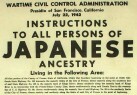
March 2 — General DeWitt issued Proclamation No. 1 designating the Western half of the three Pacific Coast states and the southern third of Arizona as a military area and stipulating that all persons of Japanese descent would eventually be removed therefrom.
March 11 — General DeWitt established the Wartime Civil Control Administration (WCCA), with Col. Karl R. Bendetsen as Director, to carry out the evacuation program.
March 18 — President Roosevelt signed Executive Order No. 9102 creating the War Relocation Authority to assist persons evacuated by the military under Executive Order No. 9066. Milton S. Eisenhower was named Director.
March 21 — President Roosevelt signed Public Law 503 (77th Congress) making it a federal offense to violate any order issued by a designated military commander under authority of Executive Order No. 9066.
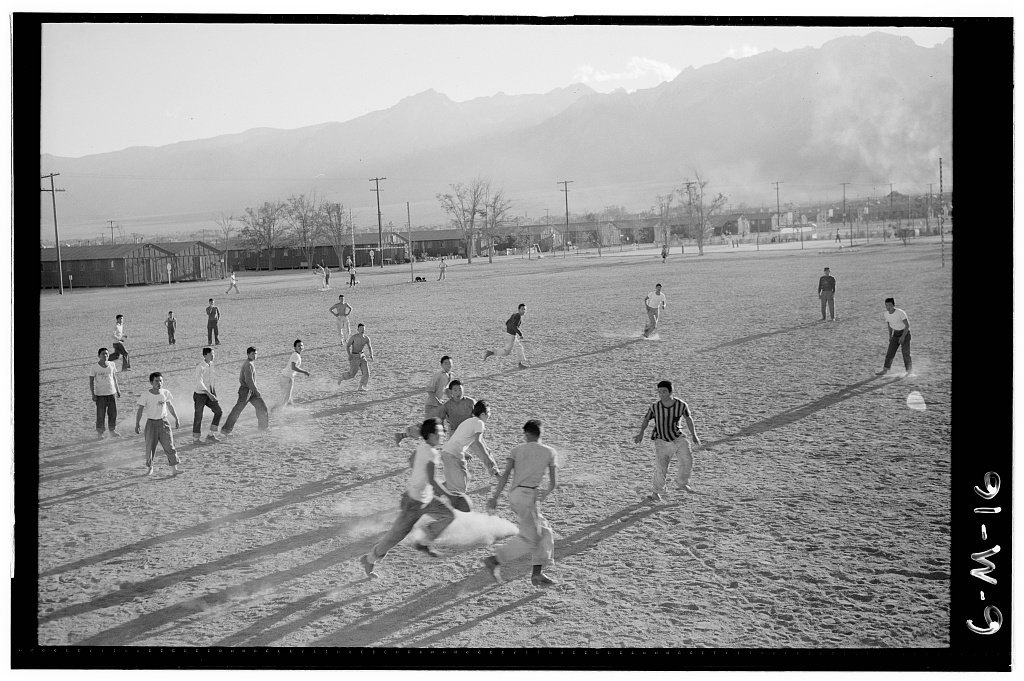
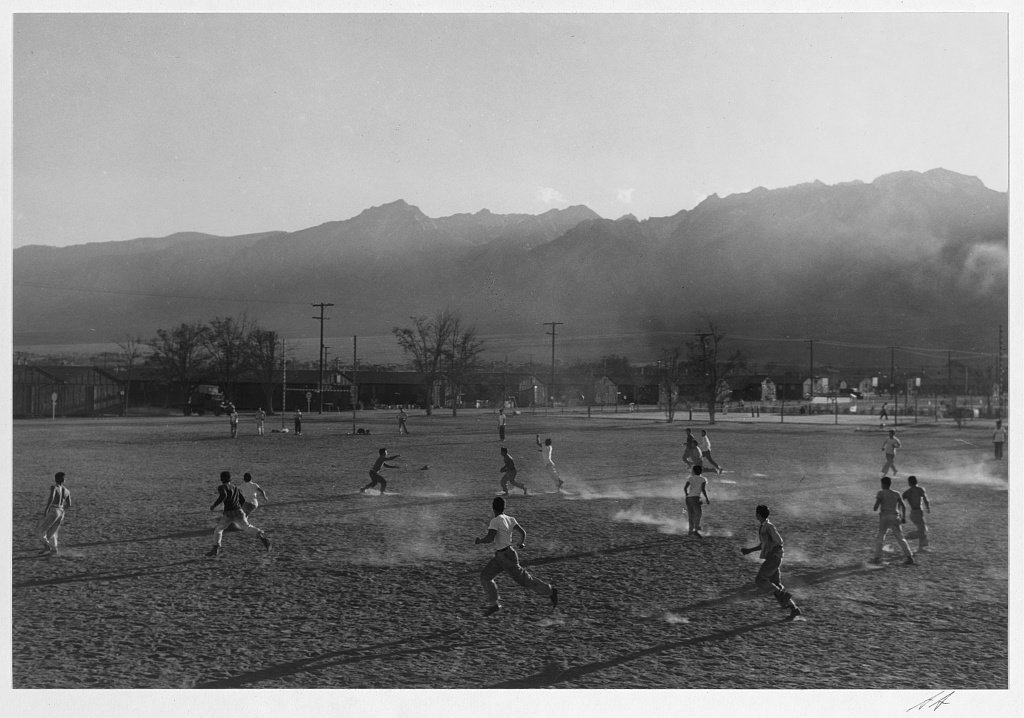
March 22 — First large contingent of Japanese and Japanese Americans moved from Los Angeles to the Manzanar Assembly Center operated by the Army in the Owens Valley of California.
March 23 — General DeWitt issued Civilian Exclusion Order No. 1 ordering the evacuation of all people of Japanese descent from Bainbridge Island in Puget Sound, and their removal by March 30, to the Puyallup Army Assembly Center near Seattle.

March 27 — General DeWitt issued Proclamation No. 4 (effective March 29) forbidding further voluntary migration of Japanese and Japanese Americans from the West Coast military area.
April 7 — Representatives of the governments of the ten Western states met at Salt Lake City with Director Milton S. Eisenhower of WRA and Colonel Bendetsen of WCCA to discuss resettlement plans for the evacuated people. The majority of the conferees registered uncompromising protest against unrestricted migration or resettlement within the western states. (This meeting is referred to as the Governors’ Conference).
May 8 — The first contingent of evacuees arrived at the Colorado River Relocation Center (Poston) near Parker, Arizona.
May 21 — Group of 15 evacuees left from the Portland Army Assembly Center for seasonal agricultural work in Malheur County, Oregon, under civilian restriction order of the Western Defense Command.
May 27 — First contingent of evacuees arrived at the Tule Lake Relocation Center in northern California.
May 29 — “National Student Relocation Council” was established, with John Nason as chairman.
June 1 — The Manzanar Army Assembly Center was transferred from WCCA to WRA and renamed Manzanar Relocation Center.
June 2 — General DeWitt issued Public Proclamation No. 6 forbidding further voluntary migration of people of Japanese descent from the eastern half of California and simultaneously announced that all such people would eventually be removed from this area directly to WRA centers.
June 17 — President Roosevelt appointed Dillon S. Myer to succeed Milton S. Eisenhower as director of WRA after Eisenhower’s resignation to become Deputy Director of the Office of War In formation.
July 20 — WRA adopted its first leave policy which launched the relocation program outside of centers. On this same date the Gila River Relocation Center in Arizona received its first contingent of evacuees from the Turlock Army Assembly Center in California.
August 7 — Western Defense Command announced the completion of evacuation of 110,000 from their homes in the military areas either to Army Assembly Centers or to WRA centers. The last of the residents of Japanese descent from eastern California were moved to relocation centers, even though most of them had already moved voluntarily from their homes near the West Coast to new homes farther inland.

August 10 — Minidoka Relocation Center near Twin Falls, Idaho, received the first contingent of evacuees from the Puyallup Army Assembly Center.
August 12 — Heart Mountain Relocation Center near Cody, Wyoming, received its first group of evacuees from the Pomona Army Assembly Center.
August 13 — WRA began an agency conference of key staff members in San Francisco to determine basic policies for the operation of relocation centers,
August 27 — The Granada Relocation Center near La Mar, Colorado, was opened with the arrival of a group of evacuees from the Merced Army Assembly Center.
September 11 — The Central Utah Relocation Center near Delta, Utah, received the first group of evacuees from the Tanforan Army Assembly Center.
September 18 — The Rohwer Relocation Center near McGhee, Arkansas, received its first group of evacuees from the Stockton Army Assembly Center.
September 26 — The WRA issued its revised and expanded basic leave regulations effective on October 1. These regulations laid the basis for an all-out resettlement program.
October 6 — The Jerome Relocation Center near Dermott, Arkansas, the last of the ten centers ready for business, received a group of evacuees from the Fresno Army Assembly Center.
November 3 — The transfer of evacuees from the Army Wartime Civil Control Administration to the WRA was completed with the arrival of the last group at the Jerome Center from Fresno.
November 14 — A community-wide strike and demonstration (The Poston Incident) was staged by the evacuees of Unit One of the Colorado River Center.
November 15 — Announcement was made of plans to eliminate the WRA regional offices as line offices, effective December 1.
November 23 — The Poston Incident was settled by an agreement between the administration and a committee of the residents.
December 6 — Some Manzanar residents staged a demonstration over the arrest of a resident. The military were called in and took over temporarily.
December 10 — A small group of troublemakers was moved from Manzanar to a Moab, Utah, abandoned CCC camp; aggressive pro-American Nisei were moved to a Death Valley CCC camp site to avoid more trouble at Manzanar.
1943
January 4 — WRA field offices were established in Chicago and Salt Lake City to facilitate relocation; soon thereafter, offices were opened in Cleveland, Minneapolis, Des Moines, New York, Denver, Kansas City, and Boston.
January 20 — Chairman Robert Reynolds of the Senate Committee on Military Affairs appointed a subcommittee under the chairman ship of Senator A. B. Chandler of Kentucky to investigate the WRA program and to consider a bill introduced by Senator Mon Wallgren to transfer the functions of WRA to the War Department.
January 28 — Secretary of War Henry L. Stimson announced plans to forma Japanese American Combat Team to be made up of volunteers from both the mainland and Hawaii.
February 8 — Army enlistment and leave clearance registration began at most of the relocation centers.
March 11 — WRA Director Dillon Myer wrote a letter to Secretary of War Stimson recommending an immediate relaxation of the West Coast Exclusion Orders against persons of Japanese descent. This recommendation was rejected in a reply dated May 10 in which segregation was strongly urged.
March 20 — Project directors were authorized to issue leave permits to persons wishing to relocate, in cases where leave clearance had been given by the Washington office.
April 8 — Senator Chandler wrote to Director Myer setting forth tentative recommendations of his subcommittee regarding the WRA program and urging that the “disloyal” evacuees be separated from the other residents of WRA centers.

May 6 — Mrs. Eleanor Roosevelt spent a full day at the Gila River Relocation Center.
May 12 — Two investigators from the staff of the House of Representatives Committee on Un-American Activities arrived unannounced at the Manzanar Relocation Center to begin a probe of the WRA program.
May 23 — Director and Mrs. Myer had lunch with President Roosevelt at the White House.
May 31 — Meeting of all project directors was held in Washington to discuss the situation in the various centers and the possibility of a segregation program. The directors were unanimous in favor of a segregation program.
June 3 — Chairman Martin Dies of the Committee on Un-American Activities announced the appointment of a three-man subcommittee, with John M. Costello of California as Chairman and Karl Mundt of South Dakota and Herman Eberharter of Pennsylvania as members, to investigate the WRA.
June 25 — Director Dillon Myer wrote to Assistant Secretary of War John J. McCloy regarding plans for a segregation program and the selection of Tule Lake as the segregation center.
July 6 — Director Myer appeared for the first time before the Costello Subcommittee to testify and to defend the administration of the WRA program.
August, September, and early October — More than 15,000 people were moved in and out of the Tule Lake Center.
October 11 — The last group of evacuees from other centers arrived at Tule Lake.
October 15 — A truck accident, which killed one evacuee, led to a farm strike at Tule Lake.
November 1 — A mass demonstration was staged at Tule Lake for the benefit of the National Director who was there on a visit.
November 4 — An outbreak of violence occurred at Tule Lake between WRA internal security staff and a group of dissident young evacuees. Troops were called in, and the center was transferred to military control.
November 8 — A so-called fact-finding committee of the California legislature began its investigation of the Tule Lake disturbance by holding hearings in the nearby village of Tule Lake.
November 16 — Director Dillon Myer met with the state commanders and state adjutants of the American Legion in Indianapolis.
November 24 — Director Myer testified before the Senate Committee on Military Affairs regarding the Tule Lake disturbance.
November 29 — The Costello Subcommittee began a series of hearings on the Tule Lake situation.
1944
January 14 — The control of the Tule Lake Center was transferred back to the WRA by the military.
January 20 — Secretary of War Stimson announced that in view of the record achieved by Japanese Americans in the Army, they would thereafter be recruited through the regular Selective Service procedures.
February 16 — President Roosevelt signed Executive Order 9423 transferring WRA to the Department of the Interior.
May — The 442nd Combat Team embarked for the Italian front.
June 8 — President Roosevelt announced a plan to bring approximately one thousand European refugees into the United States outside the regular immigration quotas and quarter them at an Emergency Refugee Shelter to be administered by WRA at Oswego, New York.
June 30 — The Jerome Relocation Center was closed and the five thou sand remaining residents were transferred to other centers.
July 1 — President Roosevelt signed Public Law 405 (78th Congress) permitting United States citizens to renounce their citizenship on American soil in time of war under procedures approved by the Attorney General.
August 3 — European refugees arrived at New York en route to the Emergency Refugee Shelter at Oswego, New York.
December 17 — The War Department announced the revocation (effective on January 2, 1945) of the West Coast mass exclusion orders which had been in effect against people of Japanese descent since the spring of 1942.
December 18 — The WRA announced that all relocation centers would be closed before the end of 1945 and that the entire WRA pro gram would be liquidated on June 30, 1946. On this same date the U.S. Supreme Court ruled in the Korematsu case that the West Coast evacuation was constitutional; the Court also ruled on the Endo case to the effect that WRA had no authority to detain a “concededly loyal” American citizen.
1945
January 8 — An attempt was made to burn and dynamite the packing shed of a returned evacuee in Placer County, California. This was the first of thirty West Coast incidents, over a period of five months from January to June.
January 10-20 — Field area offices were established at Los Angeles, San Francisco, and Seattle.
February 16 — An “all center” evacuee conference was held at Salt Lake City far the purpose of discussing and documenting the problems inherent in the liquidation of WRA centers.
April 30 — Director Myer, appearing before a House Appropriations Subcommittee, estimated that approximately 44,000 “relocatable” evacuees would be left in centers by June 30.
May 14 — Secretary of Interior Harold L. Ickes publicly denounced the incidents of West Coast terrorism and called for more vigorous local law enforcement.
June 20 — Director Dillon Myer and Assistant Director Robert Cozzens started on a trip of several days duration from Los Angeles up the big valley of California to visit returning evacuees, especially those who had been subjected to terrorism.
July 13 — WRA announced a schedule of closing dates for all centers, except Tule Lake, between October 15 and December 15.
July 16 — Captain George Grandstaff, a Caucasian officer with the 442nd Combat Team, began a speaking tour of the hot spots in California to plead for tolerance toward the returning evacuees.
August 1 — Director Myer issued Administrative Notice 289 calling for the scheduled relocation of remaining residents during the last six weeks of operation of each WRA center.
August 15 — VJ Day.
September 4 — The Western Defense Command issued Public Proclamation No. 24 revoking all individual exclusion orders and all further military restrictions against persons of Japanese descent.
December 1 — The last Relocation Center, except Tule Lake, was closed.
December 22 — President Truman announced that the refugees at Oswego should be considered for admission to the United States under regular immigration quotas.
1946
February 4 — Refugee Shelter at Fort Ontario, Oswego, New York, was closed.
February 23 — Last group of repatriates from Tule Lake to Japan sailed from Long Beach, California; 432 aboard ship at sailing time.
May 8 — The Director of WRA received “The Medal for Merit” as a result of the work of the agency during the war.
May 15 — The last of the WRA field offices were closed.
June 30 — The War Relocation Authority Program was officially terminated.