   |
Archaebibliophilia
Occasional Postings of a Lover of Archaic Books
"a book... I have found" II Chron. 34:14,15
"knowledge delighteth thy soul" Prov. 2:10
"out of his treasure things new and old" Matt. 13:525
Occasional Postings of a Lover of Archaic Books
"a book... I have found" II Chron. 34:14,15
"knowledge delighteth thy soul" Prov. 2:10
"out of his treasure things new and old" Matt. 13:525
| <2025 |
|
October 3, 2026
"Judaism is dead" -- Henry Cowles
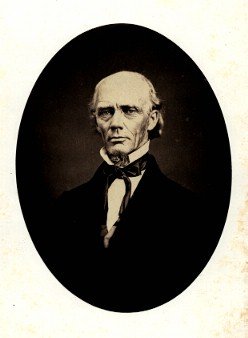
Henry Cowles (1803-1881) was a godly commentator on the whole Bible and a professor at Oberlin College (where Charles Finney also once taught and served as president; Cowles, however, did have important theological differences from Finney, for which we are pleased to know, in regards to the atonement, perfectionism and eschatology).
Below is a rather long excerpt from the final chapter in Cowles' commentary on the book of Exekiel, where he is declaring his views regarding a figurative interpretation of the prophecies in Ezekiel. Spurgeon referred to Cowles as "one of the most instructive of American writers; he is clear and definite, and leaves his meaning impressed upon the mind. His scholarship is respectable."
I plead for the figurative interpretation and against the literal, and draw my arguments,
1. From the New Testament;
2. From the Old, and especially from these prophecies themselves in their relation to the writer and his first readers.
3. From the nature of the case — especially as creating an intensely strong probability against the literal and in favor of the figurative interpretation.
1. The literal system of interpretation must be rejected because it is absolutely precluded and forbidden by the New Testament. The entire spirit and genius of the gospel dispensation as unfolded by Christ and his inspired apostles is utterly, squarely, fatally against it. For, the literal system must hold that according to this vision, Judaism will yet be fully restored — restored with more than all its ancient surroundings, and in more than its ancient fullness. But according to the New Testament, Judaism is dead. It had done its great work when Jesus died as the Lamb of God and thenceforth it ceased to exist under divine authority. In the age of the epistle to the Hebrews, it had already "decayed, waxed old, and was ready to vanish away." Paul declared repeatedly and in many various forms that Christ had "broken down the middle wall of partition between Jews and Gentiles" by setting aside whatever was peculiar to the Jew; that he "had abolished in his flesh the enmity, even the law of commandments contained in ordinances," etc. (Eph. 2:14, 15); that he had "blotted out the handwriting of ordinances that was against us" (Gentiles), "which was contrary to us, and took it out of the way, nailing it to his cross" (Col. 2:14). This was the end of the Mosaic system.
And yet more if possible to this point, the burden of Paul's epistle to the Galatians is, that relapsing from Christianity to Judaism is not only a folly (chap. 3: 1, 3) but a sin, and essentially an apostasy from Christ. He declares, "There is neither Jew nor Greek" (Judaism being defunct), "for ye are all one in Christ Jesus." "But now, after that ye have known God, how turn ye again to the weak and beggarly elements, whereunto ye desire again to be in bondage?" "Ye observe [Jewish] days and months and times and years. I am afraid of you lest I have bestowed upon you labor in vain" (Gal. 4: 9-11). "I, Paul, say unto you that if ye be circumcised, Christ shall profit you nothing; for I testify again to every man that is circumcised that he is a debtor to do the whole law. Christ is become of no effect unto you, whosoever of you are justified by the law: ye are fallen from grace" (Gal. 5:2-4). That is; circumcision and the whole ritual system has no farther mission, has no longer any binding force. Before Christ came, it led toward and unto Christ; after his coming, it leads away from Christ; forces itself in as a substitute for Christ, and therefore must be rejected and denounced as ruinous to souls.
With admirable and wise forbearance the Lord allowed the converted Jews time on this great change from Judaism to a pure Christianity; but proper out of existence as a thing that had done its work and could never be used in his kingdom any more.
And now is it credible that this wall of partition is going up again? that "ordinances," bloody sacrifices, all and more than all that the Mosaic system ever had, shall be restored? If it were to be restored according to the literal construction of Ezekiel 40-48 chapters, what would it mean? Would it point to another Christ, another atoning Lamb, another great High Priest to make intercession for us? If our present New Testament be accepted as authority, a return to Judaism is forever foreclosed. The testimony of Jesus and his apostles on this point could not be made stronger than it is.
Our Lord spake on this vital question in decisive terms. Standing in view of Mt. Gerizim, with the long mooted question before him whether that mount or Jerusalem were the one prescribed locality for all acceptable worship, he plainly signified that this question had ceased to be a practical one; that the whole system of restricting special forms of worship to one place was now passing by. To the woman of Samaria he solemnly averred (Jn. 4: 21-24); "Woman, believe me; the hour cometh when ye shall neither in this mountain nor yet at Jerusalem, worship the Father. The hour cometh and now is when the true worshipers shall worship the Father in spirit and in truth," implying that nothing else should be requisite for acceptance with God. So long as sacrifices, altars, and a visible glory in the most holy place were of divine appointment, some one place for this worship would be a necessity. If these prophecies of Ezekiel are literal, that necessity must return again, and the words of our Lord to the woman of Samaria must cease to have force. The hour must arrive — with the literal fulfillment of Ezekiel — when men must worship God as of old in the one prescribed place, and not merely in spirit and in truth, but in all the forms of ancient Judaism as well.
Did Christ anticipate this supposed change back to Judaism? Had he himself inspired Ezekiel to predict it? The question is its own answer! There can be no return to the old regime of one only place of acceptable worship; and that, in the forms of a dead Judaism! Under the gospel economy, every pious heart is God's temple, and the wide world is open to the offering of each heart's truthful homage to God. This gospel economy can never in any future age give place to Judaism.
Yet again. The inspired apostles were in all vital points inspired interpreters of Old Testament prophecy. In all that affects the great elementary features of the old system and of the new, this position must be valid, else their inspiration becomes practically of no account.
Inquiring now for their inspired interpretation of those prophecies which speak of the Christian age, we may fitly begin with asking what place and what significance they assign to the temple of God in these gospel days. Prophecy speaks of a temple of God in the Messiah's age; what do the apostles understand it to mean?
They answer that in this age Christians are themselves the temple of the living God, and that "God dwells in them and walks in them." "Know ye not," (said Paul, 1 Cor. 3. 16,) "that ye are the temple of God and that the Spirit of God dwelleth in you?" "What! know ye not that your body is the temple of the Holy Ghost which is in you?" (1 Cor. 6: 19.) And then as if to clinch this argument, Paul cites the Old Testament prophecy in which God said, "I will dwell in them and walk in them," and finds its fulfillment in the new gospel fact; "Ye are the temple of the living God." See 2 Cor. 6:16.
Further, ask the apostle James how he understands the prophecy of Amos (chap. 9: 11, 12) about rebuilding the fallen tabernacle of David. He replies that it refers to the conversion of the Gentiles, and to their being gathered into the Christian Church. He gives not a hint of the literal rebuilding of the old temple. See Acts 15: 13-18. And this was the doctrine of the whole Church in council assembled then and there.
Or ask the Apostle Paul whether he connects the future conversion of the Jews with their restoration to their own land. Ask him if he assumes that these two events will be coincident, and their restoration a necessary means to their conversion. He answers that he knows nothing about such restoration. Their conversion to Christ he believes in, rejoices in exultingly; but he has not the first hint of their returning to their own land — much less of their rebuilding the temple of wood and stone. Examine his words, Rom. 11: 11-36.
Finally the old system and the new have too many vital points of dissimilarity, not to say antagonism, to admit of being amalgamated, or in any way compounded together. The genius of the old was restrictive, exclusive, and put itself on the defensive. The genius of the new is expansive, aggressive, framed to grasp the whole world. The former walls itself in to shut off idolatry and all contamination from the world without: the latter faces and assails the idolatry and sin of the world every-where under the one grand behest; "Go ye into all the world, and preach the Gospel to every creature." How can these two systems amalgamate? And how can it be supposed that the world is to be converted by going back to the centralized forms of Judaism?
2. The evidence from the Old Testament, i.e., from these prophecies themselves, considered in view of the circumstances of their authors and first readers, has been frequently referred to in these notes, and hence may be presented with the more brevity here.
In a word, then, these prophets were Jews, of Jewish education, with only Jewish conceptions of the kingdom of God, and with only Jewish terms, phrases, figures and symbols for expressing these conceptions. The same is true of their first readers, to whom of necessity they must adapt their writings. If any should suggest here that the Lord himself is the speaker and revealer, still the case remains the same; for the Lord speaks to Jews, whether prophets or people, and only in Jewish language and figures. Hence the future kingdom of Christ must be revealed to the prophets and to the Jewish people in words and symbols drawn from the existing economy. This necessity is absolute, if the Lord aimed to reveal any thing — if he aimed to speak so as to be understood.
This principle is introduced here, not precisely to prove that these prophecies reveal gospel blessings, but to account for their phraseology and their symbols. The proof that they teach the gloriously converting power of the Gospel and of the Spirit of God in the latter days comes from the facts,
3. It remains to show in a few closing words that in the nature of the case the literal system is for every reason intensely improbable. Thus:
That the ten tribes, thoroughly lost to all reliable history since their captivity two thousand five hundred and eighty-seven years ago, should appear again; produce their unbroken and distinct genealogies; prove their identity, and file into their places in the allotment of tribes as given in Ezek. 48, is violently improbable.**
That the natural boundaries of Palestine should be miraculously changed so as to make it a perfect rectangle; that the great river from the sanctuary should flow, with a growth so unprecedented, into the Dead Sea, and make its waters salubrious, fill them with fish, etc., all in the literal sense, is very improbable.
That the better times of the gospel age; its one period of most perfect beauty, purity and glory, should be brought about by receding from the genius of New Testament Christianity to the genius of Judaism, is preeminently improbable.
That the Lord should subject his Gentile churches to the same terrible contest with Judaism which cost so much martyr-blood in the first and second centuries, is improbable.
That he should subject the Jews themselves to those temptations to bigotry, exclusiveness, and uncharitableness, which in the first Christian age often proved too stubborn for even the grace of the gospel, is improbable.
That he should expose them to the power of the old national spirit of reliance upon ritual forms and ceremonies, or to the national pride in which they accounted themselves the only favored people of God, is utterly improbable.
And finally, that the Lord should give his Church in the future age a system in which the spirit of love, purity and peace is lost in the letter of forms and ceremonies; in which (as e.g. in Ezek. 47: 1-12) you have, instead of the unexampled glory and power of the Divine Spirit, only a beautiful river and plenty of good fish, and fruit-trees in abundance for sensual delights; in short, that God should lead the church and the world backward from a spiritual gospel to a sensual paradise — is utterly improbable and even incredible.
For one, I rejoice that it is. I rejoice that the instincts of our Christian nature revolt against this view of these prophecies. I rejoice that there is no trustworthy evidence to sustain the literal interpretation, and that the figurative view is amply supported by evidence, unfolding glorious truth in harmony with the whole tenor of Old Testament prophecy and of New Testament interpretation of it, and revealing a sublimely grand and auspicious future for the kingdom of our divine Redeemer. AMEN.
FOOTNOTE:
** The restoration of the lost ten tribes should be considered in the light of Bible history. Thus:
2 Kings 17 shows that the ten tribes had forsaken the God of Israel, and were therefore utterly rejected with no qualifying promise of restoration (vs. 17-20): that their captivity, so far as known to the sacred historian, was final (vs. 23, 34, 41); that the change of population then made was entire, the Assyrian king taking away all the Hebrew people, and filling their homes and country with colonists from Assyria, sending back only one priest to teach them the worship of the former God of the land. The Samaritan community had scarcely the least tinge of Israelite blood.
Next, note that 1 Chron. 5: 25, 26 certifies respecting the two and a half tribes that they were carried away captive "unto this day;" i.e., up to the date of the last finishing touch of this genealogical history, which, as the reader will see by comparing 1 Chron. 9 with Neh. 11, comes down to a period many (136) years later than the first return of the Jews with Zerubbabel. Nehemiah's latest date is B.C. 400, and his genealogies correspond with those of 1 Chron. 9, so that the testimony which precludes the restoration of the two and a half tribes "down to this day" reaches long after the return of the Jews to Palestine in B. C. 536-444.
And finally the book of Ezra shows (chap. 1:5) that the returning captives were "the fathers of Judah and Benjamin;" in chap. 2, that special regard was had to the point of genealogy, since those are named who could not make out their record (vs. 59-63); that Ezra gives his own record carefully (7:1-5), and also that of his company (8:1-14), and of the Levites (8: 16-20); but gives not the least hint of the ten tribes. Further, his book shows that the taking of strange [heathen] wives was the besetting sin of the people (chaps. 9 and 10), which the testimony of Nehemiah confirms (chap. 13:23-30). If this sin needed such stringent measures to withstand it among the Jews proper, even while residing in their own land, how much more must the ten tribes have lost their distinct nationality by its power over them in that remote land of Assyria?
Thus stands the historical evidence of Scripture in reference to the restoration of the ten tribes — utterly and strongly against it. In the light of Scripture, the supposition is unhistorical, every way improbable, and in nowise credible.
Hence the restoration of these lost tribes, in any yet future age, becomes intensely improbable — virtually impossible.
1. From the New Testament;
2. From the Old, and especially from these prophecies themselves in their relation to the writer and his first readers.
3. From the nature of the case — especially as creating an intensely strong probability against the literal and in favor of the figurative interpretation.
1. The literal system of interpretation must be rejected because it is absolutely precluded and forbidden by the New Testament. The entire spirit and genius of the gospel dispensation as unfolded by Christ and his inspired apostles is utterly, squarely, fatally against it. For, the literal system must hold that according to this vision, Judaism will yet be fully restored — restored with more than all its ancient surroundings, and in more than its ancient fullness. But according to the New Testament, Judaism is dead. It had done its great work when Jesus died as the Lamb of God and thenceforth it ceased to exist under divine authority. In the age of the epistle to the Hebrews, it had already "decayed, waxed old, and was ready to vanish away." Paul declared repeatedly and in many various forms that Christ had "broken down the middle wall of partition between Jews and Gentiles" by setting aside whatever was peculiar to the Jew; that he "had abolished in his flesh the enmity, even the law of commandments contained in ordinances," etc. (Eph. 2:14, 15); that he had "blotted out the handwriting of ordinances that was against us" (Gentiles), "which was contrary to us, and took it out of the way, nailing it to his cross" (Col. 2:14). This was the end of the Mosaic system.
And yet more if possible to this point, the burden of Paul's epistle to the Galatians is, that relapsing from Christianity to Judaism is not only a folly (chap. 3: 1, 3) but a sin, and essentially an apostasy from Christ. He declares, "There is neither Jew nor Greek" (Judaism being defunct), "for ye are all one in Christ Jesus." "But now, after that ye have known God, how turn ye again to the weak and beggarly elements, whereunto ye desire again to be in bondage?" "Ye observe [Jewish] days and months and times and years. I am afraid of you lest I have bestowed upon you labor in vain" (Gal. 4: 9-11). "I, Paul, say unto you that if ye be circumcised, Christ shall profit you nothing; for I testify again to every man that is circumcised that he is a debtor to do the whole law. Christ is become of no effect unto you, whosoever of you are justified by the law: ye are fallen from grace" (Gal. 5:2-4). That is; circumcision and the whole ritual system has no farther mission, has no longer any binding force. Before Christ came, it led toward and unto Christ; after his coming, it leads away from Christ; forces itself in as a substitute for Christ, and therefore must be rejected and denounced as ruinous to souls.
With admirable and wise forbearance the Lord allowed the converted Jews time on this great change from Judaism to a pure Christianity; but proper out of existence as a thing that had done its work and could never be used in his kingdom any more.
And now is it credible that this wall of partition is going up again? that "ordinances," bloody sacrifices, all and more than all that the Mosaic system ever had, shall be restored? If it were to be restored according to the literal construction of Ezekiel 40-48 chapters, what would it mean? Would it point to another Christ, another atoning Lamb, another great High Priest to make intercession for us? If our present New Testament be accepted as authority, a return to Judaism is forever foreclosed. The testimony of Jesus and his apostles on this point could not be made stronger than it is.
Our Lord spake on this vital question in decisive terms. Standing in view of Mt. Gerizim, with the long mooted question before him whether that mount or Jerusalem were the one prescribed locality for all acceptable worship, he plainly signified that this question had ceased to be a practical one; that the whole system of restricting special forms of worship to one place was now passing by. To the woman of Samaria he solemnly averred (Jn. 4: 21-24); "Woman, believe me; the hour cometh when ye shall neither in this mountain nor yet at Jerusalem, worship the Father. The hour cometh and now is when the true worshipers shall worship the Father in spirit and in truth," implying that nothing else should be requisite for acceptance with God. So long as sacrifices, altars, and a visible glory in the most holy place were of divine appointment, some one place for this worship would be a necessity. If these prophecies of Ezekiel are literal, that necessity must return again, and the words of our Lord to the woman of Samaria must cease to have force. The hour must arrive — with the literal fulfillment of Ezekiel — when men must worship God as of old in the one prescribed place, and not merely in spirit and in truth, but in all the forms of ancient Judaism as well.
Did Christ anticipate this supposed change back to Judaism? Had he himself inspired Ezekiel to predict it? The question is its own answer! There can be no return to the old regime of one only place of acceptable worship; and that, in the forms of a dead Judaism! Under the gospel economy, every pious heart is God's temple, and the wide world is open to the offering of each heart's truthful homage to God. This gospel economy can never in any future age give place to Judaism.
Yet again. The inspired apostles were in all vital points inspired interpreters of Old Testament prophecy. In all that affects the great elementary features of the old system and of the new, this position must be valid, else their inspiration becomes practically of no account.
Inquiring now for their inspired interpretation of those prophecies which speak of the Christian age, we may fitly begin with asking what place and what significance they assign to the temple of God in these gospel days. Prophecy speaks of a temple of God in the Messiah's age; what do the apostles understand it to mean?
They answer that in this age Christians are themselves the temple of the living God, and that "God dwells in them and walks in them." "Know ye not," (said Paul, 1 Cor. 3. 16,) "that ye are the temple of God and that the Spirit of God dwelleth in you?" "What! know ye not that your body is the temple of the Holy Ghost which is in you?" (1 Cor. 6: 19.) And then as if to clinch this argument, Paul cites the Old Testament prophecy in which God said, "I will dwell in them and walk in them," and finds its fulfillment in the new gospel fact; "Ye are the temple of the living God." See 2 Cor. 6:16.
Further, ask the apostle James how he understands the prophecy of Amos (chap. 9: 11, 12) about rebuilding the fallen tabernacle of David. He replies that it refers to the conversion of the Gentiles, and to their being gathered into the Christian Church. He gives not a hint of the literal rebuilding of the old temple. See Acts 15: 13-18. And this was the doctrine of the whole Church in council assembled then and there.
Or ask the Apostle Paul whether he connects the future conversion of the Jews with their restoration to their own land. Ask him if he assumes that these two events will be coincident, and their restoration a necessary means to their conversion. He answers that he knows nothing about such restoration. Their conversion to Christ he believes in, rejoices in exultingly; but he has not the first hint of their returning to their own land — much less of their rebuilding the temple of wood and stone. Examine his words, Rom. 11: 11-36.
Finally the old system and the new have too many vital points of dissimilarity, not to say antagonism, to admit of being amalgamated, or in any way compounded together. The genius of the old was restrictive, exclusive, and put itself on the defensive. The genius of the new is expansive, aggressive, framed to grasp the whole world. The former walls itself in to shut off idolatry and all contamination from the world without: the latter faces and assails the idolatry and sin of the world every-where under the one grand behest; "Go ye into all the world, and preach the Gospel to every creature." How can these two systems amalgamate? And how can it be supposed that the world is to be converted by going back to the centralized forms of Judaism?
2. The evidence from the Old Testament, i.e., from these prophecies themselves, considered in view of the circumstances of their authors and first readers, has been frequently referred to in these notes, and hence may be presented with the more brevity here.
In a word, then, these prophets were Jews, of Jewish education, with only Jewish conceptions of the kingdom of God, and with only Jewish terms, phrases, figures and symbols for expressing these conceptions. The same is true of their first readers, to whom of necessity they must adapt their writings. If any should suggest here that the Lord himself is the speaker and revealer, still the case remains the same; for the Lord speaks to Jews, whether prophets or people, and only in Jewish language and figures. Hence the future kingdom of Christ must be revealed to the prophets and to the Jewish people in words and symbols drawn from the existing economy. This necessity is absolute, if the Lord aimed to reveal any thing — if he aimed to speak so as to be understood.
This principle is introduced here, not precisely to prove that these prophecies reveal gospel blessings, but to account for their phraseology and their symbols. The proof that they teach the gloriously converting power of the Gospel and of the Spirit of God in the latter days comes from the facts,
(1.) That they refer to gospel times.
(2.) That they must therefore be construed of gospel blessings, and not of Mosaic forms and ritualities: and
(3.) That the nature and magnitude of these symbols demand a most magnificent fulfillment and can be satisfied with nothing less.
(2.) That they must therefore be construed of gospel blessings, and not of Mosaic forms and ritualities: and
(3.) That the nature and magnitude of these symbols demand a most magnificent fulfillment and can be satisfied with nothing less.
3. It remains to show in a few closing words that in the nature of the case the literal system is for every reason intensely improbable. Thus:
That the ten tribes, thoroughly lost to all reliable history since their captivity two thousand five hundred and eighty-seven years ago, should appear again; produce their unbroken and distinct genealogies; prove their identity, and file into their places in the allotment of tribes as given in Ezek. 48, is violently improbable.**
That the natural boundaries of Palestine should be miraculously changed so as to make it a perfect rectangle; that the great river from the sanctuary should flow, with a growth so unprecedented, into the Dead Sea, and make its waters salubrious, fill them with fish, etc., all in the literal sense, is very improbable.
That the better times of the gospel age; its one period of most perfect beauty, purity and glory, should be brought about by receding from the genius of New Testament Christianity to the genius of Judaism, is preeminently improbable.
That the Lord should subject his Gentile churches to the same terrible contest with Judaism which cost so much martyr-blood in the first and second centuries, is improbable.
That he should subject the Jews themselves to those temptations to bigotry, exclusiveness, and uncharitableness, which in the first Christian age often proved too stubborn for even the grace of the gospel, is improbable.
That he should expose them to the power of the old national spirit of reliance upon ritual forms and ceremonies, or to the national pride in which they accounted themselves the only favored people of God, is utterly improbable.
And finally, that the Lord should give his Church in the future age a system in which the spirit of love, purity and peace is lost in the letter of forms and ceremonies; in which (as e.g. in Ezek. 47: 1-12) you have, instead of the unexampled glory and power of the Divine Spirit, only a beautiful river and plenty of good fish, and fruit-trees in abundance for sensual delights; in short, that God should lead the church and the world backward from a spiritual gospel to a sensual paradise — is utterly improbable and even incredible.
For one, I rejoice that it is. I rejoice that the instincts of our Christian nature revolt against this view of these prophecies. I rejoice that there is no trustworthy evidence to sustain the literal interpretation, and that the figurative view is amply supported by evidence, unfolding glorious truth in harmony with the whole tenor of Old Testament prophecy and of New Testament interpretation of it, and revealing a sublimely grand and auspicious future for the kingdom of our divine Redeemer. AMEN.
FOOTNOTE:
** The restoration of the lost ten tribes should be considered in the light of Bible history. Thus:
2 Kings 17 shows that the ten tribes had forsaken the God of Israel, and were therefore utterly rejected with no qualifying promise of restoration (vs. 17-20): that their captivity, so far as known to the sacred historian, was final (vs. 23, 34, 41); that the change of population then made was entire, the Assyrian king taking away all the Hebrew people, and filling their homes and country with colonists from Assyria, sending back only one priest to teach them the worship of the former God of the land. The Samaritan community had scarcely the least tinge of Israelite blood.
Next, note that 1 Chron. 5: 25, 26 certifies respecting the two and a half tribes that they were carried away captive "unto this day;" i.e., up to the date of the last finishing touch of this genealogical history, which, as the reader will see by comparing 1 Chron. 9 with Neh. 11, comes down to a period many (136) years later than the first return of the Jews with Zerubbabel. Nehemiah's latest date is B.C. 400, and his genealogies correspond with those of 1 Chron. 9, so that the testimony which precludes the restoration of the two and a half tribes "down to this day" reaches long after the return of the Jews to Palestine in B. C. 536-444.
And finally the book of Ezra shows (chap. 1:5) that the returning captives were "the fathers of Judah and Benjamin;" in chap. 2, that special regard was had to the point of genealogy, since those are named who could not make out their record (vs. 59-63); that Ezra gives his own record carefully (7:1-5), and also that of his company (8:1-14), and of the Levites (8: 16-20); but gives not the least hint of the ten tribes. Further, his book shows that the taking of strange [heathen] wives was the besetting sin of the people (chaps. 9 and 10), which the testimony of Nehemiah confirms (chap. 13:23-30). If this sin needed such stringent measures to withstand it among the Jews proper, even while residing in their own land, how much more must the ten tribes have lost their distinct nationality by its power over them in that remote land of Assyria?
Thus stands the historical evidence of Scripture in reference to the restoration of the ten tribes — utterly and strongly against it. In the light of Scripture, the supposition is unhistorical, every way improbable, and in nowise credible.
Hence the restoration of these lost tribes, in any yet future age, becomes intensely improbable — virtually impossible.
September 5, 2026
Timothy and Helen Pietsch
I've mentioned the Pietschs a number of times in these blogs... and
have finally created a special webpage to help remember them and their
amazing lives and dedication to the Lord's work in Japan, from 1936 to
1992, minus six war years.
July 9, 2026
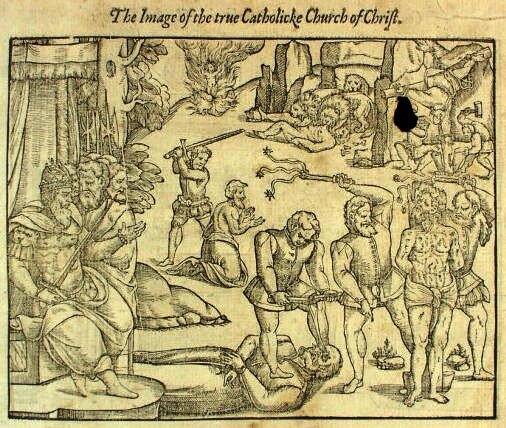
Drunk with the blood of the saints -- Millions killed by the papacy
There have been many kings and emperors, warriors and ruthless leaders
who have murdered millions who were in their way. The Roman Catholic
system from its inception has done the same. This historical fact no
one can doubt. The number of martyrs and victims of papal control is
very difficult, if not impossible, to calculate, but here are some
excerpts from those who have written about the history of persecution
and martyrdom.From: A Mirror or Looking glass, both for saints, and sinners by Samuel Clarke (1657)
p171:
Mexico, is now called New-Spain, in which is that excellent tree called Mete which they plant, and dress as we do our Vines, yielding so many sorts of commodities: For when they be tender, they make of them Conserves, Paper, Flax, Mantles, Mats, Shooes, Girules, and Cordage: On the leaves grow prickles so hard, and sharp, that they use them instead of sawes. From the root of the tree comes a juice like unto syrup,which if you seeth, it will become Hony, if you purifie it, it will become Sugar: you may also make Wine, and Vineger of it: The rind rosted cureth hurts, and sores, and from the top boughs is such a Gum which is an excellent antidote against poison. It abounds also with many golden sanded Rivers, wherein are Crocodiles which the natives eat: It hath Mines of gold, and a mountain burning like Aetna. It's bounded on the East with Sucutan, and the Gulph of Mexico: on the West with California: on the South with Peruana; and the Northern limits are not known.
It was very populous before the arrival of the Spaniards, who in seventeen years slew six millions of them, roasting some, plucking out the eyes, cutting off the arms of others, and casting them alive to bee devoured of dogs, and wild beasts. Mechuacan, one of the Provinces of New-Spain, abounds with Mulberry trees, Silk, Hony, Wax, black Amber, and great plenty of Fish: the Inhabitants are tall, strong, active, and speak a copious language.
p186:
Bartholomew de las Gasts, a Dominick Frier, and Bishop in America, who wrote in the year 1542. saith thus of them. The Indians are a simple, harmless people, loyal to their Lords, and such as gave no occasion of offence to the Spaniards, till by their extream injuries they provoked them thereto. To these Lambs (saith hee) the Spaniards came as cruel, and hungry Tygers, Bears, and Lions, intending nothing for these forty years but blood, and slaughter to satisfie their avarice and ambition: Insomuch that of three millions of Natives, that they found in Hispaniola there remains not one.
Cuba, and the other Islands indured the like miseries; and in the firm land ten Kingdomes, greater than all Spain, were dis-peopled, and left desolate, in which there perished not less than twelve millions by their tyranny, hee might as truly have said fifty millions.
p187:
And thus they did in all other places whithersoever they came: In the Islands of St. John, and Jamica were six hundred thousand Inhabitants, and within few years, there were scarcely two hundred left in either of them: In Cuba a Cacique, or Lord, called all his subjects together, and shewed them a box of gold, saying, This is the Spaniards God, and made them dance about it, and then hurled it into the River: And afterwards being taken, and condemned to the fire, when hee was bound to the stake, a Frier came and preached to him about Heaven, and Hell: The Cacique asked if any Spaniards were in Heaven? yea (said the Frier) such as were good: Then said the Cacique, I will rather go to Hell, than come where any of that cruel Nation are.
In the Land of Lucaia they destroyed all, and when they shipped multitudes of them for the Mines in Hispaniola, for want of food, a third part of them commonly perished by the way, so that an unskilful Pilot might have been directed his way by these floating Carkasses.The like havock they made in the Continent, almost unpeopling all places whether they came. From Dariena to Nicaragua, they slew four hundred thousand people with Dogs, sword, fire, and other torments.
They used to send Friers to Preach, that under pain of confiscation, and losse of Lands, Liberty, Life, &c. they should acknowledge God, and the King of Spain: yea they would steal to some places, and half a mile off of the citys by night they would make this Proclamation where none heard it, and then in the Night whilst they were asleep; fire their houses, slaying, and taking Captive at their pleasures, and then fall to search for gold. A certain Cacique gave the Spanisb Governour the weight of nine thousand Crowns in gold, and hee by way of requital to extort more, bound him to a poll, and putting fire to his feet, forced him to send home for three thousand more, and yet not satisfied, hee persisted to torment him, till the marrow came forth of his feet, wherewith hee died; when any of the Indians fainted under their grievous burdens, or for want of food, the Spaniards, least they should loose time in undoing the chain wherein they were tyed, they would cut off his head, and so let the body fall out. At another time they robbed the Nicaraguans of their Corn; whereby thirty thousand of them died of famine, and a mother was driven to eat her own child; besides, five hundred thousand were carried away into bondage, and fifty or sixty thousand more were slain in their warres; so that in one of the most populous Regions in the World (saith Casas) there remain not above four or five thousand persons. Cortes used to have four Kings to wait upon him; hee burned sixty Kings, their children looking on. Another Spaniard cast four of their Kings to bee devoured by his dogs.
In New-Spain from the year 1518 to 1530. within the compasse of four hundred and eighty miles about Mexico, they destroyed above four millions of people by fire, and sword, besides those that dyed by miserable servitude and drudgery. In the Province of Naco and Honduras in the space of eleven years, two millions of men perished by the same ways. In Guatimala, in sixteen years space,were destroied five millions of souls. Alvarado, who was the instrument of this destruction dyed by the fall of his horse, and had his City of Guatimala destroyed, and overwhelmed by a threefold deluge, of Earth, water, and stones. In his expeditions, he forced the Indians by ten, or twenty thousand at a time to go with him, allowing them no other sustenance, but the flesh of their slain enemys, keeping in his Army Shambles of mans flesh.
In Panuco and Xalisco, they exercised the like cruelties; One of the Spaniards forced eight thousand of the Indians to wall about his Garden, and suffered them all to perish with Famine. In Machuachan they tortured the King that came forth to meet them, that they might extort gold from him: they set his feet in the stocks, and put fire thereto, binding his hands to a Post behind him, and then had a boy standing by that basted his roasted feet with Oil. Another stood with a Cross-bow bent against his breast, and a third stood with Dogs ready to devour him, by these tortures hee dyed. They forced the Indians to bring them their gods, hoping they had been of gold, but when their golden hopes failed, they forced them to redeem them again with Gold. Yea where the Friers had forced the Indians to cast away their gods, the Spaniards brought more from other places to sell them. In the Province of St. Martha, they laid utterly waste and desolate four hundred and fifty miles of land, by destroying the Inhabitants: The like they did in the Kingdome of Venezula, where they destroyed four or five millions. Besides, they carried of them Captive out of the Continent into the Islands, a million of People.
They spared no sort of persons; plucked the Children from the breasts to quarter them to their dogs, tortured Kings with new devices borrowed either from the Inquisition, or from hell: they used to cut off the Noses, and hands of men and women that lived peaceably with them: they sold Fathers, Mothers, Children, asunder into diverse places, and to diverse persons never to meet again; they used to ly with the women, that being with child they might yield them the more mony in their sale. The Spanish Priests used to devote them with Curses to the Devil, and taught them vices by their evil practises and examples, infomuch as one said, Hee would perswade the King of Spain to send no more Priests into America. They teach them Usury, Lying. Swearing, Blasphemy. A Caciques son that was towardly in his youth, and proved after dissolute, being asked the reason of it, said, since I was a Christian, I have learned to swear several sorts of Oaths, to Dice, to Lye, to Swagger, and now I want nothing but a Concubine to make me a compleat Christian; This made them, to say, that of all Gods the Christians God was the worst, which had such bad servants, and to wish for their own gods again, of whom they never received so much hurt as from the Christians. A Christian (said one of them) is one that impiously demands Maiz, Honey, Silk, Raiment, an Indian woman to lye with; they call for gold and silver, are idle and will not work, are Gamesters, Dicers, wicked Blasphemers, Backbiters, Quarrellers, &c. And taking a peece of Gold, hee said, Loe this is the Christians God: For this they kill us, and one another, for this they play, blaspheme, curse, steal and do all manner of villanies.
In Peru they had publike places of torture, whereinto they might put a thousand of the miserable Creatures at once, by exquisite tortures to force them to a confession of their hidden treasures: such as escaped these, used to hang themselves in the Mountains, and their wives by them, and their little children at their feet. By Dogs at Land they worried them, and in their Pearl fishings, exposed them to the ravenous Sharks in the seas, by fire, and sword consuming twenty millions of people since the Jesuits went amongst them. These and infinite more, have been the cruelties which the cruel Spaniards have exercised upon the poor, naked, innocent people: Our Author, a Papist, that relates these things, lest any should think that hee wrote too much, protests that they were a thousand times worse than hee had set down, the Reading whereof might astonish the sence of the Reader, amaze his Reason, exceed his faith, and fill his heart with horror, and uncouth passions. It is no marvel that God follows such bloody beasts with his vengeance, as lately hee hath done (if the relation be true) which cometh from the mouths of some of themselves, lately taken by some of our Frigots upon the Coast of Spain, as they came out of these Countryes, whereof the Narrative follows.
The Marquesse of Bajdex, now taken by our Fleet neer Cadix, upon examination saith, that above five months since there happened in Lima a fearfull Earthquake, and a most miraculous rain of fire in Peru, insomuch that the whole City of Lima is swallowed up, and destroyed, as also the City of Calao, in which places there perished above eleven thousand Spaniards, and (through the wonderful distinguishing hand of God) not above one hundred Indians. In the City of Lima the King of Spain hath lost by the Earthquake, one hundred Millions of silver ready wrought up. Also the famous Mines of Potozi, where they had their greatest quantities of silver, are destroyed in a wonderfull manner, so that the hill is not to be seen, but all is plain, nor is there any further possibility of having gold, or silver in Peru: Some of the Spaniards themselves acknowledge, that this judgement is justly befaln them for their cruelty to the poor Indians, who dying to God for vengeance, have pulled down this visible hand of God upon them.
From: The Battle Of The Giants: A Debate On The Roman Catholic Religion (1875)
p326:
But edicts, canons, and decrees, are not a dead letter. They have been all personified, and acted out to the letter. Who has not heard of that personification of every thing that is diabolically cruel -- the HOLY OFFICE OF THE INQUISITION? What abuse of language! Think not, my friends, that I will rake up its ashes; that I will rehearse its horrible racks, and engines, and instruments of torture; that I will describe a single auto da fe, one of the horrid tragedies of the acts of faith, whose flagrance language fails to speak. "It was the vice of the ape," my opponent has said. Of what age? Of Innocent III.? Of the era of transubstantiation? No, indeed; but of the age of Napoleon; of the age of pope Pius, the saint of 1814! Yes, of the present age! It was got up, indeed, by Innocent (inapposite name !) III., and was fully in operation in Italy, A.D. 1251. Its first officer, Dominic, was afterwards made a saint! In Spain and Portugal it was perfected; and its reign of terror, in unfigurative truth, transcends all description. My soul sickens at the thought. In Spain alone, from 1481 to 1814, about half a million suffered by it. Lorente (Paris edit. tom. iv. p. 271,) sets down the victims of one department of torment, those burnt, at 33,912; and of other rigorous punishments, at 291,450. He is, by other historians, supposed to be far below the full amount. From the records of the inquisition, the manuscripts taken from the inquisitorial palace at Barcelona, when taken by siege in 1828, one may reckon, that in all Spain, in a little over three centuries, half a million suffered all manner of cruelties from this infernal tribunal.
It was even employed as a means of converting the heathen, in pagan lands. It is said, that 800 persons have been condemned at one session, by one of its tribunals. And, still worse, in Seville, in the year 1481, 2000 persons were condemned to the flames, and 20,000 more to inferior punishments. Such were the tender mercies of these Roman gospel arguments to save men's souls from hell! It was the vice of a dark age, and yet restored by Pius VII. in 1826!! What!
But, this is only one of the tribunals of persecution: it was only one of the means of persecuting and destroying heretics and schismatics. Shall I relate the persecutions of the Waldenses and Albigenses, and other Protestants, sometimes called Lollards, Wickliffites, Hugonots, &c. &c.? Shall I tell of the millions in France, Spain, Portugal, Holland, England, Ireland, and elsewhere? Shall I tell of the massacre of St. Bartholomew's day? of the persecutions consequent upon the revocation of the edict of Nantz? or the Irish massacre? and of all the other deeds of horror! I shall not attempt it. I cannot describe the slaughter of two millions, in the early crusades against Jews and infidels; nor of fifteen millions of Indians and pagans; nor of a million Waldenses, murdered and banished in a single generation. I say, again, I cannot relate these heart-stirring scenes; and I shall only say, that historians and martyrologists variously give the aggregate from fifty to sixty-eight millions of human beings, that have been sacrificed and devoured by this Moloch; this insatiable demon of persecution, as taught in theory and carried out in practice, by her who calls herself HOLY MOTHER!!! What a scarlet, crimsoned, cruel mother she is! On her will be avenged the blood of all martyrs. Even the persecutions of those whom she taught to persecute, lie justly chargeable against her. What guarantee, then, have we that this being the native spirit of the system, it would not again repeat the same tragic scenes, in any country where it obtains an ascendancy? 'Tis true, indeed, that the Protestant powers in Europe hold it now in check. But, were these removed, from what premises would we infer, that the same means would not be resorted to in this and every Protestant country, so soon as this kind mother should feel it a duty, "to extirpate heresy" out of the land!!
From: Ecce Venit by A. J. Gordon (1890)
p138:
As for that other cup with which the Harlot has intoxicated herself, "I saw the woman drunken with the blood of saints and with the blood of martyrs," -- what language shall we borrow to describe it? It has been estimated that the papacy has directly or indirectly slain fifty millions of martyrs on account of their faith, the vast majority of these being sincere Christians, whose only crime was that they would not own allegiance to Antichrist. Let charity discount the number by one half, if it were possible, and let her suggest every conceivable palliation for the murder of the rest, and we still have the most ghastly chapter which the volume of history contains. Would that we might mingle our weeping with floods of repentant tears from the eyes of this cruel mother, if, forsooth, we could thereby mitigate the wrath treasured up against the day of wrath which her crimes have earned. But, alas! we find "Te Deums" sung over Huguenot slaughters, but not one papal Miserere can we discover. Commemorative medals are still extant signalizing the massacre of St. Bartholomew, but not one monumentum lacrimarum over that event is to be found in all the archives of the seven-hilled city. "And when I saw her I wondered with great wonder," writes the Seer; and now that history has filled in every detail of the crimson outline of prophecy, we wonder with even profounder amazement that such a demoniacal tragedy could ever have been enacted in the name of Christianity. But we remember that the woman who did these things was "drunken." And there is no intoxication so profound as that induced by pagan superstition tinctured with Christian blood. Even Martin Luther, while yet in the delirium tremens of popery, raged with this blood-thirst. "So intoxicated was I, and drenched in papal dogmas," are his words, "that I would have been most ready to murder, or assist others in murdering, any person who should have uttered a syllable against the duty of obedience to the Pope." Nay, even those who have been sobered by generations of Protestant abstinence from persecution, if they once return to the cups of the Harlot, speedily exhibit symptoms of the old appetite, as witnessed, for example, in the oft-quoted saying of Dr. Manning, now cardinal, when urging Romish aggression in England: "It is yours, right reverend fathers, to subjugate and subdue, to bend and to break the will of an imperial race."
From: A Theological Dictionary by Charles Buck (1841)
p597:
III. Persecution of Christians by those of the same name.
.....
Terrible persecutions were carried on in various parts of Germany, and even in Bohemia, which continued about thirty years, and the blood of the saints was said to flow like rivers of water. The countries of Poland, Lithuania, and Hungary, were, in a similar manner, deluged with Protestant blood.
In HOLLAND, and in the other Low Countries, for many years the most amazing cruelties were exercised under the merciless and unrelenting hauds of the Spaniards, to whom the inhabitants of that part of the world were then in subjection. Father Paul observes, that these Belgie martyrs were 50,000; but Grotius and others observe, that there were 100,000 who suffered by the hand of the executioner.
.....
FRANCE.
In the city of Meaux they threw above 200 into gaol; and after they had ravished and killed a great number of women, and plundered the houses of the Protestants, they executed their fury on those they had imprisoned; and calling them one by one, they were killed, as Thuanus expresses, like sheep in a market. In Orleans they murdered above 500 men, women, and children, and enriched themselves with the spoil. The same cruelties were practised at Angers, Troyes, Bourges, La Charité, and especially at Lyons, where they inhumanly destroyed above 800 Protestants; children hanging on their parents' necks; parents embracing their children; putting ropes about the necks of some, dragging them through the streets, and throwing them, mangled, torn, and half dead, into the river. According to Thuanus, above 30,000 Protestants were destroyed in this massacre, or, as others affirm, above 100,000.
.....
But all these persecutions were, however, far exceeded in cruelty by those which took place in the time of Louis XIV.
.....
If any, to escape these barbarities, endeavoured to save themselves by flight, they pursued them into the fields and woods, where they shot at them like wild beasts, and prohibited them from departing the kingdom (a cruelty never practised by Nero or Dioclesian) upon pain of confiscation of effects, the galleys, the lash, and perpetual imprisonment. With these scenes of desolation and horror the popish clergy feasted their eyes, and made only matter of laughter and sport of them!!!
Besides the above-mentioned persecutions, there have been several others carried on in different parts of the world. Scotland, for many years together, has been the scene of cruelty and bloodshed, till it was delivered by the monarch at the Revolution. Spain, Italy, and the valley of Piedmont, and other places, have been the seats of much persecution. Popery, we see, has had the greatest hand in this mischievous work. It has to answer, also, for the lives of millions of Jews, Mohammedans, and barbarians. When the Moors conquered Spain in the eighth century, they allowed the Christians the free exercise of their religion; but in the fifteenth century, when the Moors were overcome, and Ferdinand subdued the Moriscoes, the descendants of the above Moors, many thousands were forced to be baptized, or burnt, massacred, or banished, and their children sold for slaves; besides innumerable Jews, who shared the same cruelties, chiefly by means of the infernal courts of the Inquisition. A worse slaughter, if possible, was made among the natives of Spanish America, where fifteen millions are said to have been sacrificed to the genius of popery in about forty years. It has been computed that fifty millions of Protestants have at different times been the victims of the persecutions of the Papists, and put to death for their religious opinions. Well, therefore, might the inspired penman say, that at mystic Babylon's destruction "was found in her the blood of prophets, of saints, and of all that was slain upon the earth!" Rev. xviii. 24.
To conclude this article, who can peruse the account here given without feeling the most painful emotions, and dropping a tear over the madness and depravity of mankind? Does it not show us what human beings are capable of when influenced by superstition, bigotry, and prejudice? Have not these baneful principles metamorphosed men into infernals; and entirely extinguished all the feelings of humanity, the dictates of conscience, and the voice of reason? Alas! what has sin done to make mankind such curses to one another? Merciful God! by thy great power suppress this worst of all evils, and let truth and love, meekness and forbearance, universally prevail!
Sources:
Limborch's Introduction to his History of the Inquisition; Memoirs of the Persecutions of the Protestants in France, by Lewis DeEnarolles; Comber's History of the Parisian Massacre of St. Bartholomew; A. Robinson's History of Persecution; Lockman's History of Popish Persecution; Clark's Looking-Glass for Persecutors; Doddridge's Sermon on Persecution; Jortin's ditto, vol. iv. ser. 9; Bower's Lives of the Popes; Foxe's Martyrs; Wodrow's History of the Sufferings of the Church of Scotland; Neale's History of the Puritans, and of New England; History of the Bohemian Persecutions.
p171:
Mexico, is now called New-Spain, in which is that excellent tree called Mete which they plant, and dress as we do our Vines, yielding so many sorts of commodities: For when they be tender, they make of them Conserves, Paper, Flax, Mantles, Mats, Shooes, Girules, and Cordage: On the leaves grow prickles so hard, and sharp, that they use them instead of sawes. From the root of the tree comes a juice like unto syrup,which if you seeth, it will become Hony, if you purifie it, it will become Sugar: you may also make Wine, and Vineger of it: The rind rosted cureth hurts, and sores, and from the top boughs is such a Gum which is an excellent antidote against poison. It abounds also with many golden sanded Rivers, wherein are Crocodiles which the natives eat: It hath Mines of gold, and a mountain burning like Aetna. It's bounded on the East with Sucutan, and the Gulph of Mexico: on the West with California: on the South with Peruana; and the Northern limits are not known.
It was very populous before the arrival of the Spaniards, who in seventeen years slew six millions of them, roasting some, plucking out the eyes, cutting off the arms of others, and casting them alive to bee devoured of dogs, and wild beasts. Mechuacan, one of the Provinces of New-Spain, abounds with Mulberry trees, Silk, Hony, Wax, black Amber, and great plenty of Fish: the Inhabitants are tall, strong, active, and speak a copious language.
p186:
Bartholomew de las Gasts, a Dominick Frier, and Bishop in America, who wrote in the year 1542. saith thus of them. The Indians are a simple, harmless people, loyal to their Lords, and such as gave no occasion of offence to the Spaniards, till by their extream injuries they provoked them thereto. To these Lambs (saith hee) the Spaniards came as cruel, and hungry Tygers, Bears, and Lions, intending nothing for these forty years but blood, and slaughter to satisfie their avarice and ambition: Insomuch that of three millions of Natives, that they found in Hispaniola there remains not one.
Cuba, and the other Islands indured the like miseries; and in the firm land ten Kingdomes, greater than all Spain, were dis-peopled, and left desolate, in which there perished not less than twelve millions by their tyranny, hee might as truly have said fifty millions.
p187:
And thus they did in all other places whithersoever they came: In the Islands of St. John, and Jamica were six hundred thousand Inhabitants, and within few years, there were scarcely two hundred left in either of them: In Cuba a Cacique, or Lord, called all his subjects together, and shewed them a box of gold, saying, This is the Spaniards God, and made them dance about it, and then hurled it into the River: And afterwards being taken, and condemned to the fire, when hee was bound to the stake, a Frier came and preached to him about Heaven, and Hell: The Cacique asked if any Spaniards were in Heaven? yea (said the Frier) such as were good: Then said the Cacique, I will rather go to Hell, than come where any of that cruel Nation are.
In the Land of Lucaia they destroyed all, and when they shipped multitudes of them for the Mines in Hispaniola, for want of food, a third part of them commonly perished by the way, so that an unskilful Pilot might have been directed his way by these floating Carkasses.The like havock they made in the Continent, almost unpeopling all places whether they came. From Dariena to Nicaragua, they slew four hundred thousand people with Dogs, sword, fire, and other torments.
They used to send Friers to Preach, that under pain of confiscation, and losse of Lands, Liberty, Life, &c. they should acknowledge God, and the King of Spain: yea they would steal to some places, and half a mile off of the citys by night they would make this Proclamation where none heard it, and then in the Night whilst they were asleep; fire their houses, slaying, and taking Captive at their pleasures, and then fall to search for gold. A certain Cacique gave the Spanisb Governour the weight of nine thousand Crowns in gold, and hee by way of requital to extort more, bound him to a poll, and putting fire to his feet, forced him to send home for three thousand more, and yet not satisfied, hee persisted to torment him, till the marrow came forth of his feet, wherewith hee died; when any of the Indians fainted under their grievous burdens, or for want of food, the Spaniards, least they should loose time in undoing the chain wherein they were tyed, they would cut off his head, and so let the body fall out. At another time they robbed the Nicaraguans of their Corn; whereby thirty thousand of them died of famine, and a mother was driven to eat her own child; besides, five hundred thousand were carried away into bondage, and fifty or sixty thousand more were slain in their warres; so that in one of the most populous Regions in the World (saith Casas) there remain not above four or five thousand persons. Cortes used to have four Kings to wait upon him; hee burned sixty Kings, their children looking on. Another Spaniard cast four of their Kings to bee devoured by his dogs.
In New-Spain from the year 1518 to 1530. within the compasse of four hundred and eighty miles about Mexico, they destroyed above four millions of people by fire, and sword, besides those that dyed by miserable servitude and drudgery. In the Province of Naco and Honduras in the space of eleven years, two millions of men perished by the same ways. In Guatimala, in sixteen years space,were destroied five millions of souls. Alvarado, who was the instrument of this destruction dyed by the fall of his horse, and had his City of Guatimala destroyed, and overwhelmed by a threefold deluge, of Earth, water, and stones. In his expeditions, he forced the Indians by ten, or twenty thousand at a time to go with him, allowing them no other sustenance, but the flesh of their slain enemys, keeping in his Army Shambles of mans flesh.
In Panuco and Xalisco, they exercised the like cruelties; One of the Spaniards forced eight thousand of the Indians to wall about his Garden, and suffered them all to perish with Famine. In Machuachan they tortured the King that came forth to meet them, that they might extort gold from him: they set his feet in the stocks, and put fire thereto, binding his hands to a Post behind him, and then had a boy standing by that basted his roasted feet with Oil. Another stood with a Cross-bow bent against his breast, and a third stood with Dogs ready to devour him, by these tortures hee dyed. They forced the Indians to bring them their gods, hoping they had been of gold, but when their golden hopes failed, they forced them to redeem them again with Gold. Yea where the Friers had forced the Indians to cast away their gods, the Spaniards brought more from other places to sell them. In the Province of St. Martha, they laid utterly waste and desolate four hundred and fifty miles of land, by destroying the Inhabitants: The like they did in the Kingdome of Venezula, where they destroyed four or five millions. Besides, they carried of them Captive out of the Continent into the Islands, a million of People.
They spared no sort of persons; plucked the Children from the breasts to quarter them to their dogs, tortured Kings with new devices borrowed either from the Inquisition, or from hell: they used to cut off the Noses, and hands of men and women that lived peaceably with them: they sold Fathers, Mothers, Children, asunder into diverse places, and to diverse persons never to meet again; they used to ly with the women, that being with child they might yield them the more mony in their sale. The Spanish Priests used to devote them with Curses to the Devil, and taught them vices by their evil practises and examples, infomuch as one said, Hee would perswade the King of Spain to send no more Priests into America. They teach them Usury, Lying. Swearing, Blasphemy. A Caciques son that was towardly in his youth, and proved after dissolute, being asked the reason of it, said, since I was a Christian, I have learned to swear several sorts of Oaths, to Dice, to Lye, to Swagger, and now I want nothing but a Concubine to make me a compleat Christian; This made them, to say, that of all Gods the Christians God was the worst, which had such bad servants, and to wish for their own gods again, of whom they never received so much hurt as from the Christians. A Christian (said one of them) is one that impiously demands Maiz, Honey, Silk, Raiment, an Indian woman to lye with; they call for gold and silver, are idle and will not work, are Gamesters, Dicers, wicked Blasphemers, Backbiters, Quarrellers, &c. And taking a peece of Gold, hee said, Loe this is the Christians God: For this they kill us, and one another, for this they play, blaspheme, curse, steal and do all manner of villanies.
In Peru they had publike places of torture, whereinto they might put a thousand of the miserable Creatures at once, by exquisite tortures to force them to a confession of their hidden treasures: such as escaped these, used to hang themselves in the Mountains, and their wives by them, and their little children at their feet. By Dogs at Land they worried them, and in their Pearl fishings, exposed them to the ravenous Sharks in the seas, by fire, and sword consuming twenty millions of people since the Jesuits went amongst them. These and infinite more, have been the cruelties which the cruel Spaniards have exercised upon the poor, naked, innocent people: Our Author, a Papist, that relates these things, lest any should think that hee wrote too much, protests that they were a thousand times worse than hee had set down, the Reading whereof might astonish the sence of the Reader, amaze his Reason, exceed his faith, and fill his heart with horror, and uncouth passions. It is no marvel that God follows such bloody beasts with his vengeance, as lately hee hath done (if the relation be true) which cometh from the mouths of some of themselves, lately taken by some of our Frigots upon the Coast of Spain, as they came out of these Countryes, whereof the Narrative follows.
The Marquesse of Bajdex, now taken by our Fleet neer Cadix, upon examination saith, that above five months since there happened in Lima a fearfull Earthquake, and a most miraculous rain of fire in Peru, insomuch that the whole City of Lima is swallowed up, and destroyed, as also the City of Calao, in which places there perished above eleven thousand Spaniards, and (through the wonderful distinguishing hand of God) not above one hundred Indians. In the City of Lima the King of Spain hath lost by the Earthquake, one hundred Millions of silver ready wrought up. Also the famous Mines of Potozi, where they had their greatest quantities of silver, are destroyed in a wonderfull manner, so that the hill is not to be seen, but all is plain, nor is there any further possibility of having gold, or silver in Peru: Some of the Spaniards themselves acknowledge, that this judgement is justly befaln them for their cruelty to the poor Indians, who dying to God for vengeance, have pulled down this visible hand of God upon them.
From: The Battle Of The Giants: A Debate On The Roman Catholic Religion (1875)
p326:
But edicts, canons, and decrees, are not a dead letter. They have been all personified, and acted out to the letter. Who has not heard of that personification of every thing that is diabolically cruel -- the HOLY OFFICE OF THE INQUISITION? What abuse of language! Think not, my friends, that I will rake up its ashes; that I will rehearse its horrible racks, and engines, and instruments of torture; that I will describe a single auto da fe, one of the horrid tragedies of the acts of faith, whose flagrance language fails to speak. "It was the vice of the ape," my opponent has said. Of what age? Of Innocent III.? Of the era of transubstantiation? No, indeed; but of the age of Napoleon; of the age of pope Pius, the saint of 1814! Yes, of the present age! It was got up, indeed, by Innocent (inapposite name !) III., and was fully in operation in Italy, A.D. 1251. Its first officer, Dominic, was afterwards made a saint! In Spain and Portugal it was perfected; and its reign of terror, in unfigurative truth, transcends all description. My soul sickens at the thought. In Spain alone, from 1481 to 1814, about half a million suffered by it. Lorente (Paris edit. tom. iv. p. 271,) sets down the victims of one department of torment, those burnt, at 33,912; and of other rigorous punishments, at 291,450. He is, by other historians, supposed to be far below the full amount. From the records of the inquisition, the manuscripts taken from the inquisitorial palace at Barcelona, when taken by siege in 1828, one may reckon, that in all Spain, in a little over three centuries, half a million suffered all manner of cruelties from this infernal tribunal.
It was even employed as a means of converting the heathen, in pagan lands. It is said, that 800 persons have been condemned at one session, by one of its tribunals. And, still worse, in Seville, in the year 1481, 2000 persons were condemned to the flames, and 20,000 more to inferior punishments. Such were the tender mercies of these Roman gospel arguments to save men's souls from hell! It was the vice of a dark age, and yet restored by Pius VII. in 1826!! What!
But, this is only one of the tribunals of persecution: it was only one of the means of persecuting and destroying heretics and schismatics. Shall I relate the persecutions of the Waldenses and Albigenses, and other Protestants, sometimes called Lollards, Wickliffites, Hugonots, &c. &c.? Shall I tell of the millions in France, Spain, Portugal, Holland, England, Ireland, and elsewhere? Shall I tell of the massacre of St. Bartholomew's day? of the persecutions consequent upon the revocation of the edict of Nantz? or the Irish massacre? and of all the other deeds of horror! I shall not attempt it. I cannot describe the slaughter of two millions, in the early crusades against Jews and infidels; nor of fifteen millions of Indians and pagans; nor of a million Waldenses, murdered and banished in a single generation. I say, again, I cannot relate these heart-stirring scenes; and I shall only say, that historians and martyrologists variously give the aggregate from fifty to sixty-eight millions of human beings, that have been sacrificed and devoured by this Moloch; this insatiable demon of persecution, as taught in theory and carried out in practice, by her who calls herself HOLY MOTHER!!! What a scarlet, crimsoned, cruel mother she is! On her will be avenged the blood of all martyrs. Even the persecutions of those whom she taught to persecute, lie justly chargeable against her. What guarantee, then, have we that this being the native spirit of the system, it would not again repeat the same tragic scenes, in any country where it obtains an ascendancy? 'Tis true, indeed, that the Protestant powers in Europe hold it now in check. But, were these removed, from what premises would we infer, that the same means would not be resorted to in this and every Protestant country, so soon as this kind mother should feel it a duty, "to extirpate heresy" out of the land!!
From: Ecce Venit by A. J. Gordon (1890)
p138:
As for that other cup with which the Harlot has intoxicated herself, "I saw the woman drunken with the blood of saints and with the blood of martyrs," -- what language shall we borrow to describe it? It has been estimated that the papacy has directly or indirectly slain fifty millions of martyrs on account of their faith, the vast majority of these being sincere Christians, whose only crime was that they would not own allegiance to Antichrist. Let charity discount the number by one half, if it were possible, and let her suggest every conceivable palliation for the murder of the rest, and we still have the most ghastly chapter which the volume of history contains. Would that we might mingle our weeping with floods of repentant tears from the eyes of this cruel mother, if, forsooth, we could thereby mitigate the wrath treasured up against the day of wrath which her crimes have earned. But, alas! we find "Te Deums" sung over Huguenot slaughters, but not one papal Miserere can we discover. Commemorative medals are still extant signalizing the massacre of St. Bartholomew, but not one monumentum lacrimarum over that event is to be found in all the archives of the seven-hilled city. "And when I saw her I wondered with great wonder," writes the Seer; and now that history has filled in every detail of the crimson outline of prophecy, we wonder with even profounder amazement that such a demoniacal tragedy could ever have been enacted in the name of Christianity. But we remember that the woman who did these things was "drunken." And there is no intoxication so profound as that induced by pagan superstition tinctured with Christian blood. Even Martin Luther, while yet in the delirium tremens of popery, raged with this blood-thirst. "So intoxicated was I, and drenched in papal dogmas," are his words, "that I would have been most ready to murder, or assist others in murdering, any person who should have uttered a syllable against the duty of obedience to the Pope." Nay, even those who have been sobered by generations of Protestant abstinence from persecution, if they once return to the cups of the Harlot, speedily exhibit symptoms of the old appetite, as witnessed, for example, in the oft-quoted saying of Dr. Manning, now cardinal, when urging Romish aggression in England: "It is yours, right reverend fathers, to subjugate and subdue, to bend and to break the will of an imperial race."
From: A Theological Dictionary by Charles Buck (1841)
p597:
III. Persecution of Christians by those of the same name.
.....
Terrible persecutions were carried on in various parts of Germany, and even in Bohemia, which continued about thirty years, and the blood of the saints was said to flow like rivers of water. The countries of Poland, Lithuania, and Hungary, were, in a similar manner, deluged with Protestant blood.
In HOLLAND, and in the other Low Countries, for many years the most amazing cruelties were exercised under the merciless and unrelenting hauds of the Spaniards, to whom the inhabitants of that part of the world were then in subjection. Father Paul observes, that these Belgie martyrs were 50,000; but Grotius and others observe, that there were 100,000 who suffered by the hand of the executioner.
.....
FRANCE.
In the city of Meaux they threw above 200 into gaol; and after they had ravished and killed a great number of women, and plundered the houses of the Protestants, they executed their fury on those they had imprisoned; and calling them one by one, they were killed, as Thuanus expresses, like sheep in a market. In Orleans they murdered above 500 men, women, and children, and enriched themselves with the spoil. The same cruelties were practised at Angers, Troyes, Bourges, La Charité, and especially at Lyons, where they inhumanly destroyed above 800 Protestants; children hanging on their parents' necks; parents embracing their children; putting ropes about the necks of some, dragging them through the streets, and throwing them, mangled, torn, and half dead, into the river. According to Thuanus, above 30,000 Protestants were destroyed in this massacre, or, as others affirm, above 100,000.
.....
But all these persecutions were, however, far exceeded in cruelty by those which took place in the time of Louis XIV.
.....
If any, to escape these barbarities, endeavoured to save themselves by flight, they pursued them into the fields and woods, where they shot at them like wild beasts, and prohibited them from departing the kingdom (a cruelty never practised by Nero or Dioclesian) upon pain of confiscation of effects, the galleys, the lash, and perpetual imprisonment. With these scenes of desolation and horror the popish clergy feasted their eyes, and made only matter of laughter and sport of them!!!
Besides the above-mentioned persecutions, there have been several others carried on in different parts of the world. Scotland, for many years together, has been the scene of cruelty and bloodshed, till it was delivered by the monarch at the Revolution. Spain, Italy, and the valley of Piedmont, and other places, have been the seats of much persecution. Popery, we see, has had the greatest hand in this mischievous work. It has to answer, also, for the lives of millions of Jews, Mohammedans, and barbarians. When the Moors conquered Spain in the eighth century, they allowed the Christians the free exercise of their religion; but in the fifteenth century, when the Moors were overcome, and Ferdinand subdued the Moriscoes, the descendants of the above Moors, many thousands were forced to be baptized, or burnt, massacred, or banished, and their children sold for slaves; besides innumerable Jews, who shared the same cruelties, chiefly by means of the infernal courts of the Inquisition. A worse slaughter, if possible, was made among the natives of Spanish America, where fifteen millions are said to have been sacrificed to the genius of popery in about forty years. It has been computed that fifty millions of Protestants have at different times been the victims of the persecutions of the Papists, and put to death for their religious opinions. Well, therefore, might the inspired penman say, that at mystic Babylon's destruction "was found in her the blood of prophets, of saints, and of all that was slain upon the earth!" Rev. xviii. 24.
To conclude this article, who can peruse the account here given without feeling the most painful emotions, and dropping a tear over the madness and depravity of mankind? Does it not show us what human beings are capable of when influenced by superstition, bigotry, and prejudice? Have not these baneful principles metamorphosed men into infernals; and entirely extinguished all the feelings of humanity, the dictates of conscience, and the voice of reason? Alas! what has sin done to make mankind such curses to one another? Merciful God! by thy great power suppress this worst of all evils, and let truth and love, meekness and forbearance, universally prevail!
Sources:
Limborch's Introduction to his History of the Inquisition; Memoirs of the Persecutions of the Protestants in France, by Lewis DeEnarolles; Comber's History of the Parisian Massacre of St. Bartholomew; A. Robinson's History of Persecution; Lockman's History of Popish Persecution; Clark's Looking-Glass for Persecutors; Doddridge's Sermon on Persecution; Jortin's ditto, vol. iv. ser. 9; Bower's Lives of the Popes; Foxe's Martyrs; Wodrow's History of the Sufferings of the Church of Scotland; Neale's History of the Puritans, and of New England; History of the Bohemian Persecutions.
A much more recent account attempting to keep records of the total deaths from papal rule is Estimates Of The Number Killed By The Papacy In The Middle Ages And Later by David A. Plaisted (2006). Of special interest are his Conclusion notes with source material references and links. More are listed in his References. A further study based on Plaisted's research can be found here:
Summary of Estimates of the Number Killed by the Papacy
March 20, 2026
Drive-by evangelism
The famous radio news commentator, Rush Limbaugh, used to call news reporters the "drive-by media" because they would report on something and fire away with false reporting and then quickly leave the scene. No in-depth balanced reporting at all.The same can be said about modern evangelists and their techniques of getting people to quickly "say the sinner's prayer" and then go on their way, hoping they can get the decision-maker into their church -- drive-by evangelism. Perhaps another way of saying it would be like a "one-night stand" -- gratify one's desires without any commitment. Another would be "evangelistic persuasion" -- convince someone to do something they ought to do to get rid of guilty feelings and thereby be a good Christian. Just as the media creates damage by their wrong reporting, so do modern Christian workers with their shallow evangelistic methods.
A lot of people go around witnessing and report they have had so many number of decisions, how many "got saved." Saved? Really? There is no repentance evidenced. How do these "soul winner" drive-by's know their subjects have repented of their sins? No different from the media drive-by's where an event happens and it's over before you know it, leaving "victims" in its path. One wonders just how many "almost Christians" have been produced through this type of "soul winning."
Salvation is not a "spur of the moment" event. It takes time -- just as the seed planted takes time and pregnancy which brings forth a new life takes time. Just as no one will get to heaven because Christ died, so no one will get to heaven just by believing. The Apostle Paul makes it clear regarding the former, and James the latter.
Matthew Mead wrote about "easy believism" way back in the mid-1600's. Here is from his sermon summary entitled, The Almost Christian Discovered:
If eternal life be of so easy attainment, and to be had at so cheap a rate,
why did our Lord Christ tell us, "Strait is the gate, and narrow is the
way which leadeth unto life, and few there be that find it?" And why
should the Apostle perplex us with such a needless injunction, "To give
diligence to make our calling and election sure?" Certainly therefore it is no such easy thing to be saved, as many make it.
The professor rests in his duties, and so is but almost a Christian; but you must be sure to rest upon the Lord Christ: this is the way to be altogether Christians; for, if ye believe, then are ye Abraham's seed, and heirs according to the promise...
And thus I have answered the first query; to wit, how far a man may go in the way to heaven, and yet be but almost a Christian.
The professor rests in his duties, and so is but almost a Christian; but you must be sure to rest upon the Lord Christ: this is the way to be altogether Christians; for, if ye believe, then are ye Abraham's seed, and heirs according to the promise...
And thus I have answered the first query; to wit, how far a man may go in the way to heaven, and yet be but almost a Christian.
1. He may have much knowledge.
2. He may have great gifts.
3. He may have a high profession.
4. He may do much against sin.
5. He may desire grace.
6. He may tremble at the word.
7. He may delight in the word.
8. He may be a member of the church of Christ.
9. He may have great hopes of heaven.
10. He may be under great and visible changes.
11. He may be very zealous in the matters of religion.
12. He may be much in prayer.
13. He may suffer for Christ.
14. He may be called of God.
15. He may in some sense have the spirit of God.
16. He may have some kind of faith.
17. He may love the people of God.
18. He may go far in obeying the commands of God.
19. He may be in some sense sanctified.
20. He may do all, as to external duties, that a true Christian can, and yet be no better than almost a Christian.
2. He may have great gifts.
3. He may have a high profession.
4. He may do much against sin.
5. He may desire grace.
6. He may tremble at the word.
7. He may delight in the word.
8. He may be a member of the church of Christ.
9. He may have great hopes of heaven.
10. He may be under great and visible changes.
11. He may be very zealous in the matters of religion.
12. He may be much in prayer.
13. He may suffer for Christ.
14. He may be called of God.
15. He may in some sense have the spirit of God.
16. He may have some kind of faith.
17. He may love the people of God.
18. He may go far in obeying the commands of God.
19. He may be in some sense sanctified.
20. He may do all, as to external duties, that a true Christian can, and yet be no better than almost a Christian.
Wow. Like the disciples asked, "Who then can be saved?" Truly salvation is 100% of the Lord.
For those who would like to read more, see Mead's "Inferences" from page 166: "Salvation is not so easy a thing as it is imagined to be..."
March 9, 2026
John Trapp's wisdom
John Trapp, who lived from 1601 to 1669, wrote a commentary to the Bible which is full of modern-day illustrations and witty remarks. Here is one example from I Peter 4:3:For the time past of our life may suffice us
We may every one say with Austin, Nimis sero te amavi Domine. It should be a burden to our souls that we begin no sooner to love God.
In lasciviousness, lusts, &c.
The true picture of a pagan conversation, which yet is too common among those that call themselves Christians. The world is now grown perfectly profane, and can play on the Lord's day without book [i.e. without authority]; making it as Bacchus' orgies, rather than God's holy day, with piping, dancing, drinking, drabbing [per 1828 Webster's, "keeping company with lewd women"], &c. We may say as once Alsted of his Germans, that if the Sabbath Day should be named according to their observing of it, Daemoniacus potius quam Dominicus diceretur, it should be called not God's day, but the devil's.
Excess of wine
Gr. oinophlugia, or, red and rich faces, as they call them.
Revellings
Gr. komos, stinks, saith the Syriac; drunkards are stinkards; as Luther called the Swenckfeldians, stink-feldians, from the ill savour of their opinions. Tacitus tells us that among the old Germans, it was no disgrace counted to continue drinking and spewing night and day, Diem noctemque continuare potando.
Banquetings
Gr. potos, compotations, or good fellow meetings; some render it bibbings, sippings, tipplings, sitting long at it, though not to an alienation of the mind. How much more when they leave not till they have drank the three "outs" first; viz. Wit out of the head, money out of the purse, and ale out of the pot!
And abominable idolatries
Some idolatries then, say the Papists, are not abominable. A sweet inference. That all Papists are idolaters, Dr Reynolds hath plainly and plentifully proved in his learned work De idololatria Romana, never yet answered. Weston writeth that his head ached in reading it. But what a poor shift is that of Vasquez, expressly to maintain that the second commandment belonged to the Jews only; as holding it impossible to answer our arguments against their image worship? Other Popish writers utterly disannul the second commandment, making it a member of the first; and so, retaining the words, they destroy the sense and interpretation.
We may every one say with Austin, Nimis sero te amavi Domine. It should be a burden to our souls that we begin no sooner to love God.
In lasciviousness, lusts, &c.
The true picture of a pagan conversation, which yet is too common among those that call themselves Christians. The world is now grown perfectly profane, and can play on the Lord's day without book [i.e. without authority]; making it as Bacchus' orgies, rather than God's holy day, with piping, dancing, drinking, drabbing [per 1828 Webster's, "keeping company with lewd women"], &c. We may say as once Alsted of his Germans, that if the Sabbath Day should be named according to their observing of it, Daemoniacus potius quam Dominicus diceretur, it should be called not God's day, but the devil's.
Excess of wine
Gr. oinophlugia, or, red and rich faces, as they call them.
Revellings
Gr. komos, stinks, saith the Syriac; drunkards are stinkards; as Luther called the Swenckfeldians, stink-feldians, from the ill savour of their opinions. Tacitus tells us that among the old Germans, it was no disgrace counted to continue drinking and spewing night and day, Diem noctemque continuare potando.
[Per the Greek-English
dictionary: "a nocturnal and riotous procession of half drunken and
frolicsome fellows who after supper parade through the streets with
torches and music in honour of Bacchus or some other deity, and sing
and play before houses of male and female friends; hence used generally
of feasts and drinking parties that are protracted till late at night
and indulge in revelry."]
Banquetings
Gr. potos, compotations, or good fellow meetings; some render it bibbings, sippings, tipplings, sitting long at it, though not to an alienation of the mind. How much more when they leave not till they have drank the three "outs" first; viz. Wit out of the head, money out of the purse, and ale out of the pot!
And abominable idolatries
Some idolatries then, say the Papists, are not abominable. A sweet inference. That all Papists are idolaters, Dr Reynolds hath plainly and plentifully proved in his learned work De idololatria Romana, never yet answered. Weston writeth that his head ached in reading it. But what a poor shift is that of Vasquez, expressly to maintain that the second commandment belonged to the Jews only; as holding it impossible to answer our arguments against their image worship? Other Popish writers utterly disannul the second commandment, making it a member of the first; and so, retaining the words, they destroy the sense and interpretation.
And this related thought...
Do you see the elephant in the room?
Many think it is the Jew or Israel, or the Illuminati or the Deep State, or so-and-so might be the antichrist, that is to be of great concern for our future. Read my entries re the papacy and popery last year and beyond, excerpts from the writings of those who had to deal with the threat to biblical Christianity, and you will see that there is indeed an elephant clothed in scarlet, drunken with the blood of the saints, that no one seems to be noticing...
February 27, 2026
On the words "all" and "world" --
What are the limits?
In 1648, a famous theologian by the name of John Owen wrote a powerful
book about Christ's atonement, namely, just how far that atonement
reached -- to the whole world or to only the elect of God. Basically,
will everyone be saved, or only some... did Christ die for everyone, or
only for some... does God love all men, or only some? In other words,
which is true -- the doctrine of universal redemption or the doctrine
of particular redemption?You can read Owen's work here. But probably the best distillation of what Owen wrote can be found in J. I. Packer's Introductory Essay to the 1959 reprint of Owen's The Death of Death in the Death of Christ. Read that intro carefully.
My thoughts? First of all, look at these verses and you will see how the words "world" and "all" are used.
How
the word "all" is used in the New Testament - Authorized Version:
all 748, all things 170, every 117, all men 41, whosoever 31, everyone 28, whole 12, all manner of 11, every man 11, no+3756 9, every thing 7, any 7, whatsoever 6, whosoever+3739+302 3, always+1223 3, daily+2250 2, any thing 2, no+3361 2, not tr 7, misc 26; 1243
Mt 3:5 Then went out to him Jerusalem, and all Judaea, and all the region round about Jordan,
Mt 10:22 And ye shall be hated of all [men] for my name's sake: but he that endureth to the end shall be saved.
1Ti 4:10 For therefore we both labour and suffer reproach, because we trust in the living God, who is the Saviour of all men, specially of those that believe.
2Pe 3:9 The Lord is not slack concerning his promise, as some men count slackness; but is longsuffering to us-ward, not willing that any should perish, but that all should come to repentance.
Jas 1:5 If any of you lack wisdom, let him ask of God, that giveth to all [men] liberally, and upbraideth not; and it shall be given him.
2Ti 1:15 This thou knowest, that all they which are in Asia be turned away from me; of whom are Phygellus and Hermogenes.
2Ti 4:16 At my first answer no man stood with me, but all [men] forsook me: [I pray God] that it may not be laid to their charge.
Ro 1:7 To all that be in Rome, beloved of God, called [to be] saints: Grace to you and peace from God our Father, and the Lord Jesus Christ.
Ro 1:8 First, I thank my God through Jesus Christ for you all, that your faith is spoken of throughout the whole world.
Ro 5:18 Therefore as by the offence of one [judgment came] upon all men to condemnation; even so by the righteousness of one [the free gift came] upon all men unto justification of life. 19 For as by one man's disobedience many were made sinners, so by the obedience of one shall many be made righteous.
Ro 11:26 And so all Israel shall be saved: as it is written, There shall come out of Sion the Deliverer, and shall turn away ungodliness from Jacob:
Ro 11:32 For God hath concluded them all in unbelief, that he might have mercy upon all.
Ro 16:19 For your obedience is come abroad unto all [men]. I am glad therefore on your behalf: but yet I would have you wise unto that which is good, and simple concerning evil.
==========
Mark has a good number of "all" uses. And there is this important verse, which clearly states the will of the Lord regarding His elect and those without His electing purposes:
==========
From the Online Bible under Greek meaning of "all":
"All" is also used as a synecdoche in the NT. From Matthew Poole's Commentary on I Pet. 4:3:
Here is Charles Spurgeon's clarification on the meaning of "all":
all 748, all things 170, every 117, all men 41, whosoever 31, everyone 28, whole 12, all manner of 11, every man 11, no+3756 9, every thing 7, any 7, whatsoever 6, whosoever+3739+302 3, always+1223 3, daily+2250 2, any thing 2, no+3361 2, not tr 7, misc 26; 1243
Mt 3:5 Then went out to him Jerusalem, and all Judaea, and all the region round about Jordan,
Mt 10:22 And ye shall be hated of all [men] for my name's sake: but he that endureth to the end shall be saved.
1Ti 4:10 For therefore we both labour and suffer reproach, because we trust in the living God, who is the Saviour of all men, specially of those that believe.
2Pe 3:9 The Lord is not slack concerning his promise, as some men count slackness; but is longsuffering to us-ward, not willing that any should perish, but that all should come to repentance.
Jas 1:5 If any of you lack wisdom, let him ask of God, that giveth to all [men] liberally, and upbraideth not; and it shall be given him.
2Ti 1:15 This thou knowest, that all they which are in Asia be turned away from me; of whom are Phygellus and Hermogenes.
2Ti 4:16 At my first answer no man stood with me, but all [men] forsook me: [I pray God] that it may not be laid to their charge.
Ro 1:7 To all that be in Rome, beloved of God, called [to be] saints: Grace to you and peace from God our Father, and the Lord Jesus Christ.
Ro 1:8 First, I thank my God through Jesus Christ for you all, that your faith is spoken of throughout the whole world.
Ro 5:18 Therefore as by the offence of one [judgment came] upon all men to condemnation; even so by the righteousness of one [the free gift came] upon all men unto justification of life. 19 For as by one man's disobedience many were made sinners, so by the obedience of one shall many be made righteous.
Ro 11:26 And so all Israel shall be saved: as it is written, There shall come out of Sion the Deliverer, and shall turn away ungodliness from Jacob:
Ro 11:32 For God hath concluded them all in unbelief, that he might have mercy upon all.
Ro 16:19 For your obedience is come abroad unto all [men]. I am glad therefore on your behalf: but yet I would have you wise unto that which is good, and simple concerning evil.
==========
Mark has a good number of "all" uses. And there is this important verse, which clearly states the will of the Lord regarding His elect and those without His electing purposes:
Mr 4:11-12
And he said unto them, Unto you it is given to know the mystery of the kingdom of God: but unto them that are without, all [these] things are done in parables: That seeing they may see, and not perceive; and hearing they may hear, and not understand; lest at any time they should be converted, and [their] sins should be forgiven them.
And he said unto them, Unto you it is given to know the mystery of the kingdom of God: but unto them that are without, all [these] things are done in parables: That seeing they may see, and not perceive; and hearing they may hear, and not understand; lest at any time they should be converted, and [their] sins should be forgiven them.
==========
From the Online Bible under Greek meaning of "all":
3956 πᾶς pas
including all the forms of declension; adj; TDNT-5:886,795; {See TDNT 604}
AV-all 748, all things 170, every 117, all men 41, whosoever 31, everyone 28, whole 12, all manner of 11, every man 11, no + 3756 9, every thing 7, any 7, whatsoever 6, whosoever + 3739 + 302 3, always + 1223 3, daily + 2250 2, any thing 2, no + 3361 2, not tr 7, misc 26; 1243
1) individually
1a) each, every, any, all, the whole, everyone, all things, everything
2) collectively
2a) some of all types
including all the forms of declension; adj; TDNT-5:886,795; {See TDNT 604}
AV-all 748, all things 170, every 117, all men 41, whosoever 31, everyone 28, whole 12, all manner of 11, every man 11, no + 3756 9, every thing 7, any 7, whatsoever 6, whosoever + 3739 + 302 3, always + 1223 3, daily + 2250 2, any thing 2, no + 3361 2, not tr 7, misc 26; 1243
1) individually
1a) each, every, any, all, the whole, everyone, all things, everything
2) collectively
2a) some of all types
"All" is also used as a synecdoche in the NT. From Matthew Poole's Commentary on I Pet. 4:3:
"The churches to which he wrote might be made up of Jews and Gentiles, and the apostle may, by a synecdoche, ascribe that to all in common, which yet is to be understood only of a part."
Here is Charles Spurgeon's clarification on the meaning of "all":
Now, beloved, when you hear any
one laughing or jeering at a limited atonement, you may tell him this.
General atonement is like a great wide bridge with only half an arch;
it does not go across the stream: it only professes to go half way; it
does not secure the salvation of anybody. Now, I had rather put my foot
upon a bridge as narrow as Hungerford, which went all the way across,
than on a bridge that was as wide as the world, if it did not go all
the way across the stream. I am told it is my duty to say that all men
have been redeemed, and I am told that there is a Scriptural warrant
for it? "Who gave himself a ransom for all, to be testified in due
time."
Now, that looks like a very, very great argument indeed on the other side of the question. For instance, look here. "The whole world is gone after Him." Did all the world go after Christ? "Then went all Judea, and were baptized of him in Jordan." Was all Judea, or all Jerusalem baptized in Jordan? "Ye are of God, little children," and "the whole world lieth in the wicked one." Does "the whole world" there mean everybody? If so, how was it, then, that there were some who were "of God?"
The words "world" and "all" are used in seven or eight senses in Scripture; and it is very rarely that "all" means all persons, taken individually. The words are generally used to signify that Christ has redeemed some of all sorts? some Jews, some Gentiles, some rich, some poor, and has not restricted His redemption to either Jew or Gentile.
Now, that looks like a very, very great argument indeed on the other side of the question. For instance, look here. "The whole world is gone after Him." Did all the world go after Christ? "Then went all Judea, and were baptized of him in Jordan." Was all Judea, or all Jerusalem baptized in Jordan? "Ye are of God, little children," and "the whole world lieth in the wicked one." Does "the whole world" there mean everybody? If so, how was it, then, that there were some who were "of God?"
The words "world" and "all" are used in seven or eight senses in Scripture; and it is very rarely that "all" means all persons, taken individually. The words are generally used to signify that Christ has redeemed some of all sorts? some Jews, some Gentiles, some rich, some poor, and has not restricted His redemption to either Jew or Gentile.
-- Particular Redemption by C. H.
Spurgeon, Sermon No. 181, New Park Pulpit, Vol. 4, p. 135,136.
And also from Spurgeon, perhaps alluding to this very idea to clarify the extent of the call, in speaking of the ark, that not every single animal in the whole world then was taken into the ark, but that all kinds of animals were brought in, being compelled of God's Spirit, and therefore they all came willingly. Christ brings His people to Himself, receiving "all sorts of people" -- blessed Gospel message indeed!
The Ark, A Type of Christ's Salvation
ONE of the earliest types of the Saviour was Noah's ark, by which a certain company, not only of men but also of the lowest animals, were preserved from perishing by water, and were floated out of the old world into the new. See, going up the hill on which the ark is built, not only the fleet gazelle, the timid sheep, the patient ox, the noble horse, the generous dog, and the fair creatures that you would wish to spare; but here comes the lion, his jaws all stained with blood; here is the fierce tiger and the wild hyena, the filthy swine and the stupid ass; creatures of all kinds come hither and find shelter. Who complains? I hear no voice lifting up its veto and crying, "There is no room for the swine here; there is no room for the fierce tiger here." The ark was ordained on purpose to save some of every kind; and just so, our Saviour Jesus receives all sorts of people into himself, and it is no marvel if this man receiveth sinners. Hither fly, ye loving and tender doves! Hither come, ye sweet birds of purest song! But ho, ye ravens, eagles, vultures, and birds of evil name, haste ye hither also, for the ark receives all who come!
-- From Flashes of thought; 1000 choice extr. from the works of C.H. Spurgeon (1874)
Similarly, a look at the word for "world" in Greek, κόσμος kosmos:
How
the word "world" (kosmos) was used by the Apostle John:
58 times in the Gospel of John (152 times in entire New Testament)
Strong's Concordance Greek number = 2889
Joh 1:9 That was the true Light, which lighteth every man that cometh into the world <2889>.
Joh 1:10 He was in the world <2889>, and the world <2889> was made by him, and the world <2889> knew him not.
Joh 1:29 The next day John seeth Jesus coming unto him, and saith, Behold the Lamb of God, which taketh away the sin of the world <2889>. {taketh away: or, beareth}
Joh 3:16 For God so loved the world <2889>, that he gave his only begotten Son, that whosoever believeth in him should not perish, but have everlasting life.
Joh 3:17 For God sent not his Son into the world <2889> to condemn the world <2889>; but that the world <2889> through him might be saved.
Joh 3:19 And this is the condemnation, that light is come into the world <2889>, and men loved darkness rather than light, because their deeds were evil.
Joh 4:42 And said unto the woman, Now we believe, not because of thy saying: for we have heard him ourselves, and know that this is indeed the Christ, the Saviour of the world <2889>.
Joh 6:14 Then those men, when they had seen the miracle that Jesus did, said, This is of a truth that prophet that should come into the world <2889>.
Joh 6:33 For the bread of God is he which cometh down from heaven, and giveth life unto the world <2889>.
Joh 6:51 I am the living bread which came down from heaven: if any man eat of this bread, he shall live for ever: and the bread that I will give is my flesh, which I will give for the life of the world <2889>.
Joh 7:4 For there is no man that doeth any thing in secret, and he himself seeketh to be known openly. If thou do these things, shew thyself to the world <2889>.
Joh 7:7 The world <2889> cannot hate you; but me it hateth, because I testify of it, that the works thereof are evil.
Joh 8:12 Then spake Jesus again unto them, saying, I am the light of the world <2889>: he that followeth me shall not walk in darkness, but shall have the light of life.
Joh 8:23 And he said unto them, Ye are from beneath; I am from above: ye are of this world <2889>; I am not of this world <2889>.
Joh 8:26 I have many things to say and to judge of you: but he that sent me is true; and I speak to the world <2889> those things which I have heard of him.
Joh 9:5 As long as I am in the world <2889>, I am the light of the world <2889>.
Joh 9:39 And Jesus said, For judgment I am come into this world <2889>, that they which see not might see; and that they which see might be made blind.
Joh 10:36 Say ye of him, whom the Father hath sanctified, and sent into the world <2889>, Thou blasphemest; because I said, I am the Son of God?
Joh 11:9 Jesus answered, Are there not twelve hours in the day? If any man walk in the day, he stumbleth not, because he seeth the light of this world <2889>.
Joh 11:27 She saith unto him, Yea, Lord: I believe that thou art the Christ, the Son of God, which should come into the world <2889>.
Joh 12:19 The Pharisees therefore said among themselves, Perceive ye how ye prevail nothing? behold, the world <2889> is gone after him.
Joh 12:25 He that loveth his life shall lose it; and he that hateth his life in this world <2889> shall keep it unto life eternal.
Joh 12:31 Now is the judgment of this world <2889>: now shall the prince of this world <2889> be cast out.
Joh 12:46 I am come a light into the world <2889>, that whosoever believeth on me should not abide in darkness.
Joh 12:47 And if any man hear my words, and believe not, I judge him not: for I came not to judge the world <2889>, but to save the world <2889>.
Joh 13:1 Now before the feast of the passover, when Jesus knew that his hour was come that he should depart out of this world <2889> unto the Father, having loved his own which were in the world <2889>, he loved them unto the end.
Joh 14:17 Even the Spirit of truth; whom the world <2889> cannot receive, because it seeth him not, neither knoweth him: but ye know him; for he dwelleth with you, and shall be in you.
Joh 14:19 Yet a little while, and the world <2889> seeth me no more; but ye see me: because I live, ye shall live also.
Joh 14:22 Judas saith unto him, not Iscariot, Lord, how is it that thou wilt manifest thyself unto us, and not unto the world <2889>?
Joh 14:27 Peace I leave with you, my peace I give unto you: not as the world <2889> giveth, give I unto you. Let not your heart be troubled, neither let it be afraid.
Joh 14:30 Hereafter I will not talk much with you: for the prince of this world <2889> cometh, and hath nothing in me.
Joh 14:31 But that the world <2889> may know that I love the Father; and as the Father gave me commandment, even so I do. Arise, let us go hence.
Joh 15:18 If the world <2889> hate you, ye know that it hated me before it hated you.
Joh 15:19 If ye were of the world <2889>, the world <2889> would love his own: but because ye are not of the world <2889>, but I have chosen you out of the world <2889>, therefore the world <2889> hateth you.
Joh 16:8 And when he is come, he will reprove the world <2889> of sin, and of righteousness, and of judgment: {reprove: or, convince}
Joh 16:11 Of judgment, because the prince of this world <2889> is judged.
Joh 16:20 Verily, verily, I say unto you, That ye shall weep and lament, but the world <2889> shall rejoice: and ye shall be sorrowful, but your sorrow shall be turned into joy.
Joh 16:21 A woman when she is in travail hath sorrow, because her hour is come: but as soon as she is delivered of the child, she remembereth no more the anguish, for joy that a man is born into the world <2889>.
Joh 16:28 I came forth from the Father, and am come into the world <2889>: again, I leave the world <2889>, and go to the Father.
Joh 16:33 These things I have spoken unto you, that in me ye might have peace. In the world <2889> ye shall have tribulation: but be of good cheer; I have overcome the world <2889>.
Joh 17:5 And now, O Father, glorify thou me with thine own self with the glory which I had with thee before the world <2889> was.
Joh 17:6 I have manifested thy name unto the men which thou gavest me out of the world <2889>: thine they were, and thou gavest them me; and they have kept thy word.
Joh 17:9 I pray for them: I pray not for the world <2889>, but for them which thou hast given me; for they are thine.
Joh 17:11 And now I am no more in the world <2889>, but these are in the world <2889>, and I come to thee. Holy Father, keep through thine own name those whom thou hast given me, that they may be one, as we are.
Joh 17:12 While I was with them in the world <2889>, I kept them in thy name: those that thou gavest me I have kept, and none of them is lost, but the son of perdition; that the scripture might be fulfilled.
Joh 17:13 And now come I to thee; and these things I speak in the world <2889>, that they might have my joy fulfilled in themselves.
Joh 17:14 I have given them thy word; and the world <2889> hath hated them, because they are not of the world <2889>, even as I am not of the world <2889>.
Joh 17:15 I pray not that thou shouldest take them out of the world <2889>, but that thou shouldest keep them from the evil.
Joh 17:16 They are not of the world <2889>, even as I am not of the world <2889>.
Joh 17:18 As thou hast sent me into the world <2889>, even so have I also sent them into the world <2889>.
Joh 17:21 That they all may be one; as thou, Father, art in me, and I in thee, that they also may be one in us: that the world <2889> may believe that thou hast sent me.
Joh 17:23 I in them, and thou in me, that they may be made perfect in one; and that the world <2889> may know that thou hast sent me, and hast loved them, as thou hast loved me.
Joh 17:24 Father, I will that they also, whom thou hast given me, be with me where I am; that they may behold my glory, which thou hast given me: for thou lovedst me before the foundation of the world <2889>.
Joh 17:25 O righteous Father, the world <2889> hath not known thee: but I have known thee, and these have known that thou hast sent me.
Joh 18:20 Jesus answered him, I spake openly to the world <2889>; I ever taught in the synagogue, and in the temple, whither the Jews always resort; and in secret have I said nothing.
Joh 18:36 Jesus answered, My kingdom is not of this world <2889>: if my kingdom were of this world <2889>, then would my servants fight, that I should not be delivered to the Jews: but now is my kingdom not from hence.
Joh 18:37 Pilate therefore said unto him, Art thou a king then? Jesus answered, Thou sayest that I am a king. To this end was I born, and for this cause came I into the world <2889>, that I should bear witness unto the truth. Every one that is of the truth heareth my voice.
Joh 21:25 And there are also many other things which Jesus did, the which, if they should be written every one, I suppose that even the world <2889> itself could not contain the books that should be written. Amen.
================================
18 times in the Epistles of John:
1Jo 2:2 And he is the propitiation for our sins: and not for ours only, but also for the sins of the whole world <2889>.
1Jo 2:15 Love not the world <2889>, neither the things that are in the world <2889>. If any man love the world <2889>, the love of the Father is not in him.
1Jo 2:16 For all that is in the world <2889>, the lust of the flesh, and the lust of the eyes, and the pride of life, is not of the Father, but is of the world <2889>.
1Jo 2:17 And the world <2889> passeth away, and the lust thereof: but he that doeth the will of God abideth for ever.
1Jo 3:1 Behold, what manner of love the Father hath bestowed upon us, that we should be called the sons of God: therefore the world <2889> knoweth us not, because it knew him not.
1Jo 3:13 Marvel not, my brethren, if the world <2889> hate you.
1Jo 3:17 But whoso hath this world痴 <2889> good, and seeth his brother have need, and shutteth up his bowels of compassion from him, how dwelleth the love of God in him?
1Jo 4:1 Beloved, believe not every spirit, but try the spirits whether they are of God: because many false prophets are gone out into the world <2889>.
1Jo 4:3 And every spirit that confesseth not that Jesus Christ is come in the flesh is not of God: and this is that spirit of antichrist, whereof ye have heard that it should come; and even now already is it in the world <2889>.
1Jo 4:4 Ye are of God, little children, and have overcome them: because greater is he that is in you, than he that is in the world <2889>.
1Jo 4:5 They are of the world <2889>: therefore speak they of the world <2889>, and the world <2889> heareth them.
1Jo 4:9 In this was manifested the love of God toward us, because that God sent his only begotten Son into the world <2889>, that we might live through him.
1Jo 4:14 And we have seen and do testify that the Father sent the Son to be the Saviour of the world <2889>.
1Jo 4:17 Herein is our love made perfect, that we may have boldness in the day of judgment: because as he is, so are we in this world <2889>. {our love: Gr. love with us}
1Jo 5:4 For whatsoever is born of God overcometh the world <2889>: and this is the victory that overcometh the world <2889>, even our faith. {is born: Gr. has been born}
1Jo 5:5 Who is he that overcometh the world <2889>, but he that believeth that Jesus is the Son of God?
1Jo 5:19 And we know that we are of God, and the whole world <2889> lieth in wickedness.
2Jo 1:7 For many deceivers are entered into the world <2889>, who confess not that Jesus Christ is come in the flesh. This is a deceiver and an antichrist.
58 times in the Gospel of John (152 times in entire New Testament)
Strong's Concordance Greek number = 2889
Joh 1:9 That was the true Light, which lighteth every man that cometh into the world <2889>.
Joh 1:10 He was in the world <2889>, and the world <2889> was made by him, and the world <2889> knew him not.
Joh 1:29 The next day John seeth Jesus coming unto him, and saith, Behold the Lamb of God, which taketh away the sin of the world <2889>. {taketh away: or, beareth}
Joh 3:16 For God so loved the world <2889>, that he gave his only begotten Son, that whosoever believeth in him should not perish, but have everlasting life.
Joh 3:17 For God sent not his Son into the world <2889> to condemn the world <2889>; but that the world <2889> through him might be saved.
Joh 3:19 And this is the condemnation, that light is come into the world <2889>, and men loved darkness rather than light, because their deeds were evil.
Joh 4:42 And said unto the woman, Now we believe, not because of thy saying: for we have heard him ourselves, and know that this is indeed the Christ, the Saviour of the world <2889>.
Joh 6:14 Then those men, when they had seen the miracle that Jesus did, said, This is of a truth that prophet that should come into the world <2889>.
Joh 6:33 For the bread of God is he which cometh down from heaven, and giveth life unto the world <2889>.
Joh 6:51 I am the living bread which came down from heaven: if any man eat of this bread, he shall live for ever: and the bread that I will give is my flesh, which I will give for the life of the world <2889>.
Joh 7:4 For there is no man that doeth any thing in secret, and he himself seeketh to be known openly. If thou do these things, shew thyself to the world <2889>.
Joh 7:7 The world <2889> cannot hate you; but me it hateth, because I testify of it, that the works thereof are evil.
Joh 8:12 Then spake Jesus again unto them, saying, I am the light of the world <2889>: he that followeth me shall not walk in darkness, but shall have the light of life.
Joh 8:23 And he said unto them, Ye are from beneath; I am from above: ye are of this world <2889>; I am not of this world <2889>.
Joh 8:26 I have many things to say and to judge of you: but he that sent me is true; and I speak to the world <2889> those things which I have heard of him.
Joh 9:5 As long as I am in the world <2889>, I am the light of the world <2889>.
Joh 9:39 And Jesus said, For judgment I am come into this world <2889>, that they which see not might see; and that they which see might be made blind.
Joh 10:36 Say ye of him, whom the Father hath sanctified, and sent into the world <2889>, Thou blasphemest; because I said, I am the Son of God?
Joh 11:9 Jesus answered, Are there not twelve hours in the day? If any man walk in the day, he stumbleth not, because he seeth the light of this world <2889>.
Joh 11:27 She saith unto him, Yea, Lord: I believe that thou art the Christ, the Son of God, which should come into the world <2889>.
Joh 12:19 The Pharisees therefore said among themselves, Perceive ye how ye prevail nothing? behold, the world <2889> is gone after him.
Joh 12:25 He that loveth his life shall lose it; and he that hateth his life in this world <2889> shall keep it unto life eternal.
Joh 12:31 Now is the judgment of this world <2889>: now shall the prince of this world <2889> be cast out.
Joh 12:46 I am come a light into the world <2889>, that whosoever believeth on me should not abide in darkness.
Joh 12:47 And if any man hear my words, and believe not, I judge him not: for I came not to judge the world <2889>, but to save the world <2889>.
Joh 13:1 Now before the feast of the passover, when Jesus knew that his hour was come that he should depart out of this world <2889> unto the Father, having loved his own which were in the world <2889>, he loved them unto the end.
Joh 14:17 Even the Spirit of truth; whom the world <2889> cannot receive, because it seeth him not, neither knoweth him: but ye know him; for he dwelleth with you, and shall be in you.
Joh 14:19 Yet a little while, and the world <2889> seeth me no more; but ye see me: because I live, ye shall live also.
Joh 14:22 Judas saith unto him, not Iscariot, Lord, how is it that thou wilt manifest thyself unto us, and not unto the world <2889>?
Joh 14:27 Peace I leave with you, my peace I give unto you: not as the world <2889> giveth, give I unto you. Let not your heart be troubled, neither let it be afraid.
Joh 14:30 Hereafter I will not talk much with you: for the prince of this world <2889> cometh, and hath nothing in me.
Joh 14:31 But that the world <2889> may know that I love the Father; and as the Father gave me commandment, even so I do. Arise, let us go hence.
Joh 15:18 If the world <2889> hate you, ye know that it hated me before it hated you.
Joh 15:19 If ye were of the world <2889>, the world <2889> would love his own: but because ye are not of the world <2889>, but I have chosen you out of the world <2889>, therefore the world <2889> hateth you.
Joh 16:8 And when he is come, he will reprove the world <2889> of sin, and of righteousness, and of judgment: {reprove: or, convince}
Joh 16:11 Of judgment, because the prince of this world <2889> is judged.
Joh 16:20 Verily, verily, I say unto you, That ye shall weep and lament, but the world <2889> shall rejoice: and ye shall be sorrowful, but your sorrow shall be turned into joy.
Joh 16:21 A woman when she is in travail hath sorrow, because her hour is come: but as soon as she is delivered of the child, she remembereth no more the anguish, for joy that a man is born into the world <2889>.
Joh 16:28 I came forth from the Father, and am come into the world <2889>: again, I leave the world <2889>, and go to the Father.
Joh 16:33 These things I have spoken unto you, that in me ye might have peace. In the world <2889> ye shall have tribulation: but be of good cheer; I have overcome the world <2889>.
Joh 17:5 And now, O Father, glorify thou me with thine own self with the glory which I had with thee before the world <2889> was.
Joh 17:6 I have manifested thy name unto the men which thou gavest me out of the world <2889>: thine they were, and thou gavest them me; and they have kept thy word.
Joh 17:9 I pray for them: I pray not for the world <2889>, but for them which thou hast given me; for they are thine.
Joh 17:11 And now I am no more in the world <2889>, but these are in the world <2889>, and I come to thee. Holy Father, keep through thine own name those whom thou hast given me, that they may be one, as we are.
Joh 17:12 While I was with them in the world <2889>, I kept them in thy name: those that thou gavest me I have kept, and none of them is lost, but the son of perdition; that the scripture might be fulfilled.
Joh 17:13 And now come I to thee; and these things I speak in the world <2889>, that they might have my joy fulfilled in themselves.
Joh 17:14 I have given them thy word; and the world <2889> hath hated them, because they are not of the world <2889>, even as I am not of the world <2889>.
Joh 17:15 I pray not that thou shouldest take them out of the world <2889>, but that thou shouldest keep them from the evil.
Joh 17:16 They are not of the world <2889>, even as I am not of the world <2889>.
Joh 17:18 As thou hast sent me into the world <2889>, even so have I also sent them into the world <2889>.
Joh 17:21 That they all may be one; as thou, Father, art in me, and I in thee, that they also may be one in us: that the world <2889> may believe that thou hast sent me.
Joh 17:23 I in them, and thou in me, that they may be made perfect in one; and that the world <2889> may know that thou hast sent me, and hast loved them, as thou hast loved me.
Joh 17:24 Father, I will that they also, whom thou hast given me, be with me where I am; that they may behold my glory, which thou hast given me: for thou lovedst me before the foundation of the world <2889>.
Joh 17:25 O righteous Father, the world <2889> hath not known thee: but I have known thee, and these have known that thou hast sent me.
Joh 18:20 Jesus answered him, I spake openly to the world <2889>; I ever taught in the synagogue, and in the temple, whither the Jews always resort; and in secret have I said nothing.
Joh 18:36 Jesus answered, My kingdom is not of this world <2889>: if my kingdom were of this world <2889>, then would my servants fight, that I should not be delivered to the Jews: but now is my kingdom not from hence.
Joh 18:37 Pilate therefore said unto him, Art thou a king then? Jesus answered, Thou sayest that I am a king. To this end was I born, and for this cause came I into the world <2889>, that I should bear witness unto the truth. Every one that is of the truth heareth my voice.
Joh 21:25 And there are also many other things which Jesus did, the which, if they should be written every one, I suppose that even the world <2889> itself could not contain the books that should be written. Amen.
================================
18 times in the Epistles of John:
1Jo 2:2 And he is the propitiation for our sins: and not for ours only, but also for the sins of the whole world <2889>.
1Jo 2:15 Love not the world <2889>, neither the things that are in the world <2889>. If any man love the world <2889>, the love of the Father is not in him.
1Jo 2:16 For all that is in the world <2889>, the lust of the flesh, and the lust of the eyes, and the pride of life, is not of the Father, but is of the world <2889>.
1Jo 2:17 And the world <2889> passeth away, and the lust thereof: but he that doeth the will of God abideth for ever.
1Jo 3:1 Behold, what manner of love the Father hath bestowed upon us, that we should be called the sons of God: therefore the world <2889> knoweth us not, because it knew him not.
1Jo 3:13 Marvel not, my brethren, if the world <2889> hate you.
1Jo 3:17 But whoso hath this world痴 <2889> good, and seeth his brother have need, and shutteth up his bowels of compassion from him, how dwelleth the love of God in him?
1Jo 4:1 Beloved, believe not every spirit, but try the spirits whether they are of God: because many false prophets are gone out into the world <2889>.
1Jo 4:3 And every spirit that confesseth not that Jesus Christ is come in the flesh is not of God: and this is that spirit of antichrist, whereof ye have heard that it should come; and even now already is it in the world <2889>.
1Jo 4:4 Ye are of God, little children, and have overcome them: because greater is he that is in you, than he that is in the world <2889>.
1Jo 4:5 They are of the world <2889>: therefore speak they of the world <2889>, and the world <2889> heareth them.
1Jo 4:9 In this was manifested the love of God toward us, because that God sent his only begotten Son into the world <2889>, that we might live through him.
1Jo 4:14 And we have seen and do testify that the Father sent the Son to be the Saviour of the world <2889>.
1Jo 4:17 Herein is our love made perfect, that we may have boldness in the day of judgment: because as he is, so are we in this world <2889>. {our love: Gr. love with us}
1Jo 5:4 For whatsoever is born of God overcometh the world <2889>: and this is the victory that overcometh the world <2889>, even our faith. {is born: Gr. has been born}
1Jo 5:5 Who is he that overcometh the world <2889>, but he that believeth that Jesus is the Son of God?
1Jo 5:19 And we know that we are of God, and the whole world <2889> lieth in wickedness.
2Jo 1:7 For many deceivers are entered into the world <2889>, who confess not that Jesus Christ is come in the flesh. This is a deceiver and an antichrist.
Here are some assorted points I think are important to consider re Calvinistic ideas on the atonement:
Thoughts
on Calvinism
It really should not be called by his name, for it is a theology going back to Christ's teachings, and even from the beginning of the Word. God has always been the Giver of grace -- creating light, creating a new heart, giving life to that which was dead (inanimate), resurrecting that which was without power to live. Calvin codified it, so to speak, that we may in an organized fashion see the sovereignty of God in man's salvation, and man's utter dependence upon God for everything.
For this is the very fundamental issue -- how are we saved, i.e. how are we to preach to Gospel so that people are brought to a saving knowledge of Christ. Most today say man has the will to be saved and can decide. Traditional teaching says that only God can save and He has chosen who will in fact be saved, that man is incapable to doing anything toward his salvation. Therefore it is all of God's grace, from beginning to end.
To illustrate, in the Bible, salvation is compared to the following:
- Creation -- God did not co-create anything. He spoke it into existence by Himself. Christians are called a "new creation," that which God created out of nothing, by His Word. There was no decision on our part in this process. Man initiates nothing.
- Darkness to Light -- On Day One, God created light. We were once darkness, but now we are light, because God gave us light. Our role was totally passive. Self-enlightenment is an impossibility. Just as the theory of evolution takes God out of the cause, so does Arminian theology make the cause center in man. The darkness in natural man refers also to his blindness and deafness (Matt. 13:15, Acts 26:18, Eph. 4:18), where God alone can open eyes and minds and turn them from darkness to light that they may see and understand the Gospel.
- New birth -- No one who is not born again can go to heaven. God's people were given life, a new life, without any thought on their part of wanting to be born. Nothing living can be made from something dead. Just as we acknowledge God giving us our children, so we acknowledge God making us His children (rf. adoption).
- Resurrection -- We who were dead are risen with Christ to a new life. Absolutely no thought or words or action on our part produced life in us. It was all of God, from the beginning, and so will be to eternity.
Perhaps it is man's natural abhorrence of God chosing some and rejecting others, electing some to eternal life, while leaving others to perish eternally (aka reprobation). Especially hard to accept is that God discriminates, something that goes against liberal thought today. The height of absurdity perhaps to modern thinkers is that God would create someone only to destroy him.
Perhaps it is the fact that man has nothing to do with his own salvation... it is all of God, all of grace, from start to finish.
Perhaps it is the desire of evangelists and preachers to make the Gospel more easily acceptable, talk about God's love for everyone rather than God's wrath.
Does ALL mean ALL? Who are the all of the Scriptures?
They are the all who experience these aspects of God's plan of salvation:
Substitution:
We should have been the victim, but Christ became our substitute, dying
in our place vicariously.
Imputation: Our sins are imputed to Christ, and His righteousness imputed to us.
Propitiation: We were guilty and condemned to death, under God's wrath, yet Christ appeased that wrath forever by satisfying His Father's divine justice.
Redemption: Christ became our surety, paying our debt, satisfying the demand of Almighty God.
Justification: Christ, through His death and through His gift of faith to His chosen ones, has eternally justified us before God, the Judge of all mankind.
Adoption: God has, through the sacrifice and the merits of His Son, made us His children.
Imputation: Our sins are imputed to Christ, and His righteousness imputed to us.
Propitiation: We were guilty and condemned to death, under God's wrath, yet Christ appeased that wrath forever by satisfying His Father's divine justice.
Redemption: Christ became our surety, paying our debt, satisfying the demand of Almighty God.
Justification: Christ, through His death and through His gift of faith to His chosen ones, has eternally justified us before God, the Judge of all mankind.
Adoption: God has, through the sacrifice and the merits of His Son, made us His children.
The Great ONLY's:
Sola
Scriptura: The Bible alone is the source of our beliefs and our
guide.
Sola Gratia: God's grace alone is what has given us life and all that pertains to godliness.
Sola Fide: The faith that Christ gives to us is the basis of our belief in God for our salvation and Christian walk.
Sola Gratia: God's grace alone is what has given us life and all that pertains to godliness.
Sola Fide: The faith that Christ gives to us is the basis of our belief in God for our salvation and Christian walk.
Timothy Pietsch often remarked, "No one will get to heaven because Christ died." True because without Christ's resurrection, our faith is in vain. Arminians will say that Christ died for everyone, but not that He rose from the dead for everyone.
Does God love everyone?
The Word says that the carnal mind is enmity against God. The unregenerate man hates God! That is where the emphasis should be placed, for no one can determine who God loves UNTIL that person becomes a believer. But we DO know that before that happens, man is UNDER God's wrath.
A good study re God's will in saving His people is how the apostles were chosen, especially how God dealt with Paul. They were all chosen directly by Christ. No one had to preach to them that God loved them and had done everything possible for them in order that they would follow Christ. God's sovereignty over their lives prevailed.
Grace Gems had this compilation of quotes from a number of writers:
Should we tell a rebellious unsaved person, that God loves him?
Herman Hoeksema:
"To say that God loves the reprobate, is to contradict the very nature of divine election and reprobation."
John Owen:
"To affirm universal redemption, is to say that God loves all alike, which is plainly contrary to the Word of God."
Arthur Pink:
"To tell the rebellious sinner that God loves him, is to misrepresent God and the facts of his condition. The truth is, that God is angry with the wicked every day."
R.C. Sproul:
"God does not love all men in the same way. If He did, then all would be saved. His redeeming love is particular, set upon His sheep."
Charles Spurgeon:
It is a misrepresentation of the Gospel to tell a man that God loves him, and yet that God will condemn him to Hell at last. He has a salvific love only towards His elect, redeemed and believing people.
God's Word:
"You hate all evildoers." Psalm 5:5
"The Lord abhors the man of bloodshed and deceit." Psalm 5:6
"God is angry with the wicked every day!" Psalm 7:11
"The wicked and those who love violence, His soul hates!" Psalm 11:5
"There are six things the Lord hates, seven that are detestable to him . . . a false witness who pours out lies, and a person who sows discord among brothers." Proverbs 6:16 & 19
"The Lord detests all the proud of heart. Be sure of this: They will not go unpunished." Proverbs 16:5
"The LORD is a jealous and avenging God; the LORD takes vengeance and is filled with wrath. The LORD takes vengeance on His foes and maintains His wrath against His enemies!" Nahum 1:2
"Whoever rejects the Son will not see life, for God's wrath remains on him." John 3:36
"You are storing up wrath against yourself for the day of God's wrath, when His righteous judgment will be revealed." Romans 2:5
"But for those who are self-seeking and who reject the truth and follow evil--there will be wrath and anger!" Romans 2:8
"Just as it is written: Jacob I loved, but Esau I hated." Romans 9:13
"What if God, choosing to show His wrath and make His power known, bore with great patience the objects of His wrath--prepared for destruction?" Romans 9:22
Herman Hoeksema:
"To say that God loves the reprobate, is to contradict the very nature of divine election and reprobation."
John Owen:
"To affirm universal redemption, is to say that God loves all alike, which is plainly contrary to the Word of God."
Arthur Pink:
"To tell the rebellious sinner that God loves him, is to misrepresent God and the facts of his condition. The truth is, that God is angry with the wicked every day."
R.C. Sproul:
"God does not love all men in the same way. If He did, then all would be saved. His redeeming love is particular, set upon His sheep."
Charles Spurgeon:
It is a misrepresentation of the Gospel to tell a man that God loves him, and yet that God will condemn him to Hell at last. He has a salvific love only towards His elect, redeemed and believing people.
God's Word:
"You hate all evildoers." Psalm 5:5
"The Lord abhors the man of bloodshed and deceit." Psalm 5:6
"God is angry with the wicked every day!" Psalm 7:11
"The wicked and those who love violence, His soul hates!" Psalm 11:5
"There are six things the Lord hates, seven that are detestable to him . . . a false witness who pours out lies, and a person who sows discord among brothers." Proverbs 6:16 & 19
"The Lord detests all the proud of heart. Be sure of this: They will not go unpunished." Proverbs 16:5
"The LORD is a jealous and avenging God; the LORD takes vengeance and is filled with wrath. The LORD takes vengeance on His foes and maintains His wrath against His enemies!" Nahum 1:2
"Whoever rejects the Son will not see life, for God's wrath remains on him." John 3:36
"You are storing up wrath against yourself for the day of God's wrath, when His righteous judgment will be revealed." Romans 2:5
"But for those who are self-seeking and who reject the truth and follow evil--there will be wrath and anger!" Romans 2:8
"Just as it is written: Jacob I loved, but Esau I hated." Romans 9:13
"What if God, choosing to show His wrath and make His power known, bore with great patience the objects of His wrath--prepared for destruction?" Romans 9:22
The Five Points of Gomarus and Calvinism
We would not have these if it weren't for the Remonstrant's Five Points. See Synod of Dort 1618... Gomarus vs. Episcopius. Ten years earlier, Gomarus had debated against Arminius himself. Search here on "gomarus" (also search on "calvin" for a lot of additional info):
https://wesinjerd.com/archaebibliophilia/New_Finds_from_Old_Treasures_2014.html
The Five Points could have been called the Five Points of Gomarus, or at least the Five Points of the Contra-Remonstrants.
But the controversy goes back further, to Augustine and Pelagius, and before that even, with the Arians. And way before that... Cain? Natural man will always put himself first and argue his case as primary mover in salvation, believing his way to find favor in God's eyes as the way to be saved from punishment. Ultimately, therefore, it is man who wants to freely decide how he is to live rather than seeking guidance from and depending upon God's Word.
Some say they are "Four Point Calvinists," that is, they hold to all the points except limited atonement, as they don't believe God would limit salvation to anyone, that He loves everyone and wants everyone to be saved. There are Calvinists, though, who prefer the term "Particular Redemption" to "Limited Atonement."
This 3rd point (of TULIP) is probably the MOST controversial issue in the whole scheme: Does God love everyone without exception? Did Jesus die for all men past, present and future? Though many accept a particular election, that God has a people whom He has chosen to eternal life, they will say that God foreknew who would believe on Him. What they mean is that God predestinated only those He knew would choose Him, which if true, would mean their salvation is based on their choice, with God's choice of them relegated to second place.
The second most controversial is the 1st point: Is man's will unaffected by his depravity, i.e. is he in his natural state able to believe in Christ for salvation? A yes answer is what has produced the easy-believism of today, that you just have to "make a decision" and "accept the Lord as your Saviour." It is as if there are two sides of man, as the story goes, the good side (God) and the bad side (the devil) -- to which of the two will you yield? This, if true, would place God on equal footing as Satan, making them opponents in the fight over man's soul, and whoever you decide for will win the battle.
Re choosing: Natural man does not like God choosing some and not choosing others. He thinks it unfair if God leaves some out of the chance to have eternal life. So, therefore, since his concept of God is One Who is all-benevolent and merciful and bestows His grace, His love, upon anyone and everyone, then of course, it will then be up to all those people to either choose or reject such grace.
However, if this were truly the case, then God is forced to wait until someone chooses Him before He can give light, create a new heart, a new life, changing that person from dead to alive. The biblical order is reverse -- God gives light to the understanding, life to the dead soul, a new heart, in fact, creating a new person, by granting that person faith and repentance. THEN that person repents to God and is born again, saved from the wrath to come and from dead works, walking in newness of life.
There is no choice involved, as the Arminian scheme would have it. What decision-making process is there in fleeing from a burning building or grabbing onto a life preserver? You want to be saved! You MUST be saved, or you will die. It is that seed of faith planted in the good soil that will produce a response, and produce a fruitful life. And only God can make the heart a place of good soil, and make His chosen ones responsive to His drawing them.
NOTE: There are two roads -- the broad and the narrow. MANY are on the broad, and FEW on the narrow. But MANY will strive to enter the narrow and will NOT be able to! What good does "free will" do in those cases? So you see that "free will" does not accomplish anything for those people even though they exercise it.
NOTE: It is God's will that is most important. The question one should ask is this -- Will everyone God loves be saved? If not, why not? If God wills that all be saved, then they will, right? What is your answer?
Re free will: We talk about freedom and how bad a totalitarian and dictatorial government is, yet in that society there is no free will -- the citizens must obey or else. Where is free will then? Then there is the other side of the coin, how a free society can do whatever it wants. Well, no it can't. You just can't say to a police officer that you can do as you feel, nobody can tell you what to do, my body my choice, etc. But the bottom line is you'd BETTER obey or ELSE! So how does free will operate in that society?
Re God's universal love, Christ's universal death: If it is true that God's love extends to all mankind, and Christ's death was for all mankind (past, present and future), then all mankind will be saved, i.e. accounted as worthy in His sight, being made righteous by Christ's substitutionary death. They are no longer held accountable and deserving hell for eternity, but rather citizens of the Kingdom of God. Either God's love and Christ's death & resurrection results in eternal salvation for all, or modern evangelism is nothing but double-speak by telling people God loves them and Christ died for them but they may go to hell anyway.
From A Defense of Calvinism by Spurgeon:
The late lamented Mr. Denham has
put, at the foot of his portrait, a most admirable text, "Salvation is
of the Lord." That is just an epitome of Calvinism. It is the sum and
substance of it. If anyone should ask me what I mean by a Calvinist, I
would reply, "He is one who says, Salvation is of the Lord." I cannot
find in Scripture any other doctrine than this. It is the essence of
the Bible, "He only is my rock and my salvation." Tell me anything
contrary to this truth, and it will be a heresy. Tell me a heresy, and
I shall find its essence here, that it has departed from this great,
this fundamental, this rock-truth, "God is my rock and my salvation."
What is the heresy of Rome, but the addition of something to the perfect merits of Jesus Christ, the bringing in of the works of the flesh to assist in our justification? And what is the heresy of Arminianism, but the addition of something to the work of the Redeemer? Every heresy, if brought to the touchstone, will discover itself here. I have my own private opinion that there is no such thing as preaching Christ, and Him crucified, unless we preach what nowadays is called Calvinism. It is a nickname to call it Calvinism. Calvinism is the Gospel and nothing else. I do not believe we can preach the Gospel if we do not preach justification by faith, without works nor unless we preach the sovereignty of God in His dispensation of grace, nor unless we exalt the electing, unchangeable, eternal, immutable, conquering love of JEHOVAH. Nor do I think we can preach the Gospel unless we base it upon the special and particular redemption of His elect and chosen people which Christ worked out upon the cross. Nor can I comprehend a Gospel which lets saints fall away after they are called, and allows the children of God to be burned in the fires of damnation after having once believed in Jesus. Such a Gospel I abhor.
What is the heresy of Rome, but the addition of something to the perfect merits of Jesus Christ, the bringing in of the works of the flesh to assist in our justification? And what is the heresy of Arminianism, but the addition of something to the work of the Redeemer? Every heresy, if brought to the touchstone, will discover itself here. I have my own private opinion that there is no such thing as preaching Christ, and Him crucified, unless we preach what nowadays is called Calvinism. It is a nickname to call it Calvinism. Calvinism is the Gospel and nothing else. I do not believe we can preach the Gospel if we do not preach justification by faith, without works nor unless we preach the sovereignty of God in His dispensation of grace, nor unless we exalt the electing, unchangeable, eternal, immutable, conquering love of JEHOVAH. Nor do I think we can preach the Gospel unless we base it upon the special and particular redemption of His elect and chosen people which Christ worked out upon the cross. Nor can I comprehend a Gospel which lets saints fall away after they are called, and allows the children of God to be burned in the fires of damnation after having once believed in Jesus. Such a Gospel I abhor.
Re Calvinism by Downing:
4. The dynamic principle is the
infallibility or effectual working of saving grace. Divine grace is
more than a mere principle; it is a power -- a Divine dynamic. The
Divine, redemptive purpose is eternal and infallible; the working of
saving grace is wholly free and sovereign. This, according to Warfield,
is the distinguishing mark of Calvinism, rather than predestination, as
both Arminianism and Calvinism presuppose some idea of predestination:
These five points affirmed absolute predestination, particular
redemption, total depravity, irresistible grace, and the perseverance
of the saints. If a single distinguishing principle is to be
discriminated among these, it will not be found in "predestination,"
but rather in "irresistible grace"...The distinguishing mark, of
Calvinism as over against all other systems lies in its doctrines of
"efficacious grace," which, it teaches, is the undeserved, and
therefore gratuitous, and therefore sovereign mercy of God, by which he
efficaciously brings whom he will into salvation. Calvinism is
specifically the theology of grace; and all are properly Calvinists who
confess the absolute sovereignty of God in the distribution of his
saving mercy.
Christopher Ness was a valiant defender of those precious doctrines of grace; he also had a great influence on the famous Bible expositor, Matthew Henry. See this excerpt from his work, An Antidote against Arminianism (1700). His work on Bible History was recommended by Charles Spurgeon, calling it "a treasure." Though he may look glum in the illustration below, he was a Nonconformist preacher who stood faithful to God's Word in the midst of persecution in England.
Christopher Ness (1621–1705)
What are the practical applications for all this? How are we to view those around us who are not believers in Christ?
- They are under God's wrath and must turn from their wicked ways. To tell them that God loves them, that Jesus died for them, that God has done everything He can and it is up to them to decide, is NOT the biblical way to evangelize.
- There are some among them that are God's elect. God will absolutely save them, for those whom He has predestinated WILL be conformed to the image of His Son and God will call His elect and justify them. It is ONLY then that we will know they are Christians, by their godly living because of being conformed to Christ's image.
- Since we do not know who God's elect are, we pray for all those with whom we come in contact, that God will give them LIGHT in their darkness and open their minds to the truth of God's Word, His Son Jesus Christ.
February 25, 2026
Early Zionism and Anti-Semitism
| It seems that the
designation [Zionism], to distinguish the movement from the activity of
the Chovevei Zion, was first used by Matthias Acher (Birnbaum) in his
paper "Selbstemancipation," 1886. The belief that the Messiah will collect the scattered hosts (לארשי לש ויתוילג) is often expressed in Talmudic and midrashic writings; even though more universalistic tendencies made themselves felt, especially in parts of the Apocryphal literature. Among Jewish philosophers the theory held that the Messiah b. Joseph "will gather the children of Israel around him, march to Jerusalem, and there, after overcoming the hostile powers, re-establish the Temple-worship and set up his own dominion." This has remained the doctrine of Orthodox Judaism; as Friedländer expresses it in his "Jewish Religion": "There are some theologians
who assume the Messianic period to be the most perfect state of
civilization, but do not believe in the
restoration of the kingdom of David, the rebuilding of the Temple, or
the repossession of Palestine by the Jews.
They altogether reject the national hope of the Jews. These theologians
either misinterpret or wholly ignore the teachings of the Bible and the
divine promises made through the men of God."
The Reform wing of the Synagogue, however, rejects this doctrine; and the Conference of Rabbis that sat in Frankfort-on-the-Main July 15-28, 1845, decided to eliminate from the ritual "the prayers for the return to the land of our forefathers and for the restoration of the Jewish state." The Philadelphia Conference, Nov. 3–6, 1869, adopted as the first section of its statement of principles the following: "The Messianic aim of Israel is not the restoration of the old Jewish state under a descendant of David, involving a second separation from the nations of the earth, but the union of all the children of God in the confession of the unity of God, so as to realize the unity of all rational creatures, and their call to moral sanctification." This was reaffirmed at the Pittsburg Conference, Nov. 16-18, 1885, in the following words: "We consider ourselves no longer a nation, but a religious community; and we therefore expect neither a return to Palestine, nor a sacrificial worship under the sons of Aaron, nor the restoration of any of the laws concerning a Jewish state." -- From: The Jewish Encyclopedia VOL 12
TAL-ZWE (1905, 1909)
|
However, in spite of these early "rejections," there still remained a concerted effort to establish a Jewish state. Here are some of those efforts:
- An island in the Republic of Venice in the mid-1500's to which European Jews could emigrate.
- False Messiah Shabbethai Zebi sought to restore the Jews to Palestine in the mid-1600's.
- The son of August II of Poland wanted to make himself king of a Jewish state in South America in 1749. In later years, Argentina became prominent as a possible location (Herzl).
- Robinson in the US wanted to make a Jewish settlement in the upper Mississippi and Missouri territory in 1819.
- Mordecai Noah in 1845 proclaimed his views re the return of the Jews to Palestine with a plan to establish a settlement called Ararat on Grand Island in the Niagara River.
- Frankel in 1868 advised purchasing from Turkey a Jewish state in Palestine, but admitted: "Should Palestine prove to be impossible, we must seek elsewhere in any part of the globe some fixed home for the Jews."
- Henry Dunant (founder of Geneva Convention) founded two societies, the International Palestine Society and the Syrian and Palestine Colonization Society in 1876, aiming at, in the words of Luzzatto: "Palestine must be colonized and worked by the Jews in order that it may live again commercially and agriculturally."
- In the 1800's, the Rothschilds were asked several times to help finance land purchases in and around Palestine for a Jewish state.
- Oliphant proposed colonizing "the Jewish proletariat of Poland, Lithuania, Rumania, and Asiatic Turkey," but failed to obtain the sultan's permission.
- Influenced by Moses Hess, the German Jew Kalischer formed a Palestine colonization society in Frankfort in 1861, with many Orthodox rabbis engaged in this "holy cause."
- Ben Yehudah proposed the colonization of Palestine in a number of articles in 1879, and others wrote about the same desires, which influenced Christian writers to advocate similar ideas, thereby becoming a global issue; many colonization organizations such as the Federation of American Zionists were formed (in 1905 had 238 societies in the US; the Knights of Zion of Chicago had 80 societies).
- Work begins in first colony in Palestine in 1879, though Turkish authorities made it difficult for Jews to enter Palestine.
| Palestine, according to
the Mishnah, is "the holiest of all
countries." Jewish scholars have said: "The Holy Temple built or
destroyed, the Shekinah never moved from that place, as God promised at
the dedication of the Temple."
"One who walks a distance of 4 cubits in Palestine may be confident of a share in the future world." "The merit of living in Palestine equals the merit of observing all of the commandments." "Zionism is a modern development of the ancient regard for Palestine." "To be buried in Palestine is like being buried under the altar... All sins are considered absolved for the Jew who is buried in Palestine." "Palestinian dust put on the eyes, navel, and between the legs of the dead outside the Holy Land is equivalent to burying the body in Palestine." -- From: "Holiness of
Palestine," Jewish Encyclopedia
|
There is also a short entry regarding "Anti-Semitism" -- the Society of Jews was founded in London in 1896 to help combat anti-semitism, and the First Zionist Congress was to be held in 1898 in Munich (later actually held in Vienna). Kohler remarked in opposition to Zionism: "The mission of the Jew is not only spiritual or religious in character; it is social and intellectual as well, and the true Zionism demands of the Jews to be martyrs in the cause of truth and justice and peace until the Lord is one and the world one."
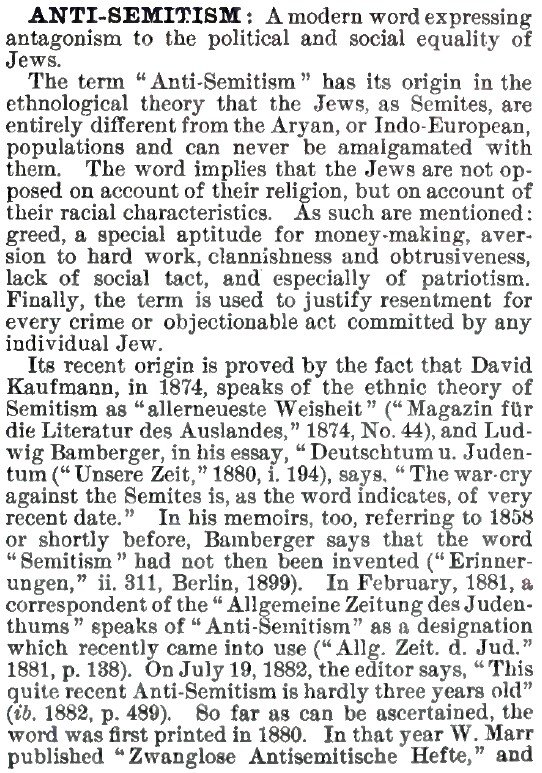

Most interesting is the protest by German and American rabbis to the founding of a Palestinian state:
The
attempts of the Zionists to found a Jewish national state in Palestine
are contrary to the Messianic promises of Judaism as laid down in Holy
Writ and in the later religious authorities; secondly, that
Judaism demands of its adherents to serve the state in which they live
and in every way to further its national interests; thirdly, that no
opposition thereto can be seen in the noble plan to colonize Palestine
with Jewish agriculturists, because that plan has no connection with
the founding of a national state. In the same spirit the Conference of
American Rabbis, which met at Richmond, Va., on Dec. 31, 1898, declared
itself as opposed to the whole Zionist movement on the ground (as one
of the members stated) "that America
was the Jews' Jerusalem and Washington their Zion."
A Berlin professor and leader of liberal Jews, Ludwig Geiger, said: "...the German Jew is a German in his national peculiarities, and Zion is for him the land only of the past, not of the future." Jewish professors at Chicago's Hebrew Union College remarked in 1899 that the Zionists were "traitors, hypocrites, or fantastic fools whose thoughts, sentiments, and actions are in constant contradiction to one another," "Zionism is an abnormal eruption of perverted sentiment," the "Zionistic agitation contradicts everything that is typical of Jews and Judaism," and that the "Zionistic movement is a mark of ingenuity, and does not come out of the heart of Judaism, either ancient or contemporary."
On the American side, the Second Congress held in Vienna in 1898 saw a six-fold increase in American Zionist organizations attending. Sec. John Hay (former ambassador in Constantinople) said in 1904 that Zionism was in his opinion "quite consistent with American patriotism." The Zionist flag was flown at the St. Louis Exposition in 1904 ("blue and white stripes, with a 'Magen Dawid' [Star of David] in the center").
The first Jewish Congress was held in Palestine in 1903. The Seventh Congress was held in Basel in 1905, and declared that it "stands firmly by the fundamental principle of the Basel Program, namely, 'The establishment of a legally secured, publicly recognized home for the Jewish people in Palestine,' and it rejects, either as an end or as a means of colonizing, activity outside Palestine and its adjacent lands." The largest voting faction in the Congress general body were the so-called Ziyyone Zionists who believed that "the diplomatic actions of Herzl have proven a failure... demands immediate work in Palestine, without waiting for the granting of a charter... land there should be bought at once."
Zionistic societies sprung up throughout the world by the early 20th century, e.g. the Shanghai Zionist Association, the Dr. Herzl East Africa Zionist Association in Nairobi, societies in Nagasaki, in Tokyo, and among US servicemen in the Philippines.
Much of Zionism -- perhaps its major theme -- deals with eschatology, that the Jew will inherit the earth when the Messiah comes, that it is their "divine right" to occupy that part of the Middle East now called Israel. This is where the controversy must focus today... the Messiah, Jesus Christ, has already come, and His message to the Jews is the same as when He first preached the gospel in the Holy Land: "The time is fulfilled, and the kingdom of God is at hand: repent ye, and believe the gospel." (Mark 1:15)
| On an aside... Arriving in Japan in 1867, Scottish missionary Norman McLeod had a fantastical idea on how the Jewish people came to Japan, specifically the Emperor Jimmu, who is considered to be the first Emperor of Japan. In McLeod's work (Epitome of the Ancient History of Japan, 1875) is this image, entitled, "Supposed Order of March of Israelites to Japan Partly Taken from Ancient Pictures." 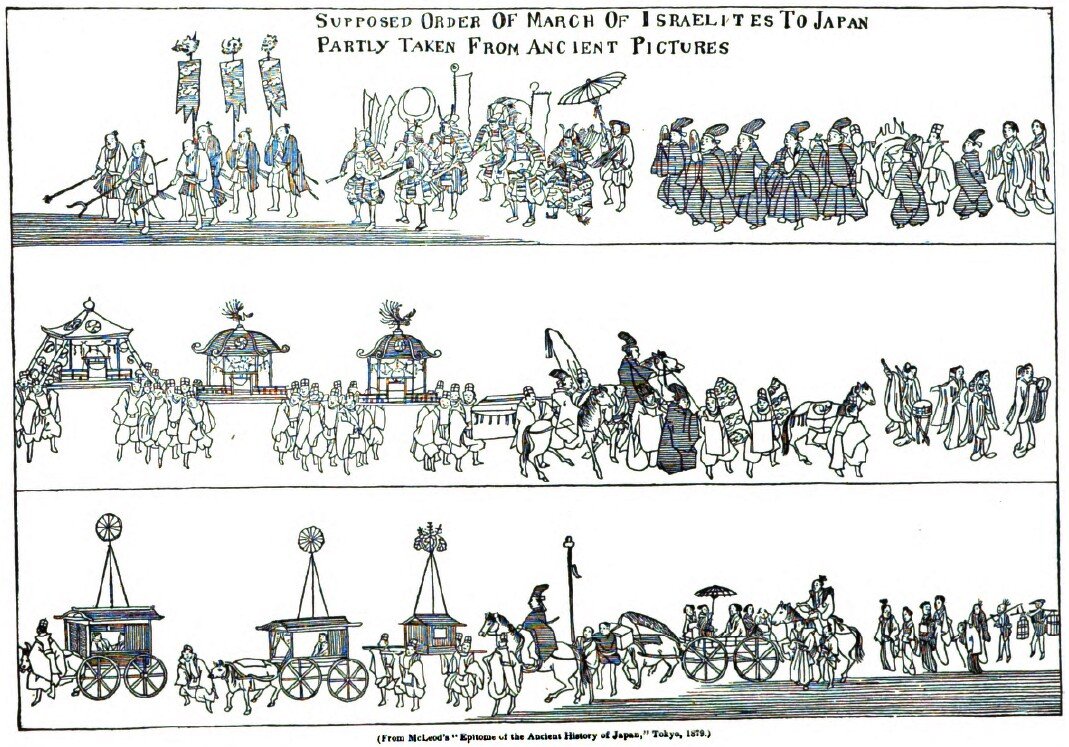 Here is that section from his book dealing with "Jim Mu." For more in-depth study, see "Japanese-Jewish Common Ancestry Theory & Shin Megami Tensei: Pseudohistorical Fantasies into Anti-Semitic Nightmares." Granted, it is not hard to see how some of the religious customs and artifacts of Japan (e.g. altars, priests, offerings, mikoshi, mizuya) can be shown to be similar to those of the Israelites in the Old Testament. The late missionary to Japan, Kenny Joseph, wrote a bilingual book showing a number of these similarities, Japan's Christian Roots 日本のクリスチャンルーツ (2010). It is no wonder, however, that pagan beliefs and customs from early history to the present can find their beginnings in the Holy Bible, copying the true forms of worship to suit their own false systems of priestcraft. |
February 10, 2026
Beware of Thomas Edison's... Aerophone!

THE
AEROPHONE
March 25, 1878
March 25, 1878
Something ought to be done to Mr. EDISON, and there is a growing conviction that it had better be done with a hemp rope. Mr. EDISON has invented too many things, and almost without exception they are things of the most deleterious character. He has been addicted to electricity for many years, and it is not very long ago that he became notorious for having discovered a new force, though he has since kept it carefully concealed, either upon his person or elsewhere. Recently he invented the phonograph, a machine that catches the lightest whisper of conversation and stores it up so that at any future time it can be brought out, to the confusion of the original speaker. This machine will eventually destroy all confidence between man and man, and render more dangerous than ever woman's want of confidence in woman. No man can feel sure that wherever he may be there is not a concealed phonograph remorseless gathering up his remarks and ready to reproduce them at some future date, even in the bosom of his family, to express any but most innocuous and colorless views? and what woman when calling on a female friend, and waiting for the latter to make her appearance in the drawing-room, will dare to express her opinion of the wrotched taste displayed in the furniture, or the hideous appearance of the family photographs?
In the days of persecution and espionage it was said, though with poetical exaggeration, that the walls had ears. Thanks to Mr. EDISON's perverted ingenuity, this has not only become a literal truth, but every shelf, closet, or floor may now have its concealed phonographic ears. No young man will venture to carry on a private conversation with a young lady, lest he should be filling a secret phonograph with evidence that, in a breach of promise suit, would secure an immediate verdict against him, and our very small boys will fear to express themselves with childish freedom, lest the phonograph should report them as having lightly used the name of "gosh," or as having threatened to "bust the snoot" of the long-suffering governess. The phonograph was, at the time of its invention, the most terrible example of depraved ingenuity which the world had seen; but Mr. EDISON has since reached a still more conspicuous peak of scientific infamy by inventing the aerophone—an instrument far more devastating in its effects and fraught with the destruction of human society.
The aerophone is apparently a modification of the phonograph. In fact, it is a phonograph which converts whispers into roars. If, for example, you mention, within hearing of the aerophone, that you regard Mr. HAYES as the greatest and best man that America has yet produced, that atrocious instrument may overwhelm you with shame by repeating your remark in a tone that can be heard no less than four miles. Mr. Edison, with characteristic effrontery, represents this as a useful and beneficent invention. He says that an aerophone can be attached to a locomotive, and that with its aid the engineer can request persons to "look out for the locomotive" who are nearing a railway crossing four miles distant from the train. He also boasts that he will attach an aerophone to the gigantic statue of "Liberty," which France is to present to this country, provided we will raise money enough to pay for it, and that the statue will thus be able to welcome incoming vessels in the Lower Bay, and to warn them not to come up to the City in case Mr. STANLEY MATTHEWS is delivering an oration on the currency, or Mr. COX is making a comic speech at Tammany Hall. Were the aerophone to be confined strictly to these uses, it might prove a comparatively unobjectionable instrument; but no man can loose a whirlwind and guarantee that its ravages shall be confined to Chicago, or to some other place where it may do positive good.
This country has long suffered from excessive talk. Had nine-tenths of our citizens who have been born during the last fifty years been absolutely dumb, the Republic would doubtless have preserved its pristine purity. It is the interminable talk of Congressmen and other leading citizens that is the source of all our public woes. Talk is likewise the bane of private life. With dumb wives there would be no need of divorce courts, and with dumb husbands home might become a blessed reality instead of a poetic dream. And yet, knowing full well that talk is a monster of such hideous meaning that to be hated needs only to be constantly heard, Mr. EDISON has devised an instrument by which the range of conversation is extended from a few feet to four miles.
Our present vocal powers are always used to their full capacity. Everybody talks with about the same volume of voice, and when the aerophone comes into use, people will universally talk as loudly as the instrument will permit. When ninety-nine people out of a hundred converse with the aerophone, there will be such a roar of conversation that the hundredth person, who may speak in his natural voice, cannot be heard. We can only faintly imagine the horrible results of the general introduction of the aerophone. Wives residing in suburban Jersey villages will call to their husbands at their places of business in the City, and require information as to subjects of purely domestic interest. Mothers whose children have wandered out of sight will howl over a four-mile tract of country direful threats as to the dying alive which awaits James Henry and Ann Eliza unless they instantly come home. From morning till midnight our ears will be tortured with the uproar of aerophonic talk, and deaf men will be looked upon as the favored few to whom nature has made life tolerable.
The result will be the complete disorganization of society. Men and women will flee from civilization and seek in the silence of the forest relief from the roar of countless aerophones. Business, marriage, and all social amusements will be thrown aside, except by totally deaf men, and America will retrograde to the Stone Age with frightful rapidity. Better is a dinner of raw turnips in a damp cave than a banquet at DELMONICO's within hearing of ten thousand aerophones. Far better is it to starve in solitude than to possess all the luxuries of civilization at the price of hearing every remark that is made within a radius of four miles. It may be too late to suppress the aerophone now, but at least there is time to visit upon the head of its inventor the just indignation of his fellow-countrymen.
John Gutenberg's Dream
The inventor of the printing press almost destroyed his invention. In a
dream he heard "an angel of light" tell him:"Thou hast discovered the
bottomless pit... Oh, think of millions of souls corrupted by thine
achievement! The poison of fiends distilled into the souls of boys and
girls, making them old in the experience of sin... Destroy thy press,
for it shall be the pander of blasphemy and lust."
But God had different plans for Gutenberg, and the press was not destroyed. In fact, the very first book Gutenberg produced in the mid-1450's was a portion of the Holy Bible. Close to five billion Bibles and portions of the Bible have been printed since then, for God used that small invention to be a means of reaching the whole world with the Gospel.
Yet many other pieces of literature have been produced which have been a bane upon society. May God protect us and give us strength to avoid the multitude of evils which assault mankind through not only the printed page but the digital page as well.
A Great Title Page from the Year
1815
Gospel of Mark -- West Saxon Version
Anyone from West Saxon? Here's an excerpt from the first few verses of the Gospel of Mark, J.W. Bright's work of 1905:John
the Baptist Prepares the Way
1 Her ys godspelles angyn Hælendes Cristes, Godes suna.
2 Swa awriten is on ðæs witegan bec Isaiam,
5 And to him ferde eall Iudeisc rice, and ealle Hierosolima-ware; and wæron fram him gefullode on Iordanes flode, hyra synna anddetende.
6 And Iohannes wæs gescryd mid oluendes hærum, and fellen gyrdel wæs ymbe his lendenu; and gærstapan, and wudu hunig he æt,
7 And he bodode, and cwæþ, Strengra cymþ æfter me, ðæs ne eom ic wyrðe ðæt ic his sceona þwanga bugende uncytte.
8 Ic fullige eow on wætere; he eow fullaþ on Halgum Gaste.
1 Her ys godspelles angyn Hælendes Cristes, Godes suna.
2 Swa awriten is on ðæs witegan bec Isaiam,
"Nu! ic asende minne engel
beforan ðinre
ansyne, se gegearwaþ ðinne weg beforan ðe.
3 Clypigende stefen on ðam westene, 'Gegearwiaþ Drihtnes weg, doþ rihte his siðas.'"
4 Iohannes wæs on westene fulligende, and bodiende dæd-bote fulwiht, on
synna forgyfenesse.ansyne, se gegearwaþ ðinne weg beforan ðe.
3 Clypigende stefen on ðam westene, 'Gegearwiaþ Drihtnes weg, doþ rihte his siðas.'"
5 And to him ferde eall Iudeisc rice, and ealle Hierosolima-ware; and wæron fram him gefullode on Iordanes flode, hyra synna anddetende.
6 And Iohannes wæs gescryd mid oluendes hærum, and fellen gyrdel wæs ymbe his lendenu; and gærstapan, and wudu hunig he æt,
7 And he bodode, and cwæþ, Strengra cymþ æfter me, ðæs ne eom ic wyrðe ðæt ic his sceona þwanga bugende uncytte.
8 Ic fullige eow on wætere; he eow fullaþ on Halgum Gaste.